PromptBehind
OpenAI · 👶 Baby & Kids

Baby & Kids prompts for ChatGPT (GPT Image)

26 prompts, each with the picture it produces.

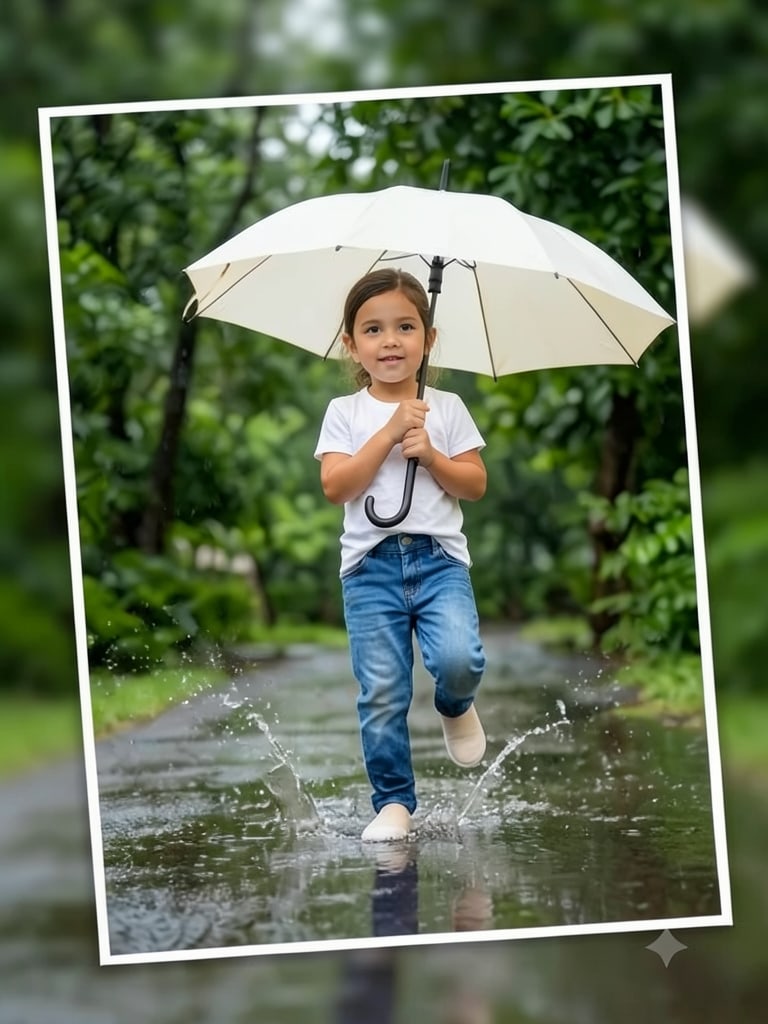
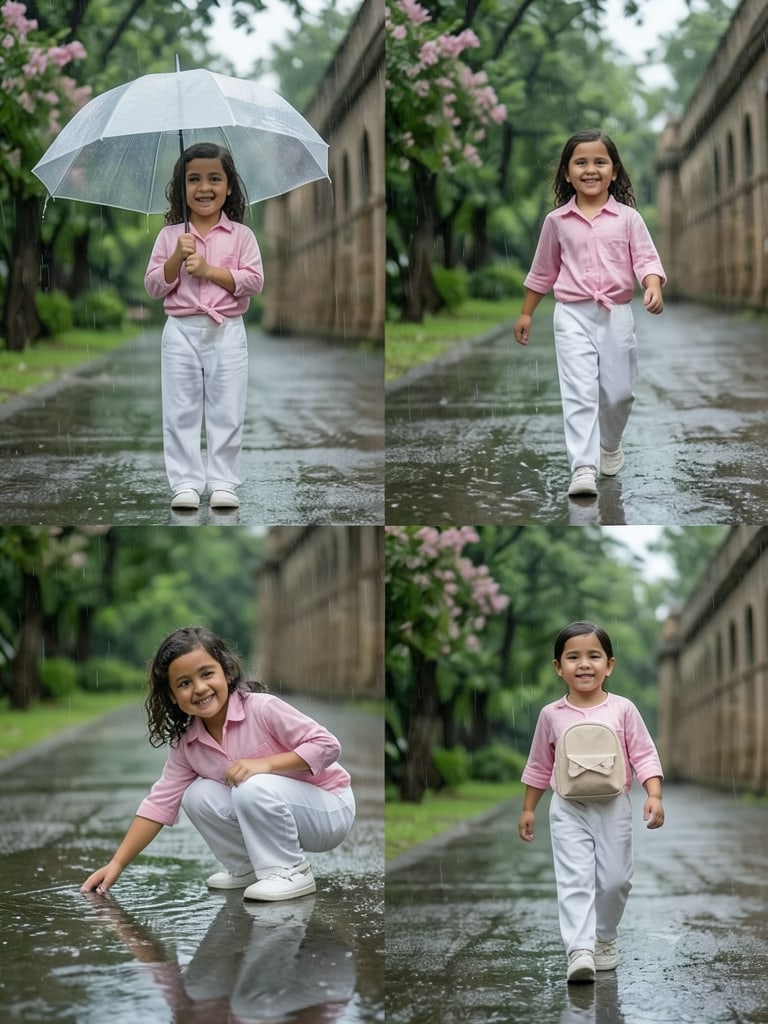
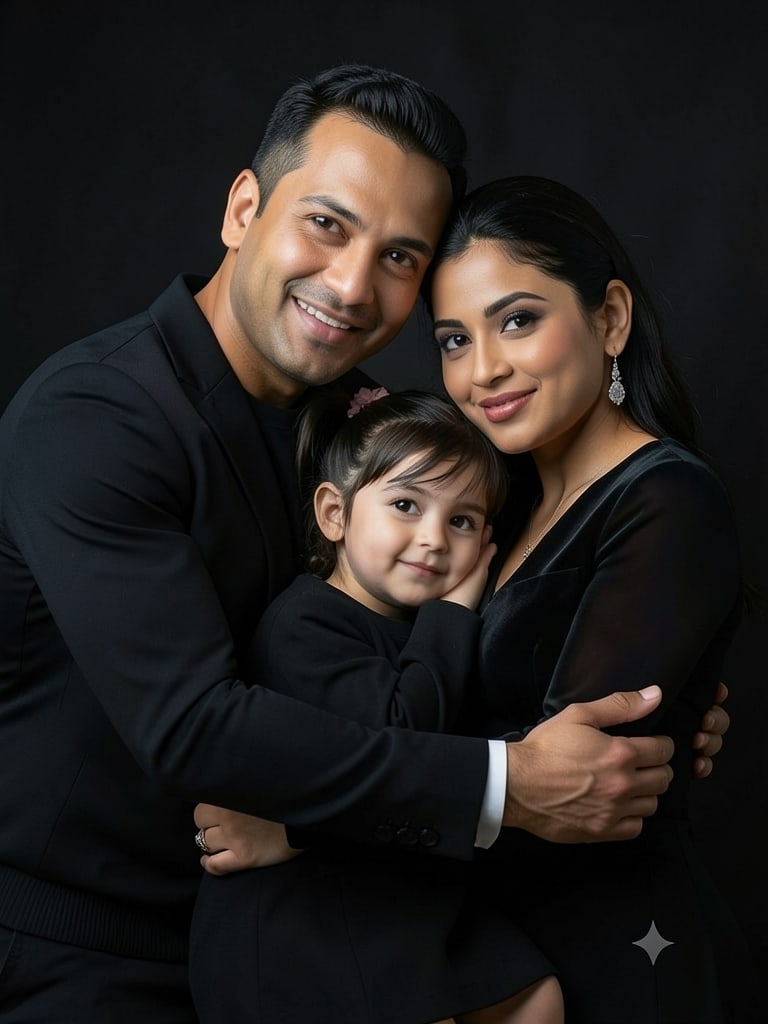
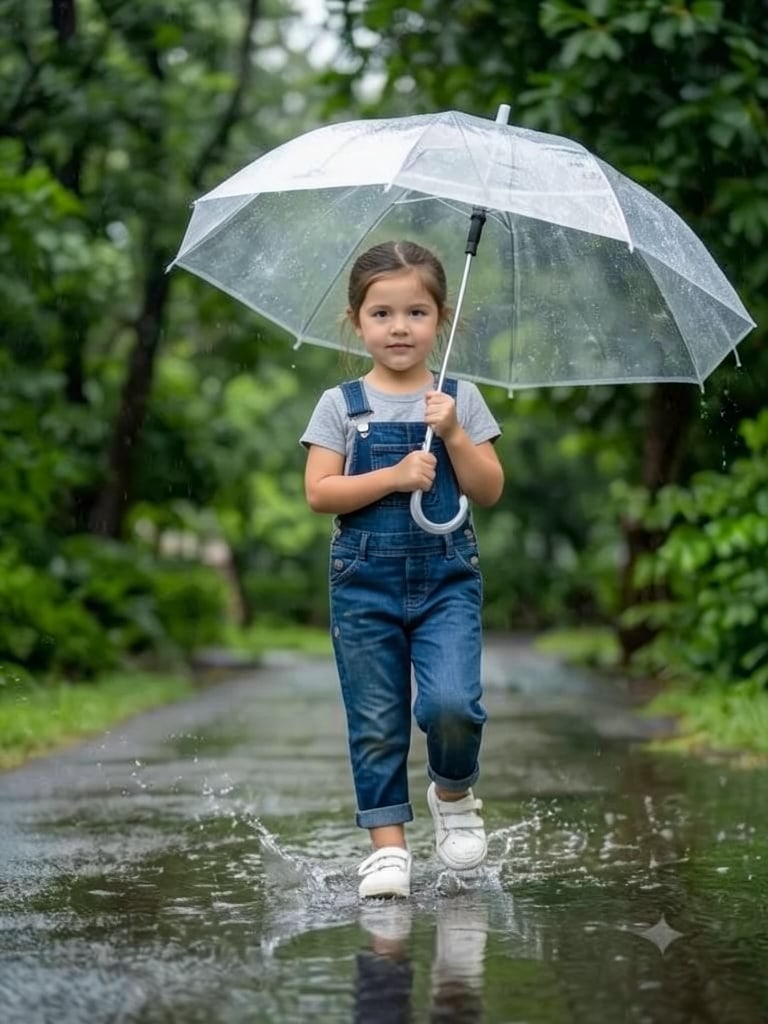
26 baby & kids prompts that people are running through ChatGPT (GPT Image) (OpenAI). Every prompt on this page is shown with the picture it produces, so you can judge the look before you copy the words.

Baby photoshoot themes, toddlers, first birthdays and kids' costume portraits. PromptBehind groups these under photography, and the ranking is by momentum — what is being copied this week, not what was popular a year ago.

The strongest image prompts name the subject, the light, the lens or medium, and the finish. Change the subject, keep the rest, and the look carries over.

Preview of One-month-old baby girl wearing a lavender dress and bow headband
image / Gemini
Baby & KidsGemini · ChatGPT

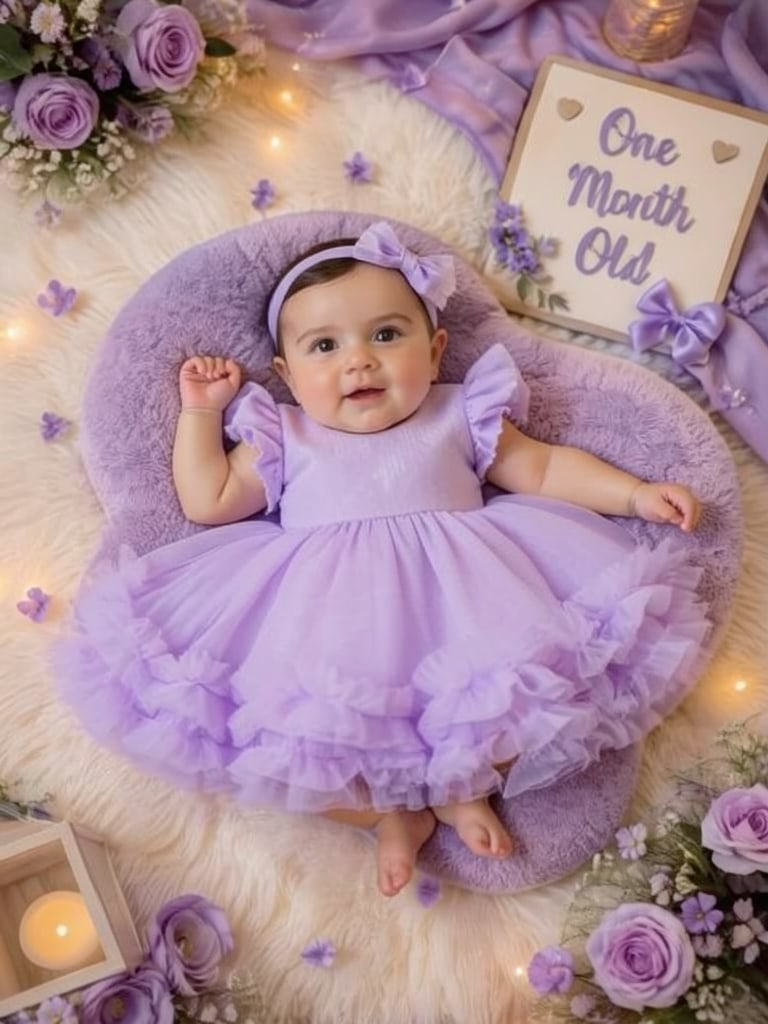
One-month-old baby girl wearing a lavender dress and bow headband

STRICT FACE IDENTITY COPY DNA Create image using the uploaded image only as the facial identity reference for the baby girl. Preserve her face exactly, including head shape, facial proportions, forehead, hairline, eyebrows, eyes, eyelids, nose, cheeks, lips, chin, jawline, ears, skin tone, natural skin texture, apparent age, expression, and every recognizable identity-defining characteristic. Do not beautify, reshape, smooth, stylize, age, de-age, or modify her facial identity in any way. Do not use the uploaded image as a reference for outfit, pose, background, props, lighting, or composition; recreate everything else from the written description below. VISUAL RECONSTRUCTION DNA Create a premium ultra-realistic one-month baby girl photoshoot in an elegant lavender-purple theme, photographed from a directly overhead perspective. The scene should feel soft, luxurious, feminine, warm, dreamy, and professionally styled, with a carefully coordinated lavender colour palette and delicate floral decorations. SUBJECT & COMPOSITION DNA Place the baby girl centrally within the composition, lying comfortably on her back on a large, plush, oval lavender-purple cushion positioned over a soft ivory-white fluffy rug. Her head should rest naturally near the upper-middle portion of the cushion while her body extends downward. Keep her complete body visible, including both feet, with realistic infant anatomy and natural proportions. Her head faces upward toward the camera with a sweet, cheerful expression and bright open eyes. One arm is gently bent upward with a relaxed little fist while the opposite arm extends naturally outward. Her legs rest comfortably beneath the dress, with both bare feet naturally visible near the lower portion of the composition. OUTFIT DNA Dress the baby girl in a beautiful lavender-purple fairy-style party dress. The dress should have a soft shimmering bodice with delicate vertical texture, short puff sleeves made from translucent lavender fabric, and a wide satin-like lavender waistband. Place a prominent soft lavender bow at the center of the waistband. The skirt should be voluminous and layered with multiple tiers of extremely soft translucent lavender tulle, creating a fluffy princess-dress silhouette. Add several layers of delicate ruffles around the lower skirt, with realistic folds, gathered fabric, fine mesh texture, and subtle tonal variations ranging from pale lilac to medium lavender. Add a matching lavender headband around her hair with a large decorative lavender bow positioned slightly toward one side of her head. Keep the accessory delicate and baby-appropriate. BACKGROUND DNA Create a soft ivory-white fluffy textured rug covering the entire background. Place a large rounded lavender plush cushion beneath the baby, creating a clear purple focal area around her body. Arrange flowing lavender-purple fabric around the upper and side edges of the frame. The fabric should have soft folds and satin-like highlights, creating an elegant draped appearance. Scatter small lavender and purple flowers naturally around the rug, especially near the corners and around the cushion, while maintaining enough negative space so the composition does not feel cluttered. ONE-MONTH MILESTONE DNA Position a beautiful rectangular cream-coloured wooden milestone sign in the upper-right area, slightly angled toward the camera. The sign should contain elegant raised lavender lettering reading: “One Month Old” Use graceful handwritten/calligraphy-style typography with clearly readable words. Add two small beige heart decorations on the sign and subtle lavender floral artwork near the lower portion. Attach or place a large lavender satin bow near the lower-right edge of the sign. FLORAL DECORATION DNA Create sophisticated floral arrangements in the upper-left and lower-right corners using lavender roses, small purple flowers, tiny white baby’s-breath flowers, soft green foliage, and delicate stems. Add a smaller floral arrangement partially entering from the lower-left corner. Scatter individual small lavender flowers naturally across the fluffy rug. Include a few delicate warm-white fairy lights intertwined around the fabric and floral arrangements. The lights should appear as tiny soft glowing points rather than visible lighting equipment. CANDLE & PROP DNA Place a small elegant glass lantern containing a single warm glowing candle near the lower-left corner. The candle should produce a subtle natural amber glow on the nearby rug, lavender flowers, and surrounding fabric. Add another small decorative glass candle lantern toward the upper-right background, partially surrounded by lavender fabric. Keep all props proportionally realistic and secondary to the baby. LIGHTING DNA Use soft, warm, dreamy illumination spread evenly across the entire scene. The baby’s face should be naturally bright with smooth highlight transitions and very gentle shadows beneath the chin, arms, dress folds, cushion, flowers, and props. Add subtle warm golden highlights from the candle flames and fairy lights, creating tiny amber reflections against the lavender environment. Maintain soft lavender colour reflections around the dress and cushion while preserving completely natural skin tones. The overall lighting should feel bright, cozy, delicate, and premium, with controlled contrast and no harsh shadows. Do not show softboxes, diffusers, reflectors, stands, studio equipment, or any visible lighting apparatus. CAMERA & OPTICAL DNA Use a professional full-frame camera positioned directly overhead at a precise 90-degree top-down angle. Use approximately a 50mm equivalent lens with sufficient depth of field to keep the baby, dress, milestone sign, flowers, and major foreground decorations sharply detailed. Create a balanced 16:9 horizontal composition, carefully arranging the baby as the central focal point while the milestone sign, floral arrangements, lavender fabric, candle lanterns, and cushion create a sophisticated surrounding frame. COLOUR & MOOD DNA Use a refined palette of lavender, lilac, soft purple, ivory white, cream, muted green, and subtle warm gold. Keep colours elegant and pastel rather than excessively saturated. The mood should communicate love, sweetness, celebration, innocence, elegance, and a special first-month milestone. PHOTOREALISM DNA Create a 4K Ultra HD, ultra-realistic professional baby photograph with authentic infant skin texture, realistic baby anatomy, natural fingers and toes, detailed hair strands, realistic fabric fibers, translucent tulle, satin highlights, plush cushion texture, fluffy rug fibers, individual flower petals, realistic greenery, physically believable candlelight, and natural object shadows. Avoid cartoon styling, plastic skin, excessive smoothing, unrealistic anatomy, extra fingers or toes, distorted facial features, artificial-looking flowers, floating objects, excessive glow, or an obvious AI-generated appearance. FINAL OUTPUT DNA The final image should look like a luxury professional one-month baby girl milestone photoshoot in a lavender princess theme, with the identity-preserved baby girl lying peacefully on a plush lavender cushion over an ivory fluffy rug, wearing a layered lavender fairy dress and matching bow headband. Surround her with lavender roses, purple flowers, white baby’s-breath, flowing lavender fabric, warm fairy lights, glowing candles, and an elegant “One Month Old” milestone sign. The result should be soft, dreamy, premium, emotionally warm, and completely photorealistic.
26 0 0
1h
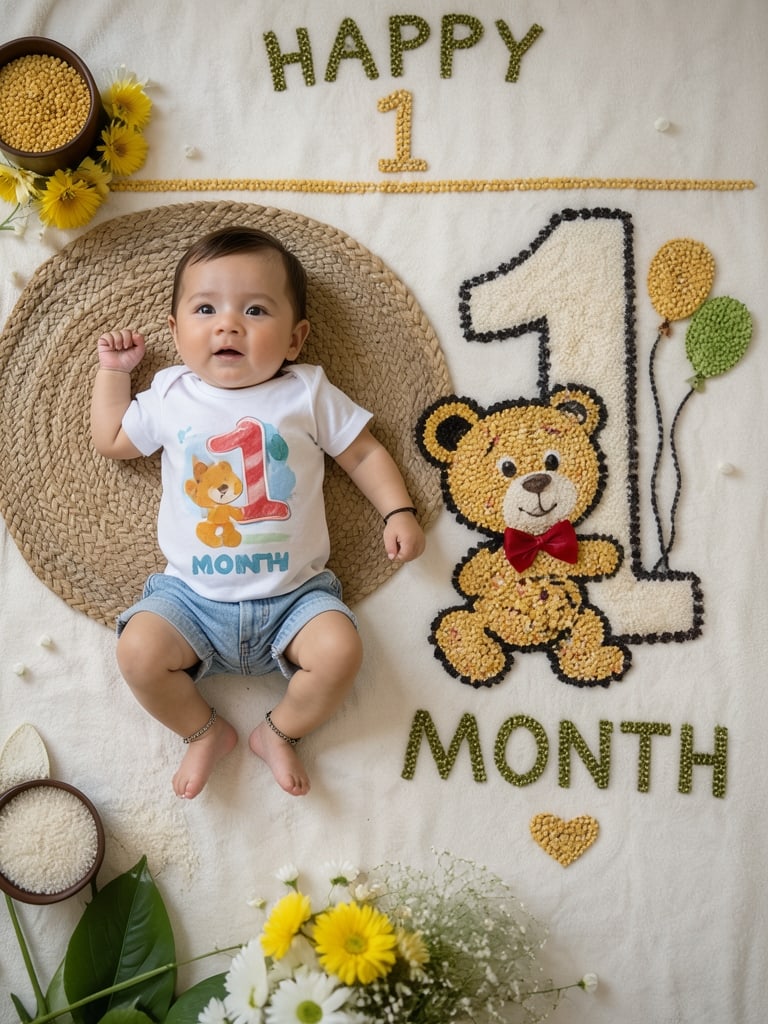
Preview of One-month-old baby lying on a woven mat beside a teddy bear made from colorful grains
image / Gemini
Baby & KidsGemini · ChatGPT

One-month-old baby lying on a woven mat beside a teddy bear made from colorful grains

STRICT FACE IDENTITY COPY DNA Create image using the uploaded image only as the facial identity reference for the baby. Preserve the baby’s face exactly, including head shape, facial proportions, forehead, hairline, eyebrows, eyes, eyelids, nose, cheeks, lips, chin, jawline, ears, skin tone, natural skin texture, apparent age, and every recognizable identity-defining characteristic. Do not beautify, reshape, smooth, stylize, age, de-age, or modify the baby’s facial identity. Do not use the uploaded image as a reference for the baby’s clothing, pose, background, props, text, or composition; recreate those elements entirely from the written description below. VISUAL RECONSTRUCTION DNA Create a premium ultra-realistic first-month baby milestone photoshoot, photographed from a directly overhead top-down perspective. The entire composition is arranged on a warm ivory-beige textured fabric surface, creating a soft, natural, handcrafted newborn photography aesthetic. The scene should feel cozy, elegant, joyful, organic, and professionally styled, with carefully arranged edible grains, flowers, greenery, and handmade decorative elements. SUBJECT & COMPOSITION DNA Place the baby slightly left of center, lying comfortably on their back on a large round natural jute braided mat. The baby occupies approximately the central-left portion of the composition while the decorative milestone artwork fills the right side. Keep the complete baby visible from head to feet with natural infant proportions and relaxed anatomy. The baby should have a calm, happy expression with the eyes open and looking naturally toward the camera positioned directly overhead. One arm rests upward with a gently curled hand while the other arm rests naturally beside the body. The legs are relaxed with a slight natural bend, and both bare feet remain visible. OUTFIT DNA Dress the baby in a clean, soft white short-sleeved baby bodysuit. The bodysuit should feature a cheerful printed teddy-bear illustration holding or positioned beside a large red-and-white number “1”, with colorful small decorative elements around it. Beneath the illustration, include the word “MONTH” in playful rounded blue-green lettering. Add delicate traditional black protective threads around the baby’s wrists and small silver anklets around both ankles. Keep the accessories subtle, realistic, and age-appropriate. MILESTONE ARTWORK DNA On the right side of the baby, create a large handcrafted number “1” made from white rice grains, outlined with small black beans or dark grains for strong definition. Integrate a cute teddy bear illustration beside and partially overlapping the number. Construct the teddy bear entirely from carefully arranged golden-yellow lentils or split pulses, with dark grains defining its outline, facial features, ears, paws, and body sections. Give the teddy bear a small realistic red bow tie around its neck. Above and around the teddy bear, create small decorative shapes using grains and pulses, including two small balloon-like forms in yellow and green. Keep every decorative element visibly handcrafted from individual grains rather than digitally printed. TYPOGRAPHY DNA At the upper portion of the composition, arrange the word “HAPPY” using individual green lentils or small green pulses, forming large uppercase letters. Directly beneath it, create a large number “1” from golden-yellow lentils. Near the lower-right portion, arrange the word “MONTH” using individual green lentils in large uppercase letters. Beneath it, add a small golden-yellow heart constructed entirely from individual grains. The lettering must look physically arranged on the fabric, with tiny irregularities between individual grains and realistic contact shadows. DECORATION DNA Place a small dark wooden bowl filled with golden-yellow lentils near the upper-left corner. Surround it with loose yellow chrysanthemum-like flowers and a few delicate white flowers. Near the lower-left corner, place another small dark bowl containing uncooked white rice. Add several large glossy green leaves extending naturally upward from the bottom-left edge. At the bottom center, create a loose floral arrangement containing bright yellow flowers, white daisy-like flowers, delicate baby’s-breath flowers, thin green stems, and broad green leaves. Keep the flowers partially entering the frame from the bottom edge rather than forming a perfectly symmetrical arrangement. Scatter a small number of individual rice grains, pulses, tiny white flowers, and subtle decorative elements naturally across the fabric while maintaining plenty of clean negative space. BACKGROUND DNA Use a warm cream-white textured fabric backdrop extending across the entire frame. The fabric should have subtle wrinkles, woven texture, soft folds, and natural tonal variation. It must feel like premium cotton or muslin material rather than a perfectly digital background. Maintain a warm neutral palette of ivory, beige, natural brown, muted green, golden yellow, white, and small red accents from the bow tie and clothing illustration. LIGHTING DNA Use soft, bright, evenly distributed natural-looking illumination from above. Keep the baby’s face clearly exposed with gentle highlight transitions and very soft shadows beneath the body, mat, grains, bowls, flowers, and decorative objects. Create subtle warm highlights across the beige fabric and golden grains while preserving accurate natural skin tones. Shadows should remain delicate and diffused, providing enough depth to separate the objects from the fabric without creating dramatic contrast. Do not show any studio equipment, softboxes, diffusers, reflectors, stands, or artificial lighting equipment. CAMERA & OPTICAL DNA Use a professional full-frame camera positioned directly overhead at a perfect 90-degree top-down angle, creating a flat-lay newborn photography composition. Use approximately a 50mm equivalent lens with enough depth of field to keep the baby and surrounding decorations sharply detailed. Maintain balanced spacing between the baby, teddy bear, milestone numbers, typography, flowers, bowls, and decorative objects. The final frame should resemble a professionally styled premium baby milestone photograph. PHOTOREALISM DNA Create a 4K Ultra HD, ultra-realistic professional photograph with authentic infant skin texture, realistic baby anatomy, natural fingers and toes, detailed fabric texture, individual visible rice and pulse grains, realistic flower petals, natural jute fibers, physically believable shadows, and highly detailed handcrafted decorations. Avoid cartoon styling, plastic skin, excessive smoothing, distorted anatomy, extra fingers or toes, duplicated objects, floating grains, malformed letters, artificial-looking flowers, or excessive digital effects. FINAL OUTPUT DNA The final image should look like a professional first-month baby milestone flat-lay photoshoot, combining the baby lying on a round jute mat with a handcrafted grain-and-pulse teddy bear, a large number “1,” “HAPPY” and “MONTH” lettering, bowls of grains, yellow and white flowers, greenery, and delicate natural decorations on a warm ivory fabric background. The composition must feel handmade, warm, joyful, elegant, realistic, and photographically authentic, while the baby’s facial identity remains completely preserved.

26 0 0
1h
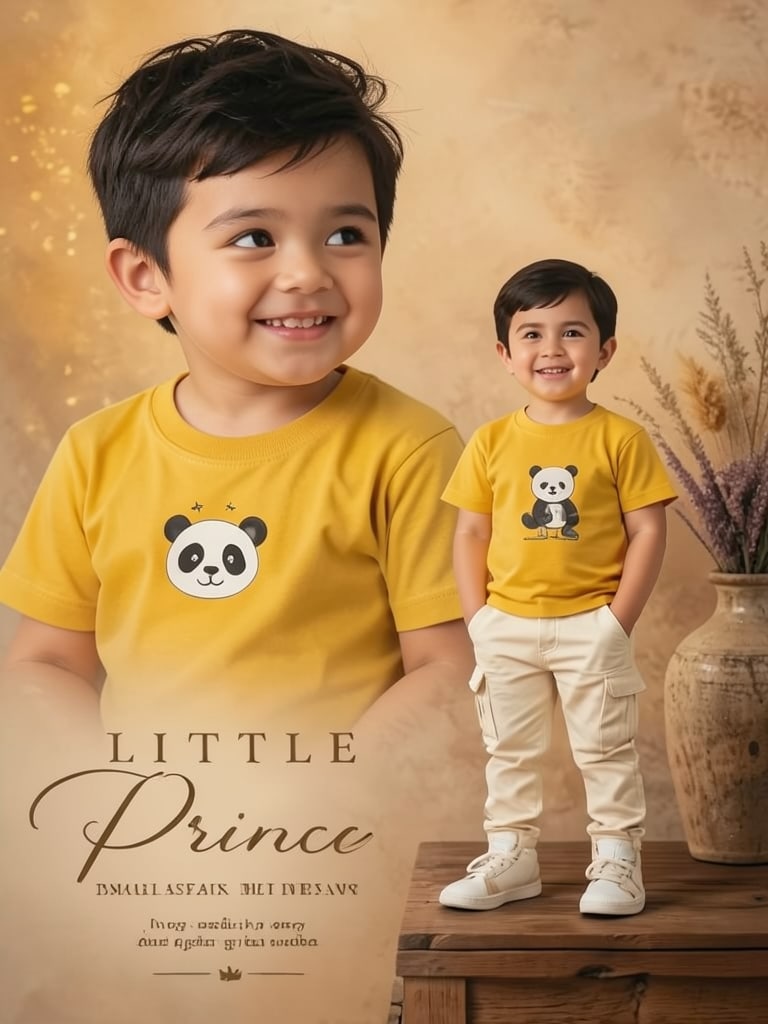
Preview of Cute baby boy in a yellow panda T-shirt and cream cargo pants featured in a Little Prince themed portrait with
image / Gemini
Baby & KidsGemini · ChatGPT

Cute baby boy in a yellow panda T-shirt and cream cargo pants featured in a Little Prince themed portrait with

create image STRICT FACE IDENTITY COPY DNA Use the uploaded image only as the facial identity reference for the child. Preserve the child’s face exactly and completely unchanged, including head shape, facial proportions, forehead, hairline, eyebrows, eyes, eyelids, eye spacing, nose, cheeks, lips, chin, jawline, ears, skin tone, natural skin texture, apparent age, facial symmetry, and recognizable identity-defining characteristics. Do not beautify, reshape, smooth, stylize, age, de-age, or modify the face. Do not use the uploaded image as a reference for clothing, pose, background, props, composition, lighting, or styling. VISUAL RECONSTRUCTION DNA Create a premium, photorealistic “Little Prince” children’s editorial portrait inspired by high-end professional studio photography. Build a sophisticated double-scale composition featuring the same identity-preserved child as a large close-up portrait on the left and a smaller full-body version standing on the right. The result should look like a professionally photographed and art-directed children’s magazine portrait rather than an obvious AI composite. SUBJECT & COMPOSITION DNA Use a vertical 9:16 composition. The large portrait occupies most of the left side, showing the child’s head, shoulders, and upper torso with a bright, natural smile and a subtle gaze toward the right. The smaller full-body child stands on the right side, fully visible from head to shoes, smiling naturally toward the camera with both hands casually placed inside the trouser pockets. Maintain identical facial identity, age, hairstyle characteristics, and natural child proportions in both representations. OUTFIT DNA Dress both versions in the same modern outfit: a mustard-yellow short-sleeve T-shirt with a small cute panda graphic on the chest, paired with light beige cargo trousers featuring realistic utility pockets and natural fabric folds. Add clean white high-top sneakers with realistic laces and textured soles. Keep the styling playful, fashionable, comfortable, and age-appropriate. HAIR & APPEARANCE DNA Give the child naturally thick, slightly tousled dark black-brown hair with realistic individual strands and soft volume. Preserve natural childlike facial proportions and authentic skin texture. Avoid excessive retouching or artificial skin smoothing. BACKGROUND & ENVIRONMENT DNA Create a warm beige studio background with subtle plaster-like texture and a refined earthy atmosphere. Place the smaller child on a rustic wooden platform. On the far right, add a tasteful ceramic vase containing dried beige and muted lavender botanical stems. Include a few subtle dried botanical elements around the platform without distracting from the child. TYPOGRAPHY DNA Leave elegant negative space in the lower-left area beneath the large portrait. Add refined editorial typography reading: LITTLE Prince Below it, add: SMALL STEPS, BIG DREAMS and a smaller supporting line: Every smile is a story that lights up the world. Use sophisticated serif lettering for “LITTLE,” an elegant handwritten/script style for “Prince,” and restrained editorial typography for the supporting text. Typography must remain secondary to the child’s portrait. LIGHTING & MOOD DNA Use soft warm studio lighting from the upper-left/front, producing gentle highlights on the child’s face and hair with realistic shadows beneath the chin and clothing. Add a subtle golden atmospheric glow and delicate dust-like texture behind the large portrait. The mood should feel warm, joyful, nostalgic, luxurious, and timeless. CAMERA & PHOTOGRAPHY DNA Use professional full-frame portrait photography aesthetics with an approximately 85mm portrait lens, shallow depth of field around f/2.0–f/2.8, natural perspective, realistic subject separation, and cinematic background blur. Keep the child’s eyes, facial details, hair, clothing texture, and shoes exceptionally sharp and realistic. COLOUR DNA Use a sophisticated palette of mustard yellow, cream, beige, warm brown, muted lavender, and soft golden highlights. Preserve natural skin tones and realistic color balance. Avoid excessive saturation, artificial HDR, or harsh contrast. QUALITY & REALISM DNA Render in 4K Ultra HD, ultra-realistic professional photography quality with authentic skin pores, individual hair strands, realistic fabric weave, natural folds, anatomically correct hands and fingers, accurate child proportions, physically believable shadows, detailed wood and ceramic textures, natural dried flowers, and seamless depth integration. Avoid cartoon styling, plastic skin, facial distortion, extra fingers, malformed hands, duplicated features, unrealistic anatomy, floating feet, cutout edges, excessive sharpening, oversaturation, or visible AI artifacts. FINAL OUTPUT DNA Create a premium Little Prince children’s editorial portrait featuring the identity-preserved child twice: a dominant smiling close-up on the left and a smaller full-body child on the right, wearing the mustard-yellow panda T-shirt, beige cargo trousers, and white high-top sneakers, surrounded by a warm beige studio environment, rustic wooden platform, dried botanical vase, elegant typography, soft golden atmosphere, cinematic depth of field, and sophisticated professional photography aesthetics. 16:9 is not required; use vertical 9:16.

26 0 0
1h
Preview of Stylish baby boy in white shirt
image / Gemini
Baby & KidsGemini · ChatGPT

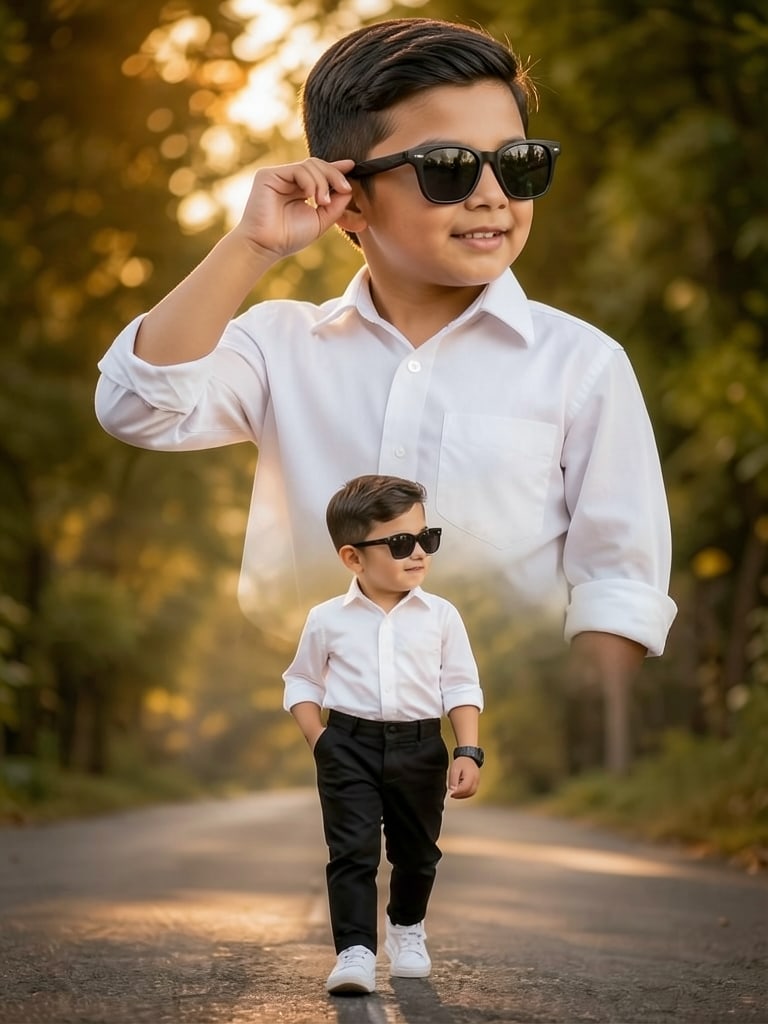
Stylish baby boy in white shirt

STRICT FACE IDENTITY COPY DNA create image using the uploaded image only for exact facial identity preservation of the child. Preserve the child’s face completely unchanged, including head shape, facial proportions, forehead, hairline, eyebrows, eyes, eyelids, eye spacing, nose, cheeks, lips, chin, jawline, ears, skin tone, natural skin texture, apparent age, facial symmetry, and every recognizable identity-defining characteristic. Do not beautify, reshape, smooth, stylize, age, de-age, or alter the child’s facial identity. Do not use the uploaded image as a reference for clothing, pose, background, props, or lighting. VISUAL RECONSTRUCTION DNA Create a photorealistic cinematic child fashion portrait inspired by the visual concept of a larger-than-life child image combined with a smaller full-body version of the same child in the foreground. The composition should look like a professionally photographed creative editorial portrait with realistic scale relationships and seamless photographic integration. SUBJECT & COMPOSITION DNA Use a vertical 9:16 composition. Create one large, softly dominant representation of the child occupying the background and upper two-thirds of the frame, while a smaller full-body representation of the same child walks naturally in the center foreground. The large background child should appear approximately from the chest upward, with the face prominently visible and softly integrated into the outdoor environment. The smaller foreground child should be fully visible from head to shoes, positioned centrally on the road and clearly separated from the background figure. The two representations must have identical facial identity, while maintaining physically believable photographic scale and depth. LARGE BACKGROUND SUBJECT DNA Show the large child wearing a clean white long-sleeve button-up shirt, with the sleeves naturally rolled slightly above the wrists. The child wears dark black trousers. The child wears stylish black rectangular sunglasses. One hand is raised naturally toward the sunglasses, gently touching or adjusting the frame near the temple. The expression should remain calm, confident, and slightly serious. The large figure should be slightly softer than the foreground child, creating convincing depth while retaining recognizable facial identity and realistic clothing detail. FOREGROUND SUBJECT DNA Show the smaller full-body child walking confidently toward the camera along the center of the road. Dress the child in the same coordinated outfit: a crisp white button-up shirt with naturally rolled sleeves, fitted black trousers, clean white low-top sneakers, and black rectangular sunglasses. Keep both hands naturally positioned, with one hand casually near the trouser pocket and the other relaxed beside the body. Add a simple dark wristwatch for subtle modern styling. The walking posture should be natural and age-appropriate, with realistic leg movement, balanced weight, correct foot placement, and believable stride. ENVIRONMENT DNA Place the scene on a quiet outdoor asphalt road surrounded by trees and greenery. Create a warm late-afternoon or early-evening atmosphere with dense foliage along both sides. The road should extend naturally into the distance behind the child, creating strong leading lines toward the center of the composition. No crowds, buildings, signs, logos, text, vehicles, or distracting objects. BACKGROUND & DEPTH DNA Create a strongly blurred natural background using shallow depth of field. Trees, foliage, distant road elements, and highlights should dissolve into smooth cinematic bokeh. Add subtle circular warm bokeh highlights in the distance, especially around the upper-left and side regions of the frame. The large background child should blend naturally into this environment rather than appearing as a pasted or duplicated cutout. LIGHTING DNA Use warm golden-hour outdoor illumination. Soft sunlight should create warm highlights along the child’s hair, shoulders, face, and clothing while maintaining gentle shadows under the chin, arms, and clothing folds. Create subtle amber highlights and a warm atmospheric glow throughout the background. The foreground child should receive balanced natural light with enough facial and clothing detail. Do not show softboxes, reflectors, lamps, diffusers, light stands, or artificial lighting equipment. Lighting describes only the resulting illumination, highlights, shadows, contrast, and color atmosphere. CAMERA & OPTICAL DNA Use a professional full-frame camera with an approximately 70–85mm portrait lens, wide enough to include the full-body foreground child while preserving compressed cinematic perspective. Use a shallow depth of field around f/2.0–f/2.8. Keep the foreground child sharply detailed, while the large background figure and distant environment have progressively softer focus. Ensure the large and small child representations share consistent lighting direction, color temperature, perspective, and photographic texture so they appear to belong to the same captured scene. COLOUR & MOOD DNA Use a warm cinematic palette of white, black, golden amber, muted green, warm brown, and soft neutral tones. The mood should be confident, stylish, playful, cinematic, youthful, and aspirational, resembling a premium children’s fashion editorial. PHOTOREALISM DNA Render in 4K Ultra HD, ultra-realistic professional photography quality with authentic child skin texture, realistic hair strands, detailed shirt fabric, natural trouser texture, realistic sunglasses reflections, accurate shoes, believable road texture, natural foliage, physically correct shadows, and seamless depth integration. Avoid plastic skin, excessive beauty retouching, facial identity changes, duplicated facial features, distorted anatomy, extra fingers, malformed hands, unrealistic child proportions, floating feet, artificial cutout edges, excessive HDR, oversaturation, fake bokeh, cartoon styling, or an obvious AI-generated appearance. FINAL OUTPUT DNA Create a premium cinematic double-scale child portrait featuring the identity-preserved child as a large background figure wearing a crisp white shirt, black trousers, and black sunglasses while adjusting the sunglasses with one hand, with a smaller full-body version of the same identity walking confidently toward the camera in the foreground wearing the same coordinated outfit. Set the scene on a tree-lined road during warm golden hour with cinematic bokeh, realistic depth, soft amber highlights, natural shadows, and seamless professional photographic integration.

26 0 0
1h
Preview of Cute baby boy wearing a teal hoodie
image / Gemini
Baby & KidsGemini · ChatGPT

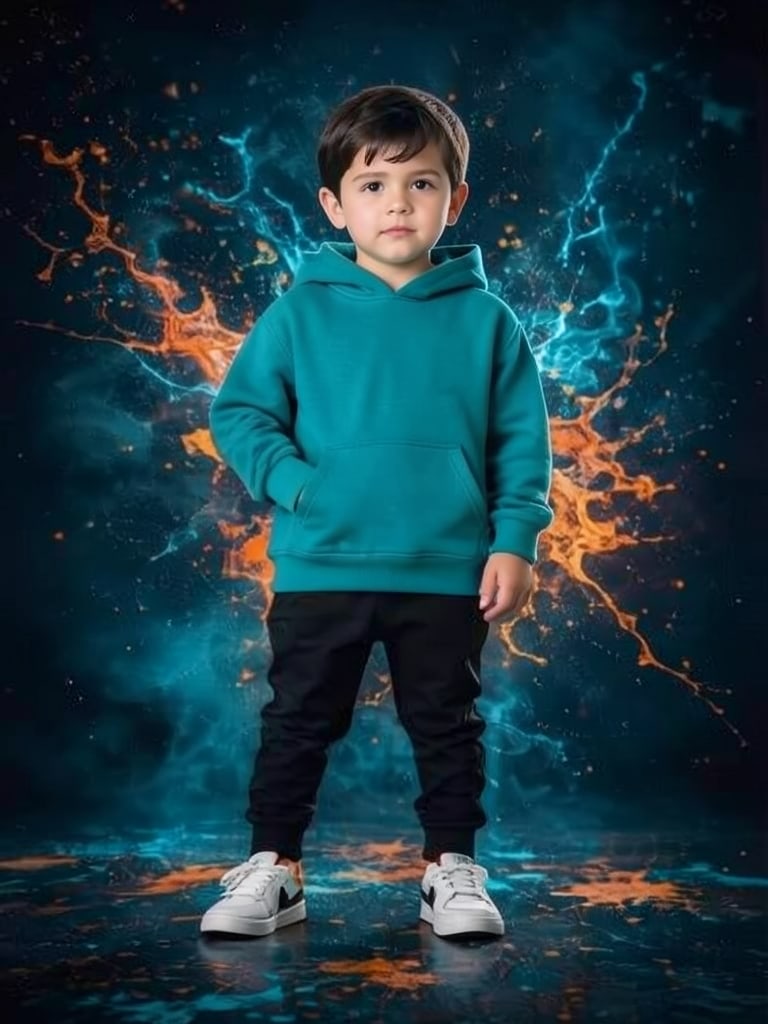
Cute baby boy wearing a teal hoodie

create image STRICT FACE IDENTITY COPY DNA Use the uploaded image only as the facial identity reference for the child. Preserve the child’s face exactly and completely unchanged, including head shape, facial proportions, forehead, hairline, eyebrows, eyes, eyelids, eye spacing, nose, cheeks, lips, chin, jawline, ears, skin tone, natural skin texture, apparent age, facial symmetry, and every recognizable identity-defining characteristic. Do not beautify, reshape, smooth, stylize, age, de-age, or alter the child’s facial identity in any way. Do not use the uploaded image as a reference for clothing, pose, background, props, lighting, colors, or composition. VISUAL RECONSTRUCTION DNA Create a premium cinematic full-body children’s fashion portrait featuring the identity-preserved young boy standing confidently in a dramatic contemporary studio environment. The overall aesthetic should be powerful, modern, energetic, futuristic, and editorial, with a striking contrast between deep teal tones and vivid orange energy effects. SUBJECT & COMPOSITION DNA Use a vertical 9:16 composition. Position the child centrally, occupying approximately 70–80% of the image height. Show the child completely from head to shoes with natural child proportions. The child stands upright in a relaxed but confident stance, facing directly toward the camera. Keep the shoulders naturally squared. His right hand rests casually inside the hoodie pocket, while his left arm hangs naturally beside the body, with relaxed fingers. Maintain realistic body proportions, natural posture, and believable weight distribution. Keep both shoes completely visible with enough space beneath the feet. OUTFIT BLUEPRINT DNA Dress the child in a solid deep teal oversized pullover hoodie with a comfortable hood resting naturally behind the neck, long sleeves, ribbed cuffs, and a realistic front kangaroo pocket. The hoodie should have a premium soft cotton/fleece texture with subtle natural folds and stitching. Pair it with slim-fit black jogger-style trousers, clean and minimal, with realistic fabric texture and natural folds around the knees and ankles. Add modern white low-top athletic sneakers featuring subtle black and vivid orange accent details, realistic laces, textured rubber soles, and premium sneaker construction. The outfit must look contemporary, stylish, youthful, and age-appropriate. HAIR & NATURAL APPEARANCE DNA Give the child naturally thick dark brown-to-black hair, softly textured with a slightly tousled modern hairstyle and realistic individual strands. Preserve natural skin texture, subtle facial details, and authentic childlike appearance. The expression should be calm, confident, and slightly serious, with a relaxed closed-mouth expression while looking directly into the camera. BACKGROUND DNA Create a deep dark teal studio background with a subtle atmospheric gradient, darker toward the edges and slightly brighter behind the child to create separation. Behind the child, create dramatic abstract energy-splash effects in vivid orange and electric teal. The effects should resemble fluid paint, illuminated smoke, sparks, and branching energetic lightning-like streaks radiating outward from behind the subject. The energy effects must remain behind the child and should never cover or distort the face or body. FLOOR & ENVIRONMENT DNA Create a dark teal studio floor that seamlessly blends into the background. Scatter subtle irregular orange and teal pigment-like splashes around the child’s feet, creating visual continuity with the energetic background. Add a soft realistic contact shadow directly beneath the shoes. Ensure the child is firmly grounded on the floor. LIGHTING DNA Use dramatic cinematic studio lighting. Illuminate the child’s face and front of the hoodie with a controlled soft key light, while adding subtle teal rim lighting around one side of the body and warm orange edge illumination from the opposite side. Create realistic highlights on the hair, hoodie folds, trousers, and sneakers. Maintain natural skin tones despite the colored environmental lighting. The orange and teal energy effects should emit a subtle believable glow onto nearby areas of the clothing and floor. CAMERA DNA Use a professional full-frame camera with an approximately 50mm portrait lens, positioned at approximately the child’s chest-to-eye level with a very slight low-angle perspective to enhance confidence without exaggerating body proportions. Use sharp focus on the child’s face and body, realistic depth of field, cinematic separation, highly detailed textures, and controlled studio perspective. COLOUR GRADING DNA Use a sophisticated deep teal, black, orange, and white color palette. The teal hoodie should harmonize with the dark background, while the orange energy effects and sneaker accents provide strong visual contrast. Maintain realistic skin tones and avoid excessive saturation, artificial HDR, or cartoon-like colors. PHOTOREALISM DNA Render in 4K Ultra HD, ultra-realistic professional photography quality. Include authentic skin pores and texture, individual hair strands, realistic cotton and fleece fabric, accurate stitching, natural clothing folds, anatomically correct hands and fingers, realistic child proportions, detailed sneaker materials, physically accurate shadows, believable energy particles, and seamless environmental integration. Avoid cartoon styling, plastic skin, facial modification, exaggerated muscles, adult-like proportions, distorted anatomy, extra fingers, malformed hands, duplicated limbs, floating feet, unrealistic shadows, excessive glow, oversharpening, or obvious AI artifacts. FINAL OUTPUT DNA Create a striking cinematic young-boy fashion portrait with the exact facial identity preserved from the uploaded image, standing confidently in a deep teal hoodie, black jogger trousers, and white sneakers with black and orange accents. Surround him with dramatic orange and electric-teal energy splashes, illuminated smoke, branching light streaks, and pigment effects against a dark teal studio environment. The final image should feel premium, powerful, youthful, cinematic, modern, and photorealistic, with the child remaining the unmistakable visual focus.

26 0 0
1h
Preview of Sleeping Krishna Baby Photoshoot With Flute And Peacock Feathers
image / Gemini
Baby & KidsGemini · ChatGPT

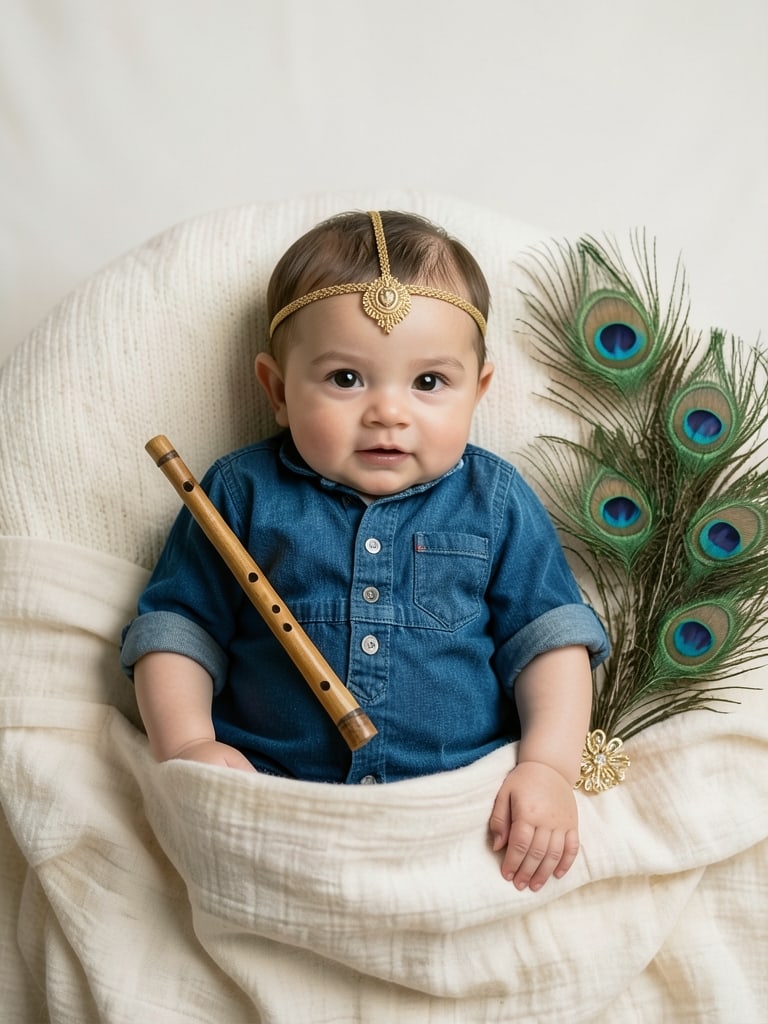
Sleeping Krishna Baby Photoshoot With Flute And Peacock Feathers

Create Image STRICT FACE IDENTITY COPY DNA Use the uploaded image strictly and exclusively as the facial identity reference for the baby. Preserve the baby’s exact facial identity, including head shape, facial proportions, closed-eye shape, eyebrows, nose, lips, cheeks, chin, skin tone, natural skin texture, hairline, and apparent age. Do not beautify, reshape, stylize, age, or modify the facial features. The uploaded image must not be used as a reference for the original composition, clothing, props, background, or lighting. VISUAL RECONSTRUCTION DNA Create a premium, photorealistic newborn Krishna-inspired studio portrait with the baby peacefully sleeping as the central subject. Reconstruct the concept as an elegant fine-art newborn photography setup using a soft ivory-and-cream palette, delicate traditional Krishna elements, luxurious textures, and a minimal heavenly atmosphere. SUBJECT & COMPOSITION DNA Place the sleeping newborn centrally in a carefully arranged vertical 9:16 composition. Position the baby lying peacefully on a plush cream-colored surface, with the head slightly elevated and the body naturally swaddled. Keep the baby’s face unobstructed and prominently visible in the upper-middle portion of the frame. Arrange the Krishna-inspired props elegantly beside the baby rather than covering the body or face. POSE & BODY LANGUAGE DNA The baby should be peacefully asleep with both eyes naturally closed, a relaxed mouth, softly rounded cheeks, and completely natural newborn proportions. Keep the tiny hands and feet comfortably wrapped within the swaddle, creating a serene sleeping pose. The body should appear naturally supported and safely positioned, with no unnatural bending or exaggerated newborn posing. OUTFIT & STYLING DNA Wrap the newborn in an exceptionally soft ivory-white muslin and knitted swaddle, layered gently around the body with realistic folds and subtle fabric texture. Add a delicate handcrafted golden Krishna-inspired forehead ornament/headband, extremely lightweight in appearance and appropriately scaled for a newborn. Include a tiny decorative peacock-feather-inspired accent near the head without touching or obstructing the baby’s face. PROP & SYMBOLISM DNA Place a finely detailed miniature golden-brown wooden Krishna flute diagonally beside the baby, resting naturally across the lower-right side of the swaddled body without covering the face. Arrange a graceful cluster of approximately five fresh peacock feathers beside the baby on the right, with clearly visible iridescent blue-green eye patterns and natural feather textures. Add a small ornate jeweled floral brooch or decorative peacock-feather holder at the base of the feather arrangement. All props must remain proportionate to the newborn and appear physically placed on the surface. ENVIRONMENT & BACKGROUND DNA Create a seamless high-key ivory studio environment with soft cream fabric underneath and behind the baby. Use subtle layered fabric folds to create depth while maintaining an uncluttered fine-art newborn photography aesthetic. Avoid distracting decorations, excessive colors, or busy elements. The entire scene should feel pure, soft, elegant, peaceful, and luxurious. LIGHTING & MOOD DNA Use extremely soft diffused studio lighting from a large overhead-front light source, producing gentle illumination across the baby’s face and swaddle with almost no harsh shadows. Add subtle warm highlights to the golden flute and jewelry while preserving the predominantly ivory-white atmosphere. Create a peaceful, divine-inspired, innocent, timeless mood with delicate tonal transitions and natural newborn skin rendering. CAMERA & PHOTOGRAPHY DNA Capture the portrait with a professional full-frame camera using an approximately 50mm lens from a carefully controlled slightly elevated overhead angle. Use precise focus on the baby’s face, natural optical depth, subtle background falloff, realistic fabric detail, finely resolved individual feather strands, and accurate newborn skin texture. Maintain elegant negative space around the subject while keeping the baby and Krishna-inspired props visually balanced within the vertical frame. QUALITY & REALISM DNA Ultra-realistic 4K Ultra HD newborn photography, lifelike newborn skin texture, realistic fine baby hair, natural eyelashes, authentic fabric fibers, physically accurate feather details, realistic metallic and gemstone reflections, detailed wooden flute texture, soft premium studio lighting, cinematic tonal range, fine-art photography quality, photorealistic rendering, natural proportions, refined luxury styling. NEGATIVE DNA No facial identity changes, no face beautification, no open eyes, no adult-like features, no older baby appearance, no distorted newborn anatomy, no oversized props, no giant feathers, no malformed hands or feet, no extra fingers, no duplicate objects, no floating props, no plastic skin, no cartoon rendering, no harsh shadows, no clutter, no excessive colors, no text, no watermark, no logo. FINAL OUTPUT DNA Create a serene, premium fine-art newborn portrait inspired by Lord Krishna, with the baby’s facial identity preserved strictly from the uploaded image and everything else reconstructed from the written blueprint. The final image should combine peaceful newborn photography with elegant Krishna symbolism through the golden flute, peacock feathers, and delicate traditional head ornament. Strict vertical 9:16 composition, 4K Ultra HD, photorealistic quality.

26 0 0
1h
Preview of One Month Baby Photoshoot with Floral Accents
image / Gemini
Baby & KidsGemini · ChatGPT

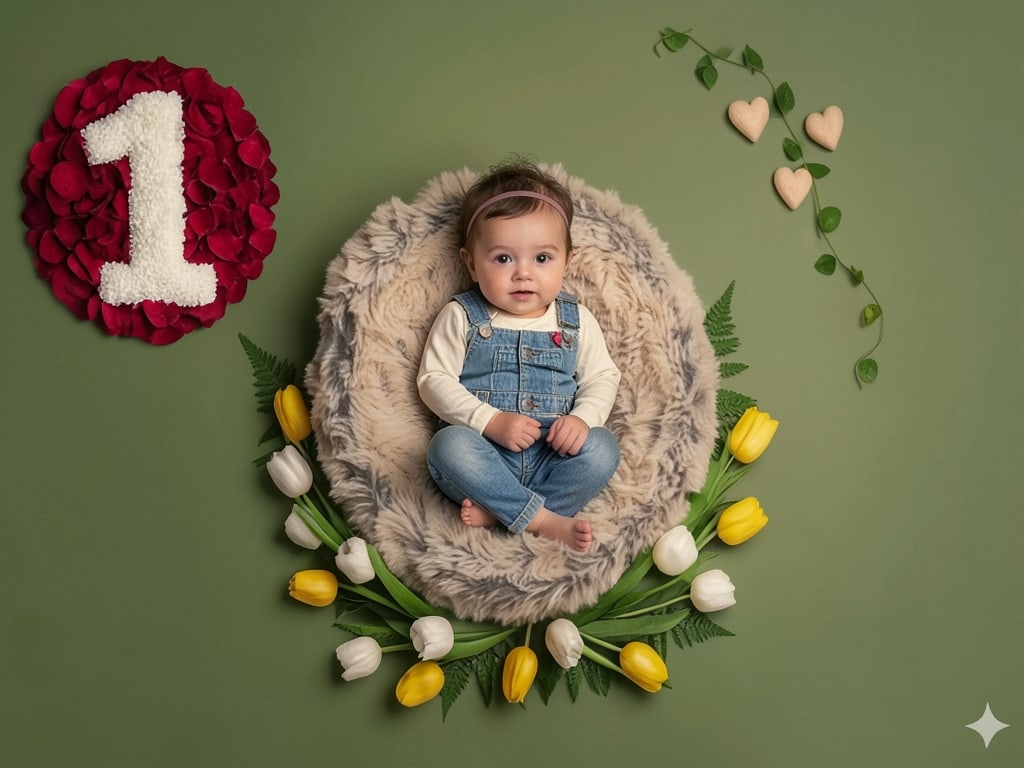
One Month Baby Photoshoot with Floral Accents

create image of an adorable one-month-old baby wrapped in a warm chocolate-brown newborn swaddle, peacefully posed inside a luxurious circular fur nest, using the uploaded image as the target visual blueprint while preserving the uploaded baby’s facial identity exactly. 16:9 aspect ratio. STRICT FACE IDENTITY LOCK Preserve the exact facial identity from the uploaded image with maximum precision. Maintain the same face shape, forehead proportions, eyebrows, eyes, nose structure, lips, cheeks, chin, skin tone, hairline, and overall facial proportions. Preserve the exact newborn appearance, expression, and facial characteristics. Do not alter age, facial structure, or identity-defining characteristics. The final baby must be instantly recognizable as the baby from the uploaded image. CAMERA ANGLE Professional top-down flat-lay newborn photography captured from a perfect 90-degree overhead angle. The entire setup should be visible with balanced spacing and clean composition. BABY POSITION & POSE The baby is positioned slightly right of center inside a perfectly round luxury fur nest. The newborn is wrapped securely in a rich chocolate-brown stretch swaddle with tiny hands posed beneath the chin in a classic newborn portrait pose. The baby looks gently upward toward the camera with a calm, peaceful expression. OUTFIT & ACCESSORIES Deep chocolate-brown newborn swaddle with matching soft newborn cap. The wrap should be smooth, snug, and professionally styled. No distracting accessories. MAIN SEATING ARRANGEMENT The baby rests inside a large circular nest made of premium beige faux fur with luxurious texture and soft cushioning. The nest should appear cozy, warm, and professionally crafted for newborn photography. FLORAL DECORATION Create a beautiful semi-circular arrangement beneath the nest using fresh yellow and white tulips with natural green stems and delicate fern leaves. The floral arrangement should fan outward elegantly from the lower half of the nest. NUMBER DESIGN At the upper-left corner create a large decorative circular badge made entirely from densely packed deep red rose petals. Inside the rose-petal circle, engrave a large number “1” using tightly packed white jasmine petals. The number must be crisp, clean, clearly visible, and handcrafted from real flower petals. ADDITIONAL DECORATIVE ELEMENTS At the upper-right corner create a delicate vine made from small green leaves forming a graceful curved shape. Hanging from the vine are three small wooden heart ornaments arranged vertically. The hearts should appear handcrafted and elegant. BACKGROUND Smooth sage-green studio backdrop with subtle premium texture. Clean minimalist appearance with no clutter, allowing the baby and floral elements to remain the primary focus. LIGHTING Soft premium newborn studio lighting with gentle shadows and warm tones. Even illumination across the baby’s face, floral arrangement, and number design. Natural professional photography lighting with realistic depth. MOOD Warm, peaceful, elegant, minimal, luxurious, cozy, timeless newborn portrait with premium studio aesthetics. PHOTOGRAPHY QUALITY Ultra-realistic newborn photography, professional studio quality, photorealistic skin texture, realistic fur details, natural flower textures, HDR quality, premium lens rendering, award-winning newborn portrait style, 8K masterpiece. WATERMARK At the top-right corner, place a very small handcrafted watermark created entirely from black grains forming the text “TEXTTOIMAGEAI.IN”. The watermark should occupy approximately 2–3% of the frame and blend naturally into the composition. FINAL REQUIREMENTS Strict face identity preservation from uploaded image, realistic newborn anatomy, perfectly crafted floral number “1”, balanced composition, premium newborn photography aesthetics, realistic flower textures, soft luxury styling, photorealistic rendering, no distortions, no extra limbs, no artificial-looking elements.

26 0 0
1h
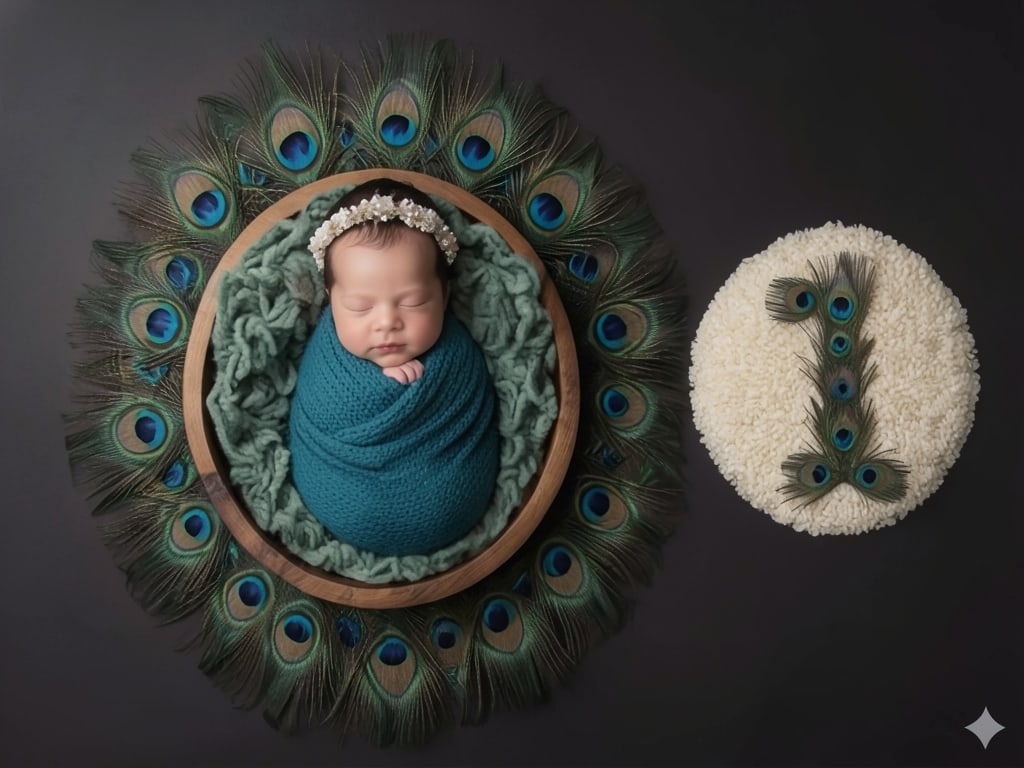
Preview of Baby 1 Month Photoshoot with Peacock Feather Theme
image / Gemini
Baby & KidsGemini · ChatGPT

Baby 1 Month Photoshoot with Peacock Feather Theme

create image of an adorable one-month-old baby peacefully sleeping inside a beautifully crafted circular wooden bowl, using the uploaded image as the target visual blueprint for overall scene arrangement while preserving the uploaded baby’s facial identity exactly. 16:9 aspect ratio. STRICT FACE IDENTITY LOCK Preserve the exact facial identity from the uploaded image with maximum precision. Maintain the same face shape, forehead proportions, eyebrows, eyelids, nose structure, lips, cheeks, chin, skin tone, hairline, and overall facial proportions. Preserve the exact newborn appearance and sleeping expression. Do not alter age, facial structure, or identity-defining characteristics. The final baby must be instantly recognizable as the baby from the uploaded image. CAMERA ANGLE Professional top-down flat-lay newborn photography captured from directly above at a perfect 90-degree overhead angle. The entire setup must be visible within the frame with balanced spacing around all decorative elements. BABY POSITION & POSE The baby is peacefully sleeping inside a round handcrafted wooden bowl positioned slightly left of center. The newborn is wrapped securely in a deep teal knitted swaddle with only the face visible. Tiny hands are gently tucked beneath the chin in a classic newborn sleeping pose. The baby’s body remains comfortably curled with natural newborn posture. OUTFIT & ACCESSORIES The baby is wrapped in a luxurious deep teal textured knit swaddle. A delicate floral crown made from tiny blush-pink flowers rests gently across the forehead. No additional accessories should distract from the elegant newborn styling. DECORATIVE SETUP The wooden bowl is lined with thick sage-green chunky knitted layers creating a soft nest-like appearance. Surrounding the bowl is a perfectly arranged circular fan made entirely of vibrant peacock feathers radiating outward symmetrically, creating a majestic peacock-inspired halo effect. Each feather should display rich emerald, teal, sapphire, and gold eye patterns with realistic texture and detail. On the right side of the composition, create a perfectly circular base made from densely packed white rice grains. Inside this rice circle, engrave a large decorative number “1” entirely using real peacock feathers arranged neatly to form the number. The feather number should be clearly visible and artistically crafted. BACKGROUND A smooth rich dark brown backdrop with subtle studio texture. The background should remain clean, elegant, and distraction-free, allowing the peacock feather arrangement and baby to remain the primary focus. LIGHTING Soft professional newborn studio lighting with gentle shadows and smooth tonal transitions. Warm diffused illumination evenly lights the baby’s face while preserving realistic depth and feather texture. No harsh highlights or dramatic contrast. MOOD Elegant, royal, peaceful, artistic, luxurious, culturally inspired, timeless newborn portrait with premium studio aesthetics. PHOTOGRAPHY QUALITY Ultra-realistic newborn photography, professional studio quality, photorealistic skin texture, realistic feather detailing, natural fabric folds, HDR quality, shallow micro-contrast, premium 8K masterpiece, award-winning newborn portrait style. WATERMARK At the top-right corner, place a very small handcrafted watermark created entirely from black grains forming the text “TEXTTOIMAGEAI.IN”. The watermark should occupy approximately 2–3% of the frame and blend naturally into the composition. FINAL REQUIREMENTS Strict face identity preservation from the uploaded image, realistic newborn anatomy, perfectly symmetrical peacock feather arrangement, clear feather-crafted number “1” on the rice base, balanced composition, premium newborn photography aesthetics, highly detailed textures, photorealistic rendering, no distortions, no extra limbs, no artificial-looking elements.

26 0 0
1h
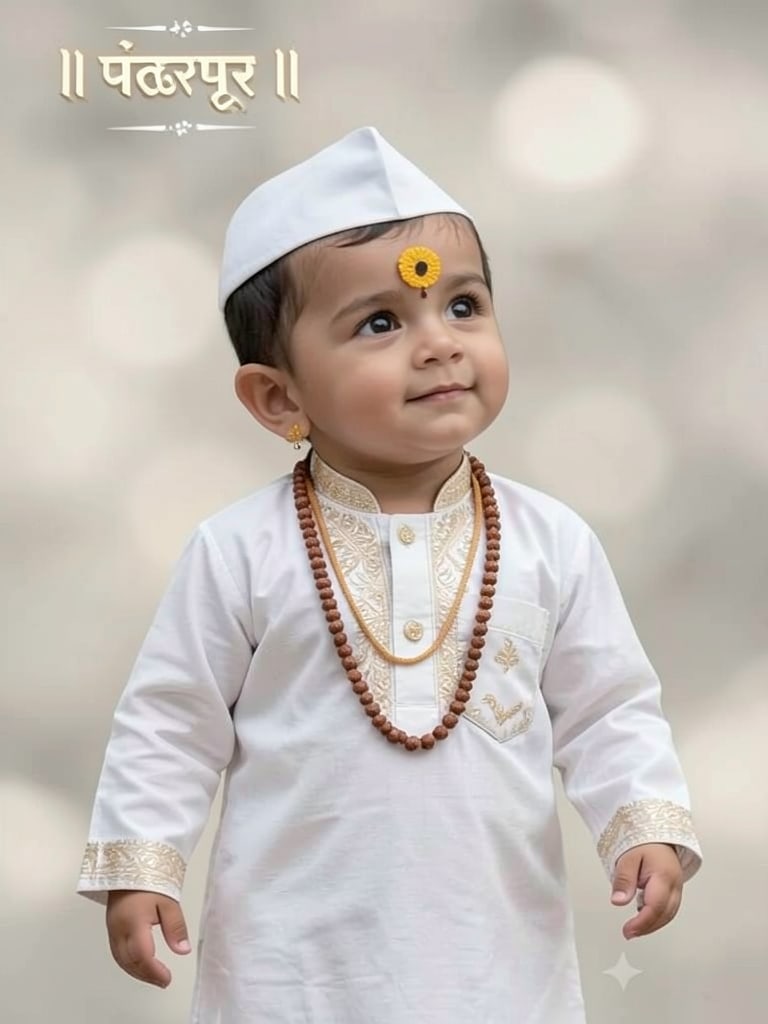
Preview of Minimalist Ashadhi Ekadashi Boy Photoshoot in Traditional Warkari Dress
image / Gemini
Baby & KidsGemini · ChatGPT

Minimalist Ashadhi Ekadashi Boy Photoshoot in Traditional Warkari Dress

create image STRICT FACE IDENTITY PRESERVATION DNA Use the uploaded image exclusively as the facial identity reference for the child. Preserve the exact facial identity, including the head shape, forehead proportions, hairline, eyebrows, eyelids, eye spacing, eye shape, nose structure, cheeks, lips, jawline, chin, ears, skin tone, skin texture, facial symmetry, and apparent age. Preserve the child’s innocent smile, naturally curious expression, and gentle facial softness exactly as shown. Do not beautify, stylize, enlarge the eyes, reshape facial proportions, sharpen facial contours, modify complexion, or apply beauty-filter effects. The uploaded image serves only as the facial identity reference while every devotional element, environment, costume, and photographic relationship is reconstructed entirely through descriptive instructions. SUBJECT DNA Create an ultra-realistic premium devotional portrait of a young Warkari child standing peacefully during the sacred Pandharpur pilgrimage. The portrait should celebrate the beauty of childhood innocence intertwined with unwavering devotion. Rather than appearing as a posed studio image, the child should appear naturally captivated by the divine atmosphere, expressing quiet happiness while looking toward an unseen spiritual presence. The entire portrait should resemble a timeless devotional fine-art photograph suitable for a museum exhibition. OUTFIT DNA Dress the child in a pristine traditional white handwoven cotton Warkari kurta featuring a standing collar, neatly stitched concealed placket, authentic cotton weave, naturally relaxed full sleeves, and realistic fabric folds produced by natural body posture. Pair the kurta with a traditional white cotton dhoti featuring hand-folded pleats and soft organic draping. Place a perfectly folded white Gandhi cap securely upon the child’s head with visible cotton stitching and crisp folded geometry. Around the neck place a long handcrafted Tulsi mala made from naturally polished dark wooden beads extending below the chest. Apply a bright saffron-yellow Vaishnav tilak centred upon the forehead with a small black devotional dot inside the tilak, accompanied by a delicate white sacred dot placed upon the left cheek. Small traditional gold earrings complete the authentic devotional styling. RITUAL OBJECT DNA Maintain devotional simplicity by allowing the Gandhi cap, Tulsi mala, Vaishnav tilak, sacred cheek marking, and traditional white attire to become the only visible devotional identifiers. Avoid unnecessary ritual objects so that the child’s spiritual expression remains the strongest visual element throughout the portrait. POSITION DNA Position the child naturally in a relaxed standing posture with approximately sixty-five percent of the body weight resting comfortably through the left supporting leg while the right leg remains slightly relaxed beneath the body. The pelvis remains centred with only minimal lateral displacement. The torso rotates gently toward camera-right by approximately twelve degrees while remaining naturally upright. The spine follows its normal relaxed childhood curvature, allowing the shoulders to remain soft and completely free of tension. The neck extends gently upward while the head rotates approximately fifteen degrees toward the child’s right side and lifts approximately six degrees upward, creating an elegant devotional profile without exaggeration. HAND POSITION DNA Both forearms remain comfortably lowered outside the visible portrait crop while the shoulders stay naturally relaxed. The upper arm muscles remain completely loose, allowing the clothing to drape naturally around the shoulders and chest. The unseen hands should rest comfortably near the lower abdomen with softly relaxed fingers, preserving anatomically accurate body mechanics despite the tight portrait composition. BODY LANGUAGE DNA The child’s posture should communicate calm devotion, quiet curiosity, and complete innocence. Every muscle remains naturally relaxed, allowing the face and upward gaze to become the emotional centre of the composition. The slight head turn combined with the gentle smile should create the impression that the child has become fascinated by something spiritually beautiful just outside the frame. EYE DIRECTION DNA The child looks softly toward the upper-right portion of the frame with bright expressive eyes filled with hope, curiosity, and devotional wonder. The eyes remain perfectly focused upon an unseen sacred presence while subtle catchlights reflect the surrounding natural light. The upward gaze should become the strongest storytelling element of the portrait. CAMERA DNA Position the camera approximately 116 centimetres above the ground, aligning the sensor almost perfectly with the child’s eye level. Maintain a perfectly frontal portrait orientation while shifting the camera approximately ten degrees toward the child’s left side, allowing the face to remain gently turned into the frame. Apply only a slight upward camera inclination of approximately one degree, preserving realistic facial proportions while reinforcing the child’s upward devotional gaze. CAMERA POSITION DNA Place the photographer approximately 2.6 metres from the child’s face while remaining centred upon the child’s torso. The optical axis intersects directly through the child’s eyes, ensuring maximum emotional engagement. Leave generous negative space in the direction of the child’s gaze so the composition naturally follows the devotional eye line toward the unseen divine presence. CAMERA DISTANCE DNA Photograph the portrait using a professional full-frame camera equipped with an 85mm premium portrait prime lens from approximately 2.6 metres. This distance preserves authentic facial proportions while creating elegant compression and luxurious background separation. The child’s head and upper torso should occupy approximately sixty percent of the vertical composition while maintaining generous breathing space around the face. CAMERA ELEVATION RELATIONSHIP DNA The eye-level camera creates an intimate relationship between the viewer and the child while allowing the upward gaze to introduce spiritual aspiration. Because the camera remains aligned with the child’s natural height, the viewer experiences the portrait from the child’s world rather than observing from above, creating stronger emotional connection and authenticity. LENS DNA Photograph using a professional full-frame camera fitted with an 85mm prime portrait lens at f/1.8. The lens should produce exceptional facial sharpness, luxurious telephoto compression, premium skin rendering, physically accurate perspective, and creamy background separation while preserving realistic anatomy. LIGHTING DNA Illuminate the portrait using beautifully diffused natural daylight entering softly from camera-left at approximately thirty degrees. The light wraps gently across the child’s face, producing smooth highlight transitions and soft shadow gradients while preserving natural skin texture. A subtle fill source created by the open sky softly illuminates the opposite side of the face, ensuring balanced tonal rendering without flattening facial depth. The overall lighting should feel peaceful, devotional, and naturally cinematic. BOKEH DNA Render the background into luxurious monochromatic creamy bokeh featuring soft neutral tonal gradients with virtually no recognizable detail. Preserve only the child in natural colour while allowing the environment to dissolve into elegant black-and-white softness. The bright saffron-yellow Vaishnav tilak becomes the strongest selective colour accent, immediately drawing attention toward the child’s forehead before leading naturally into the expressive eyes. VISUAL DEPTH DNA The foreground begins softly out of focus with subtle portions of the child’s white clothing gently guiding attention upward toward the face. The primary subject layer consists of the child rendered with pore-level skin detail, authentic cotton textures, realistic Tulsi wooden beads, naturally folded Gandhi cap, delicate gold earrings, and physically accurate facial expression. The background dissolves completely into luxurious monochromatic bokeh with subtle tonal transitions that preserve exceptional depth while eliminating visual distractions. The isolated saffron tilak acts as the visual bridge connecting innocence with devotion. ENVIRONMENT DNA Construct a minimalist outdoor devotional environment where every background element dissolves into elegant monochromatic blur. The surroundings should quietly suggest the atmosphere of Pandharpur pilgrimage without introducing identifiable distractions. Nature becomes only a supporting emotional texture, allowing the child’s expression to dominate the visual narrative completely. STORYTELLING DNA This portrait tells the story of a young devotee experiencing faith through innocent curiosity rather than ritual. The child’s peaceful smile, lifted eyes, traditional Warkari attire, and sacred tilak reflect the purity with which devotion is inherited across generations. The monochromatic environment symbolizes the fading distractions of the world, while the vibrant saffron tilak becomes the visible light of unwavering faith. The portrait should feel less like a photograph and more like a timeless spiritual memory preserved forever. TYPOGRAPHY DNA Reserve the upper-left corner for elegant Marathi devotional typography without overlapping the child. Use traditional white Devanagari calligraphy reading “॥ पंढरपूर ॥”, accompanied by subtle symmetrical devotional divider lines. The typography should remain refined, lightly textured, and visually integrated into the composition while maintaining clear hierarchy beneath the child’s face. COMPOSITION DNA Construct the composition around the visual dialogue between the child’s upward gaze and the negative space above. Position the face slightly right of centre, allowing the typography to balance the opposite side of the frame. The Tulsi mala creates graceful vertical flow while the Gandhi cap anchors the upper composition. The saffron tilak becomes the initial focal point before naturally leading the viewer toward the expressive eyes. Every visual relationship should reinforce quiet devotion, emotional innocence, and timeless spiritual beauty. FINAL OUTPUT Create an ultra-realistic premium devotional Warkari child portrait in 4K Ultra HD, photographed with a professional full-frame camera using an 85mm prime portrait lens at f/1.8, featuring physically accurate optics, authentic handwoven cotton fabrics, realistic Tulsi bead materials, naturally folded Gandhi cap, premium monochrome fine-art treatment with selective saffron devotional colour accents, luxurious creamy bokeh, soft diffused natural lighting, exceptional portrait depth, emotionally immersive storytelling, masterpiece-quality devotional fine-art photography, and a 9:16 vertical composition.

0 0 0
35m
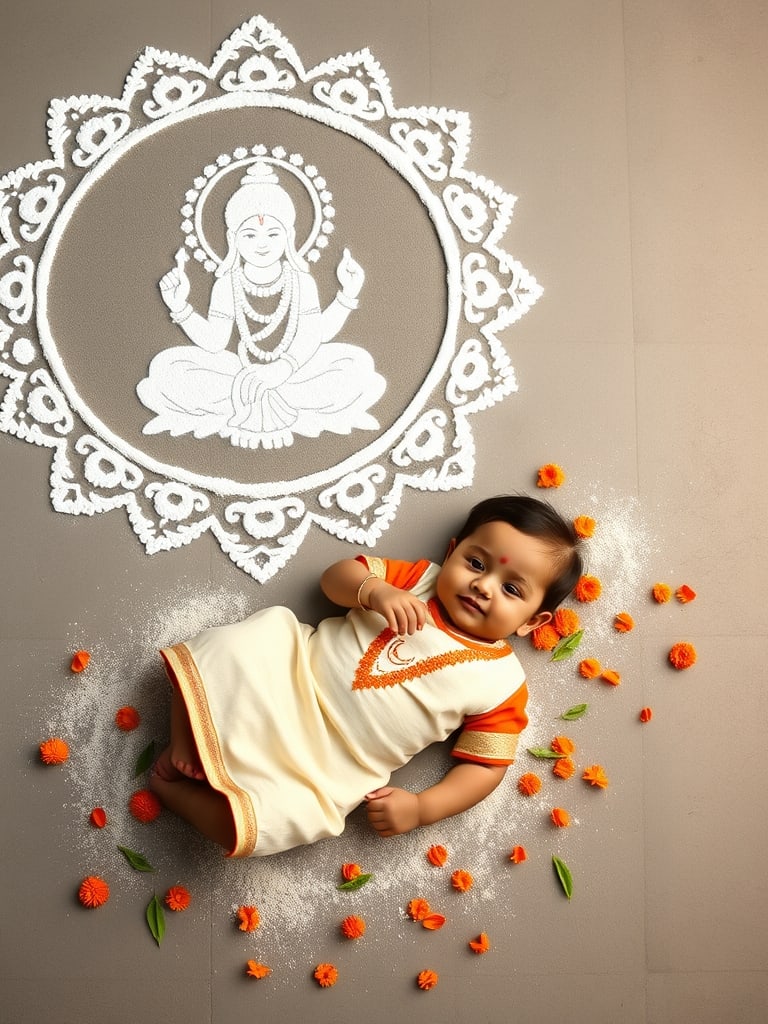
Preview of Ashadhi Ekadashi Baby Boy Theme Photoshoot with Lord Vitthal Rangoli | AI Image
image / Gemini
Baby & KidsGemini · ChatGPT

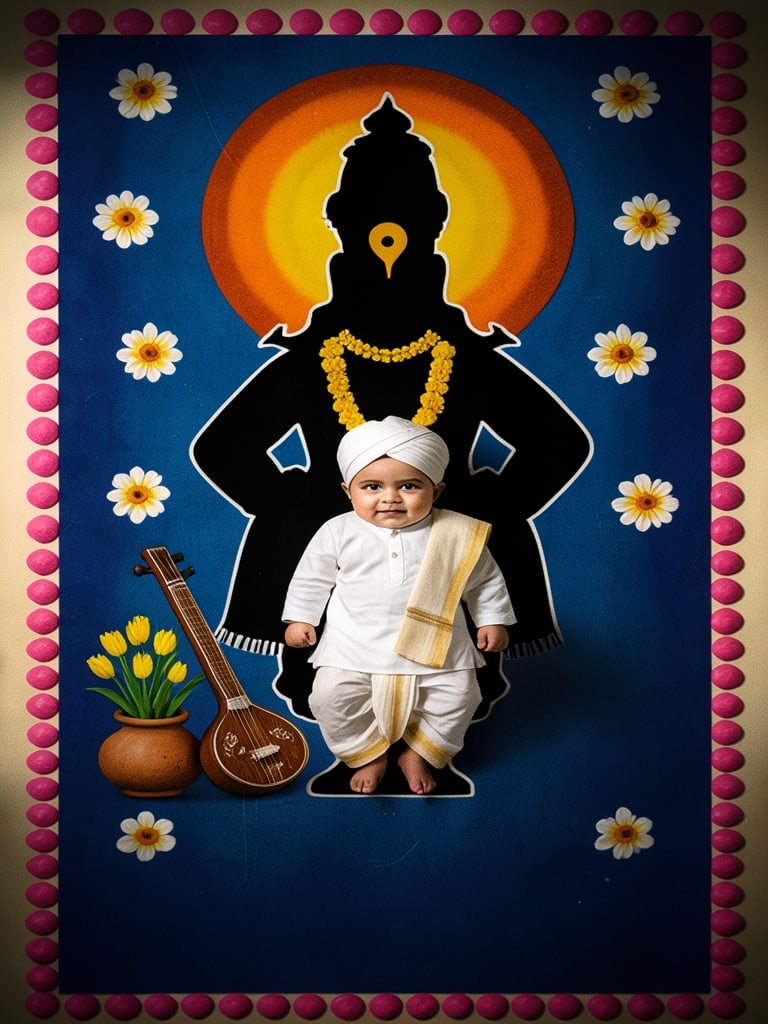
Ashadhi Ekadashi Baby Boy Theme Photoshoot with Lord Vitthal Rangoli | AI Image

create image of a premium devotional baby lay photoshoot inspired by Lord Vitthal, Baby Sant Tukaram, and authentic Maharashtrian rangoli art. Use the attached photo as the person identity reference only. The uploaded baby image must not be used as a reference for composition, outfit, props, typography, lighting, colors, background, or artwork unless explicitly instructed. Generate an ultra-realistic 4K Ultra HD vertical 9:16 masterpiece with handcrafted rangoli aesthetics, premium devotional storytelling, authentic Maharashtrian cultural elements, and luxury editorial-quality baby photography. STRICT FACE IDENTITY PRESERVATION Use the attached photo as the person identity reference only. Do not change the baby’s facial identity, expression, body proportions, or posture. Preserve the baby’s eyes, eyebrows, forehead, nose, lips, cheeks, ears, skin tone, facial proportions, infant age, natural hairline, facial symmetry, eye spacing, nose structure, lip shape, jawline, skin texture, and innocent smiling expression exactly as shown. No beautification, stylization, reshaping, facial enhancement, age modification, or artistic reinterpretation is permitted. The baby must remain unmistakably identical to the uploaded reference while naturally integrating into the devotional composition. Visual Blueprint Reconstruction Recreate the entire visual blueprint exactly while maintaining the same overall hierarchy, spatial balance, visual rhythm, and object relationships. Preserve the minimalist premium flat-lay composition with a large circular devotional rangoli positioned in the upper half of the frame and the baby positioned independently in the lower half. The composition should remain clean, symmetrical, premium, and devotional, with every decorative element appearing intentionally placed and perfectly balanced. Canvas, Floor & Background Composition Create the photoshoot on a smooth premium grey stone floor with realistic matte texture and subtle natural variations. The floor should remain clean and uncluttered while serving as an elegant neutral backdrop. Leave generous negative space between the upper devotional rangoli and the baby so the composition feels airy, luxurious, and professionally styled. Sacred Vitthal Rangoli Artwork At the upper center create a large perfectly circular white rangoli base occupying approximately the upper forty percent of the composition. Inside the circle recreate an elegant handcrafted Lord Vitthal rangoli silhouette using traditional rangoli powders. The Vitthal figure should appear as a only black upper chest and head, along with fish earrings and mukut . Place a golden pilgrimage location marker at the forehead, a yellow floral garland around the neck, twin saffron Warkari flags standing on the left, green sugarcane stalks with purple flowers on the right, and a traditional pakhawaj together with a tanpura beneath the deity. Every component must appear handcrafted entirely from authentic rangoli powder with realistic grain texture, soft powder edges, natural blending, and slight handmade imperfections. Devotional Lighting Arrangement Surround the circular rangoli with evenly spaced glowing traditional earthen diyas placed symmetrically around the outer circumference. Every diya should emit warm golden light that softly illuminates the surrounding rangoli without overpowering the artwork. The glow should create a peaceful devotional ambience while preserving natural realism. Baby Sant Tukaram Styling Position the baby in the lower half of the frame, lying comfortably on the floor with a naturally joyful, smiling expression while preserving the pose from the uploaded reference. Dress the baby in authentic Warkari attire inspired by Sant Tukaram — consisting of a pure white cotton kurta, traditional white dhoti with simple red and gold woven borders, and a modest waist belt. tulsi and rudraksha malas, and gold armlets, bangles, and anklets for devotional authenticity. Adorn the baby with a plain white Maharashtrian pagadi featuring subtle zari detailing and a small central gemstone ornament. Add a small sandalwood tilak on the forehead, maintaining natural proportions and historically accurate Warkari simplicity. Lower Decorative Elements Around the baby recreate elegant white rangoli footprints leading toward the upper Vitthal artwork. Add graceful curved white rangoli flourishes with saffron highlights on both sides of the baby, balancing the composition symmetrically. Scatter fresh orange and yellow marigold blossoms naturally around the lower section without overcrowding the design. Place a polished brass oil lamp on the baby’s right side, maintaining similar placement and scale as the reference. Decorate the lower corners with lush green leaves partially entering the frame to create a premium festive border. Typography & Calligraphy Reconstruction Along the right side recreate the vertically aligned devotional text “॥ पांडुरंग विठ्ठल ॥” exactly as handcrafted white rangoli calligraphy instead of digital typography. Every Devanagari character must be individually formed using fine white rangoli powder with visible handcrafted grain, natural powder accumulation, soft handmade edges, consistent stroke thickness, and authentic artistic imperfections. Preserve the exact vertical orientation, spacing, proportions, decorative punctuation, and overall visual balance shown in the reference. The lettering must feel created by an experienced rangoli artist rather than printed text. Materials & Rangoli Authenticity Ensure every rangoli element is visibly handcrafted using authentic coloured rangoli powder with realistic pigment grains, natural colour blending, slight powder diffusion, layered application, and subtle handmade irregularities. The diyas should be real earthen lamps with authentic clay texture and naturally flickering flames. Flowers, brass objects, fabrics, and ornaments must display premium realistic material qualities with museum-level detail. Camera, Lighting & Photography DNA Capture the composition from a perfectly perpendicular ninety-degree overhead camera angle with absolutely no perspective distortion. Use soft diffused studio lighting combined with the warm ambient glow from the surrounding diyas to reveal every rangoli texture, fabric weave, jewelry detail, floral surface, and handcrafted devotional element. Maintain crisp focus throughout the frame with premium editorial-quality color grading, ultra-realistic textures, balanced contrast, and a luxurious devotional atmosphere worthy of a professional Maharashtrian festive baby photoshoot.

0 0 0
35m
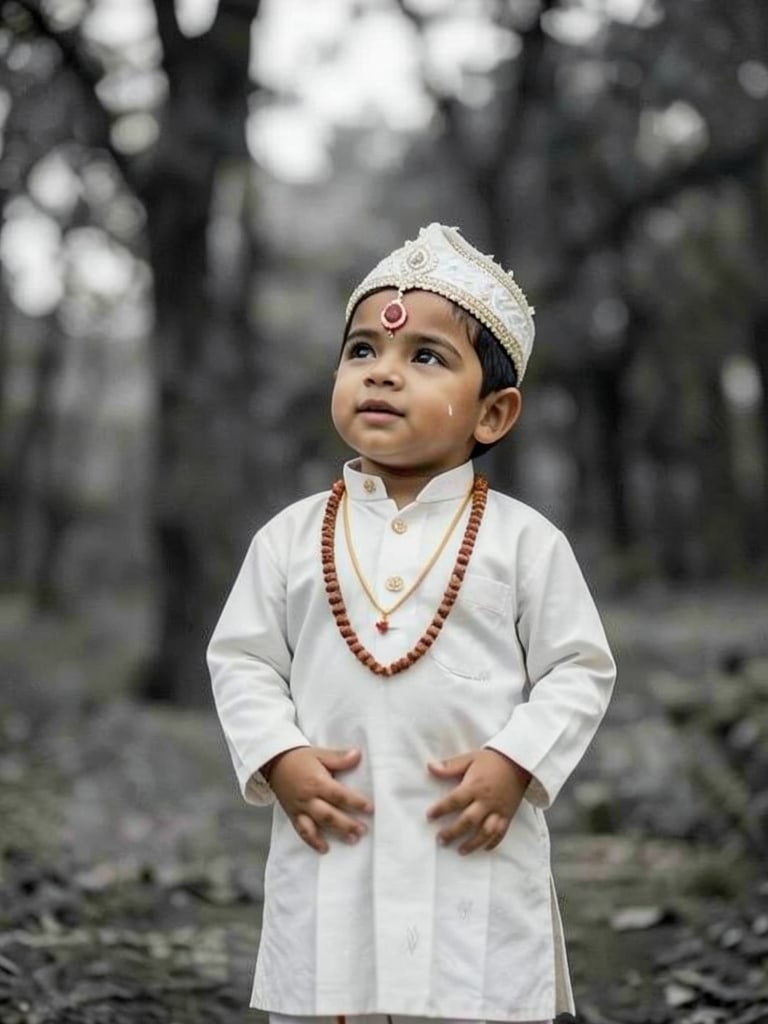
Preview of Traditional Warkari Ashadhi Ekadashi Boy Portrait in Maharashtrian Attire
image / Gemini
Baby & KidsGemini · ChatGPT

Traditional Warkari Ashadhi Ekadashi Boy Portrait in Maharashtrian Attire

create image STRICT FACE IDENTITY PRESERVATION DNA Use the uploaded image exclusively as the facial identity reference for the child. Preserve the exact facial identity, including the head shape, forehead proportions, hairline, eyebrows, eyelids, eye spacing, eye shape, nose structure, cheeks, lips, jawline, chin, ears, skin tone, skin texture, facial symmetry, and apparent age. Preserve the child’s innocent upward-looking expression, soft lips, naturally rounded cheeks, and wide devotional eyes exactly as shown. Do not beautify, stylize, enlarge the eyes, sharpen facial contours, modify complexion, alter age, or apply beauty-filter effects. The uploaded image is used only for facial identity preservation while every environmental, devotional, and photographic element is reconstructed entirely through descriptive instructions. SUBJECT DNA Create an ultra-realistic premium devotional portrait of a young Warkari girl captured during a sacred pilgrimage. The portrait should celebrate the innocence of childhood devotion, where the child gazes upward with complete faith as though silently looking toward Lord Vitthal. Rather than appearing posed, the portrait should feel like a spontaneous spiritual documentary moment transformed into museum-quality devotional fine-art photography. OUTFIT DNA Dress the child in a traditional handwoven white Warkari kurta stitched from premium soft cotton featuring a standing collar, hidden placket, naturally folded full sleeves, realistic cotton weave, and authentic fabric wrinkles created by gentle body movement. Pair the kurta with a traditional white cotton dhoti wrapped neatly around the waist with realistic layered pleats and natural draping. Place a crisp white Gandhi cap securely upon the head with visible cotton stitching, naturally folded edges, and realistic hand-pressed fabric texture. Around the neck place a long handcrafted Tulsi mala made from naturally polished dark wooden beads extending below the chest. Apply a bright yellow Vaishnav tilak to the forehead with a small black devotional dot centred within it, accompanied by a traditional white sacred dot placed delicately upon the left cheek. Small traditional gold earrings complete the devotional appearance. RITUAL OBJECT DNA Allow the devotional symbolism to remain intentionally minimal. The Gandhi cap, Tulsi mala, sacred Vaishnav tilak, white devotional attire, and sacred cheek marking become the principal spiritual identifiers. No additional ritual objects should distract from the child’s devotional expression, allowing innocence itself to become the strongest symbol of faith. POSITION DNA Position the child standing naturally while viewed from above. Approximately sixty-eight percent of the body weight transfers comfortably through the right supporting leg while the left leg remains slightly relaxed beneath the body, preserving authentic childhood balance. The pelvis remains centred with minimal lateral shift. The torso rotates gently toward camera-left by approximately eight degrees while leaning forward slightly beneath the overhead camera position. The spine follows a relaxed natural curve appropriate for a young child. Both shoulders remain lowered and relaxed while the neck extends naturally upward, allowing the head to rotate approximately twenty-two degrees toward the upper-right direction as the child looks above with quiet devotion. HAND POSITION DNA The child’s right hand gently gathers the front of the kurta near the upper chest, delicately pinching the cotton fabric between the thumb and first two fingers without visible tension. The left hand rests naturally slightly higher across the chest with softly curved fingers touching the garment lightly as though unconsciously adjusting the clothing. Every finger follows authentic childhood anatomy with relaxed joints, creating spontaneous rather than instructed body language. BODY LANGUAGE DNA The entire posture should communicate reverence, curiosity, and childlike innocence. The lifted head, softly extended neck, naturally rounded shoulders, and gentle hand placement create the feeling that the child has paused during the pilgrimage after noticing something spiritually beautiful above. Every movement should remain anatomically accurate for a young child while preserving complete emotional authenticity. EYE DIRECTION DNA The child gazes upward toward the upper-right portion of the frame with large expressive eyes filled with curiosity, hope, and devotion. The pupils remain sharply focused on an unseen divine presence beyond the frame while naturally catching soft reflections from the sky. The gaze should become the emotional centre of the portrait. CAMERA DNA Position the camera approximately 2.2 metres vertically above the child, creating a dramatic overhead perspective. Angle the camera downward at approximately 65 degrees, allowing the viewer to observe the child from above while preserving realistic facial proportions. The optical centre aligns directly above the child’s upper chest so the upward gaze naturally dominates the composition without introducing perspective distortion. CAMERA POSITION DNA Place the photographer almost directly above the child with only a slight horizontal offset toward camera-left of approximately fifteen centimetres. Maintain a working distance of approximately 2.3 metres between the lens and the child’s face. This slight offset allows the face to retain dimensional depth while emphasizing the emotional upward eye contact. CAMERA DISTANCE DNA Capture the portrait using a professional full-frame camera equipped with an 85mm premium portrait prime lens from approximately 2.3 metres. This working distance preserves natural facial proportions while producing elegant compression and luxurious background separation. The child should occupy approximately seventy percent of the frame, allowing enough surrounding space to reinforce the elevated perspective. CAMERA ELEVATION RELATIONSHIP DNA The overhead camera establishes a protective viewpoint, as though the viewer observes the child from a higher spiritual presence. The child’s upward gaze bridges the visual distance between the ground and the unseen divine source above, creating a strong emotional relationship between camera position and storytelling. The slight off-centre positioning prevents geometric stiffness while preserving complete visual harmony. LENS DNA Photograph using a professional full-frame camera fitted with an 85mm prime portrait lens at f/1.8. The lens should deliver exceptional facial sharpness, luxurious compression, smooth perspective transitions, and premium subject isolation while preserving physically accurate proportions despite the elevated viewpoint. LIGHTING DNA Illuminate the portrait using naturally diffused daylight filtered through soft cloud cover. Gentle ambient light wraps evenly across the child’s face, eliminating harsh shadows while preserving natural skin texture and delicate highlight transitions. The overhead lighting should produce soft catchlights within the eyes while maintaining realistic tonal separation throughout the white clothing. The overall illumination should feel peaceful, devotional, and naturally cinematic. BOKEH DNA Render the ground beneath the child into luxurious creamy bokeh with subtle neutral grey textures dissolving softly toward the frame edges. The environment should remain recognizable only through tonal variation while ensuring complete visual emphasis remains upon the child’s face, Gandhi cap, and devotional markings. Strong subject isolation should reinforce the emotional intimacy of the portrait. VISUAL DEPTH DNA The foreground begins immediately beneath the overhead viewpoint with softly blurred portions of the child’s white clothing guiding attention toward the face. The primary subject layer consists of the child rendered with pore-level skin detail, realistic cotton textures, authentic Tulsi bead materials, naturally folded Gandhi cap, delicate gold earrings, and physically accurate hand placement. Beneath the child, the softly textured pathway gradually dissolves into creamy neutral blur, creating exceptional foreground-to-background separation despite the overhead composition. ENVIRONMENT DNA Construct a peaceful outdoor pilgrimage environment with an unobtrusive neutral pathway beneath the child. Keep every environmental detail intentionally understated so that nothing competes with the emotional power of the child’s upward devotional gaze. The softly blurred surroundings should evoke the quiet atmosphere of a sacred pilgrimage without introducing visual distractions. STORYTELLING DNA This portrait captures the silent innocence of a young Warkari devotee who momentarily forgets the surrounding world while looking upward with unwavering faith. The white clothing symbolizes purity, the Tulsi mala reflects lifelong devotion, and the bright Vaishnav tilak becomes the visible mark of spiritual identity. Rather than documenting a child in costume, the portrait tells the story of devotion discovered through innocent curiosity. The elevated viewpoint reinforces the feeling that divine grace quietly watches over the child, transforming an ordinary moment into a timeless devotional masterpiece. COMPOSITION DNA Construct the composition around the powerful visual dialogue between the elevated camera and the child’s upward gaze. The bright Gandhi cap creates a strong geometric anchor near the top of the frame, while the face occupies the central visual focus. The Tulsi mala introduces graceful vertical flow through the clothing, and the gently folded hands create a secondary focal rhythm. Every visual pathway—including the cap, tilak, eyes, hands, and flowing white garments—should naturally converge upon the child’s expression, creating a museum-quality devotional portrait with exceptional emotional depth. FINAL OUTPUT Create an ultra-realistic premium devotional Warkari child portrait in 4K Ultra HD, photographed with a professional full-frame camera using an 85mm prime portrait lens at f/1.8, featuring physically accurate optics, authentic handwoven cotton fabrics, realistic Tulsi bead materials, naturally folded Gandhi cap, premium skin rendering, luxurious creamy bokeh, soft diffused natural lighting, exceptional overhead perspective, emotionally immersive storytelling, masterpiece-quality devotional fine-art photography, and a 9:16 vertical composition.

0 0 0
35m
Preview of Ashadhi Ekadashi Boy Photoshoot Inspired by Warkari Palkhi Tradition
image / Gemini
Baby & KidsGemini · ChatGPT

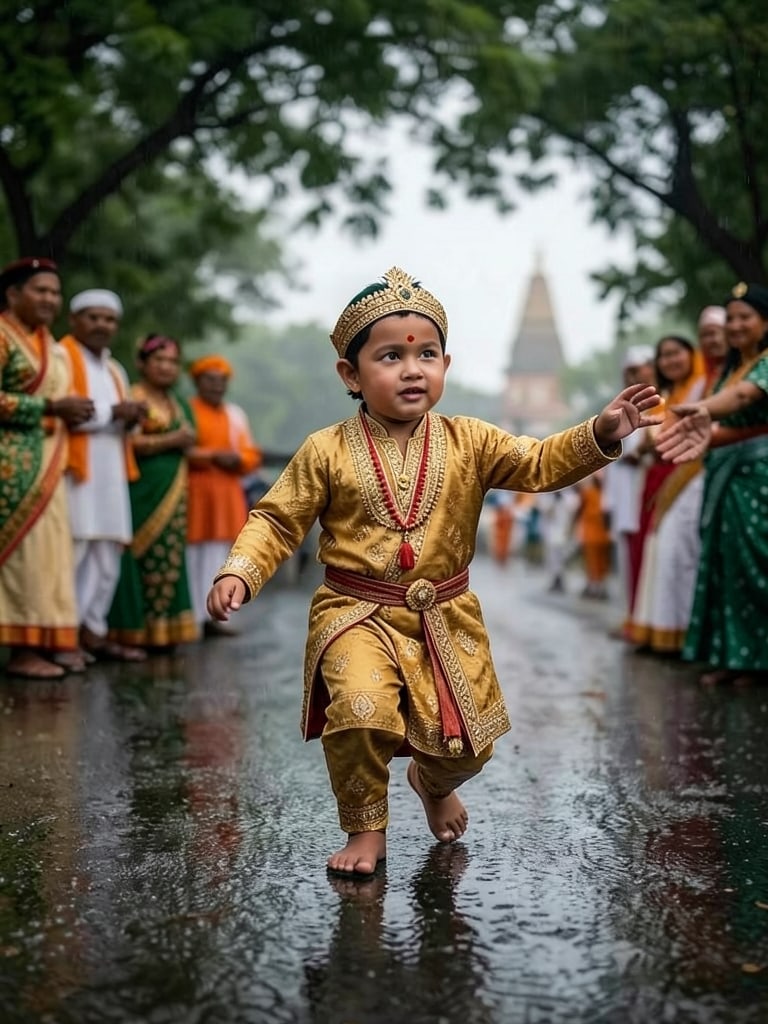
Ashadhi Ekadashi Boy Photoshoot Inspired by Warkari Palkhi Tradition

create image STRICT FACE IDENTITY PRESERVATION DNA Use the uploaded image exclusively as the facial identity reference for the baby. Preserve the baby’s exact facial identity, including the head shape, forehead proportions, hairline, eyebrows, eyelids, eye spacing, eye shape, nose structure, lips, cheeks, smile characteristics, jawline, chin, ears, skin tone, skin texture, facial symmetry, and apparent age. Preserve the joyful open-mouth smile, bright expressive eyes, and innocent toddler expression exactly as shown. Do not beautify, stylize, reshape facial proportions, enlarge the eyes, sharpen facial contours, modify complexion, or apply beauty-filter effects. The uploaded image serves only as the facial identity reference while every costume detail, environmental element, and artistic relationship is reconstructed entirely through descriptive instructions. SUBJECT DNA Create an ultra-realistic premium devotional toddler portrait inspired by the sacred Warkari tradition during the Pandharpur pilgrimage. The child is captured taking joyful independent steps along a rain-soaked temple road while happily walking toward family members standing nearby. The image should celebrate innocence, devotion, and the excitement of a young devotee participating in the spiritual journey for the very first time. Every element should communicate movement, happiness, and deep cultural authenticity. OUTFIT DNA Dress the toddler in a pristine traditional white handwoven cotton Warkari kurta featuring a simple standing collar, full sleeves, natural cotton texture, realistic fabric wrinkles created by walking, and subtle hand-stitched finishing around the neckline and cuffs. Pair the kurta with a traditional white cotton dhoti folded naturally around the legs, displaying authentic pleats and realistic movement generated by each step. Place a traditional white Gandhi cap securely upon the head with visible cotton stitching and naturally folded edges. Around the neck, place multiple authentic Tulsi bead malas with realistic wooden texture, together with a small devotional pendant resting naturally upon the chest. Apply a traditional black-and-red Vaishnav tilak at the center of the forehead with realistic hand-applied texture. The toddler wears colourful waterproof children’s sandals with visible wet reflections, adding realism while preserving the innocence of childhood. RITUAL OBJECT DNA Allow the devotional identity to remain simple and authentic by using only traditional Warkari accessories naturally worn by the child. The Tulsi mala, Gandhi cap, sacred tilak, and traditional white clothing become the principal devotional elements while the surrounding pilgrims, rain-soaked road, and temple atmosphere reinforce the spiritual narrative without introducing unnecessary props. ENVIRONMENT DNA Construct a rain-washed pilgrimage road leading toward the sacred temple area of Pandharpur. The black asphalt road glistens with fresh rainwater, creating natural reflections beneath the child’s feet. On both sides of the road, groups of Warkari devotees dressed in colourful traditional Maharashtrian attire remain softly blurred, watching the child with joyful admiration. Tall green trees arch gently over the road, their rain-soaked leaves forming a lush canopy above. Fine monsoon rain continues falling lightly throughout the scene, while distant pilgrims disappear gradually into luxurious atmospheric depth. POSITION DNA Position the toddler confidently in the centre of the rain-soaked pathway while taking a joyful forward step toward the camera. Approximately sixty-four percent of the body weight transfers through the leading right foot pressing naturally into the wet road, while the left foot begins lifting gently from the ground to continue the walking motion. The pelvis rotates subtly with the natural mechanics of toddler walking, creating realistic balance. The torso leans forward by approximately four degrees as momentum carries the child ahead with excitement. The spine remains naturally upright for a toddler, while the shoulders stay relaxed and slightly lifted through playful movement. The head remains vertically balanced with only a subtle two-degree rotation toward camera-right as the child smiles happily during the walk. HAND POSITION DNA Both arms extend naturally away from the body to assist balance during early childhood walking. The right forearm reaches gently forward with the elbow comfortably flexed, allowing the small open palm to stretch toward someone waiting just beyond the camera. The fingers remain naturally separated with relaxed infant anatomy and no visible muscular tension. The left arm extends outward slightly lower than the right, with softly curved fingers responding naturally to the walking motion. Every joint should communicate authentic toddler balance rather than instructed posing. BODY LANGUAGE DNA The child’s entire body language should express joyful confidence mixed with the charming instability of an early walker. Every movement should feel spontaneous and emotionally genuine. The slightly raised shoulders, naturally swinging arms, forward body momentum, and delighted smile should communicate excitement about moving toward loved ones while participating in the sacred pilgrimage. The posture must remain anatomically accurate for a toddler who has recently learned to walk independently. EYE DIRECTION DNA The toddler looks slightly upward toward camera-right with sparkling eyes, as though responding joyfully to a familiar family member encouraging every step. The expression should remain filled with laughter, innocence, and complete emotional freedom, creating immediate engagement with the viewer. CAMERA DNA Position the camera extremely low, approximately 42 centimetres above the wet road surface, almost at the toddler’s knee height. This dramatically lowered viewpoint emphasizes the child’s perspective while making every tiny step appear heroic and emotionally significant. The camera maintains a perfectly frontal orientation with only a subtle one-degree upward inclination, allowing the child to dominate the visual hierarchy while preserving realistic body proportions. CAMERA POSITION DNA Place the photographer approximately 3.6 metres directly in front of the toddler, remaining perfectly centred on the child’s walking path. The optical axis intersects precisely through the child’s chest, allowing both the joyful face and forward movement to remain equally important. The camera remains perfectly level without horizontal deviation, ensuring the road naturally guides the viewer’s eye directly toward the child. CAMERA DISTANCE DNA Capture the portrait using a professional full-frame camera fitted with an 85mm premium portrait prime lens from a working distance of approximately 3.6 metres. This distance preserves realistic toddler proportions while providing elegant perspective compression and luxurious separation between the child and the distant pilgrims. The child occupies approximately sixty-five percent of the vertical frame while generous environmental space reinforces the pilgrimage atmosphere. CAMERA ELEVATION RELATIONSHIP DNA The exceptionally low camera height aligns the optical centre close to the toddler’s chest, allowing the viewer to experience the world from the child’s perspective. The reflective road stretches naturally toward the foreground while the tree canopy and distant devotees rise gently behind the child, creating a powerful sense of scale despite the toddler’s small stature. LENS DNA Photograph using a professional full-frame camera equipped with an 85mm prime portrait lens at f/1.8. This combination produces exceptional facial sharpness, realistic toddler proportions, luxurious telephoto compression, and beautiful isolation between the child and the softly blurred devotional surroundings. LIGHTING DNA Illuminate the portrait using naturally diffused monsoon daylight filtered through thick cloud cover. Soft ambient light wraps evenly around the child’s face, eliminating harsh shadows while preserving realistic skin texture. Gentle reflections from the rain-soaked road bounce subtle fill light upward beneath the chin and clothing. Tiny raindrops catch soft highlights while maintaining complete natural realism, creating an atmosphere of freshness and spiritual purity. BOKEH DNA Render the distant pilgrims, trees, roadside activity, and temple pathway using luxurious creamy telephoto bokeh. Bright traditional clothing worn by the distant devotees dissolves into soft patches of warm colour while remaining recognizable enough to communicate the pilgrimage atmosphere. Gentle rain and wet reflections create subtle circular highlights throughout the background, strengthening the sense of depth without distracting from the child. VISUAL DEPTH DNA The foreground begins with richly textured rain-soaked asphalt displaying puddles, reflective water sheen, scattered droplets, and naturally distorted reflections of the toddler’s colourful sandals. The primary subject layer consists of the smiling child rendered with pore-level skin detail, realistic cotton fabric textures, authentic Tulsi beads, naturally folded Gandhi cap, wet clothing highlights, and physically accurate walking mechanics. Behind the child, softly blurred Warkari devotees dressed in saffron, white, green, and red create a lively secondary depth layer while tall rain-soaked trees frame the pathway. The distant pilgrimage route gradually dissolves into atmospheric monsoon haze, producing exceptional foreground-to-background separation. STORYTELLING DNA This portrait captures one of the most precious moments of devotion—a small child joyfully taking independent steps while participating in the sacred Warkari pilgrimage. Every smile, movement, and gesture reflects innocence meeting tradition. The surrounding devotees watch with affection as the young pilgrim happily walks through the rain toward the future, carrying forward generations of unwavering faith. Rather than appearing as a posed portrait, the image should feel like a genuine documentary moment transformed into timeless fine-art devotional photography. COMPOSITION DNA Construct the composition around the child’s forward movement, allowing the rain-soaked road to create powerful leading lines converging naturally toward the smiling face. The softly blurred devotees on both sides establish balanced visual framing without competing for attention, while the tree canopy forms a natural overhead arch guiding the eye toward the centre. The reflective foreground, joyful body language, devotional clothing, and luxurious monsoon atmosphere combine to produce a museum-quality composition where every visual relationship ultimately celebrates the innocence of a young Warkari devotee. FINAL OUTPUT Create an ultra-realistic premium devotional toddler portrait in 4K Ultra HD, photographed with a professional full-frame camera using an 85mm prime lens at f/1.8, featuring physically accurate optics, authentic handwoven cotton textures, realistic Tulsi malas, naturally folded Gandhi cap, wet reflective road surfaces, luxurious monsoon bokeh, soft diffused rain lighting, exceptional foreground-to-background depth, emotionally immersive storytelling, masterpiece-quality documentary devotional photography, and a 9:16 vertical composition.

0 0 0
35m
Preview of Ashadhi Ekadashi Baby Boy Photoshoot with Lord Vitthal Theme | Warkari Baby Photoshoot
image / Gemini
Baby & KidsGemini · ChatGPT

Ashadhi Ekadashi Baby Boy Photoshoot with Lord Vitthal Theme | Warkari Baby Photoshoot

create image of a premium devotional baby lay photoshoot inspired by the sacred Vitthal tradition, Baby Sant Tukaram symbolism, and handcrafted Maharashtrian rangoli art. Use the attached photo as the person identity reference only. The uploaded baby image is not a reference for the composition, outfit, props, typography, background, lighting, or artistic layout unless explicitly instructed. Generate an ultra-realistic 4K Ultra HD vertical 9:16 composition with museum-quality devotional storytelling, authentic rangoli craftsmanship, premium flat-lay photography, and elegant spiritual aesthetics. STRICT FACE IDENTITY PRESERVATION Use the attached photo as the person identity reference only. Do not change the baby’s facial identity, expression, body proportions, or natural posture unless explicitly instructed by the prompt. Preserve the baby’s eyes, eyebrows, forehead, nose, lips, cheeks, ears, skin tone, facial proportions, infant age, natural hairline, facial symmetry, eye spacing, nose structure, lip shape, jawline, skin texture, and innocent sleeping expression exactly as shown in the uploaded image. No beautification, stylization, facial enhancement, reshaping, age modification, gender alteration, or artistic reinterpretation is permitted. The baby must remain unmistakably identical to the uploaded reference while naturally integrating into the recreated devotional artwork. Visual Blueprint Reconstruction Reconstruct the reference image as a complete visual blueprint rather than an artistic inspiration. Preserve the overall visual hierarchy, structural balance, symmetry, proportions, spacing relationships, object scaling, negative space, and compositional rhythm exactly as shown. The entire scene must appear as a meticulously handcrafted rangoli installation viewed from directly overhead, with every visual component maintaining the same relative position and visual importance as the reference while presenting a premium devotional interpretation centred around Lord Vitthal and Baby Sant Tukaram symbolism. Canvas Layout, Composition & Spatial DNA Construct a tall vertical rectangular rangoli occupying nearly the full canvas with narrow outer margins visible around the artwork. Surround the complete rangoli with a continuous handcrafted border of uniformly sized bright pink circular rangoli dots, maintaining identical spacing, diameter, rhythm, and border thickness throughout all four edges. The internal composition should be strongly symmetrical around the central vertical axis, with the Lord Vitthal silhouette acting as the dominant visual anchor occupying approximately seventy percent of the artwork height. Position the baby inside the lower portion of the silhouette so that the baby visually becomes part of the deity’s sacred presence rather than lying independently. Maintain generous blue negative space around the silhouette, balanced equally on both sides by decorative floral motifs and devotional calligraphy. Rangoli Background & Sacred Vitthal Silhouette Create the complete artwork entirely from authentic coloured rangoli powder applied by hand over a smooth floor surface. The background should consist of rich royal-blue rangoli with naturally blended pigment transitions, visible handcrafted grain texture, soft powder diffusion, slight tonal variation, and realistic handmade imperfections. At the centre recreate the monumental black silhouette of Lord Vitthal in the traditional standing posture with both hands resting on the waist. The silhouette should retain broad shoulders, gently tapering sides, and a stable symmetrical stance exactly matching the reference proportions. Surround the silhouette with a delicate white rangoli outline that naturally separates the black figure from the blue background. Behind the head construct a perfectly centred circular halo using layered rangoli gradients transitioning from brilliant golden yellow at the centre through warm orange into deep reddish-orange toward the outer edge. Place a traditional yellow marigold garland around the silhouette’s neck using individually formed floral rangoli elements, and recreate the golden pilgrimage location marker positioned precisely at the forehead of the silhouette. Baby Sant Tukaram Composition Position the baby sleeping peacefully within the lower central portion of the Lord Vitthal silhouette, occupying approximately one-third of the silhouette height while remaining perfectly centred. Preserve the same relaxed sleeping posture with both arms naturally raised upward, elbows slightly bent, palms gently open, legs softly crossed, and facial muscles completely relaxed. Dress the baby in authentic traditional white Maharashtrian Warkari attire consisting of a clean white kurta, white dhoti finished with elegant woven golden borders, and a diagonally draped cream-white shoulder cloth carrying subtle gold edging. Wrap the head with a neatly folded traditional white Maharashtrian turban while keeping the styling simple, devotional, and historically authentic. Add a small traditional forehead tilak and allow the clothing folds to fall naturally with realistic cotton texture, fine embroidery, gentle fabric creases, and soft shadows. The overall appearance should subtly evoke Baby Sant Tukaram while remaining visually faithful to the reference composition. Supporting Devotional Objects & Relationship DNA Preserve the precise placement relationships of every supporting object. Position a polished wooden tanpura diagonally to the lower left of the baby with accurate proportions, realistic wood grain, carved detailing, and devotional significance. Place a rounded earthen flower pot immediately beside the tanpura containing several upright yellow tulips with fresh green stems. Arrange eight handcrafted rangoli flowers across the blue background using identical spacing, distribution, and visual rhythm as the reference. Each flower should consist of white petals outlined with warm yellow and orange centres formed entirely from coloured rangoli powder. Every supporting object must maintain the same visual weight and distance from the primary composition so that the artwork feels balanced and symmetrical. Typography DNA & Rangoli Calligraphy Reconstruction Reconstruct every textual element exactly as handcrafted rangoli lettering rather than digital typography. Every Devanagari character must appear individually shaped using coloured rangoli powder with visible handcrafted edges, natural powder accumulation, subtle grain variation, and slight handmade irregularities while preserving excellent readability. At the lower centre recreate the large golden title “॥ विठ्ठल ॥” using thick premium golden rangoli powder with identical proportions, baseline, stroke thickness, spacing, and visual dominance as the reference. Directly beneath it recreate the devotional line “अभंग संतांचा, विठ्ठल आवाज भक्तांचा विठ्ठल अर्थ जीवनाचा” in finely handcrafted white rangoli lettering while preserving the same line spacing, alignment, font proportions, and hierarchy. Below this reproduce “॥ राम कृष्ण हरी ॥” in bright golden rangoli powder with the same centred placement and devotional emphasis. On the right side faithfully reconstruct the handwritten Marathi devotional calligraphy exactly where it appears in the reference, preserving its handwritten flow, stroke rhythm, natural spacing, powder texture, and artistic balance without replacing it with modern fonts. Material, Texture & Rangoli Craftsmanship Every visual component should clearly display authentic rangoli craftsmanship rather than painted graphics. Powder edges should remain soft yet controlled, colours should blend naturally at transitions, and tiny pigment grains should remain visible upon close inspection. The handmade quality must be evident through realistic powder density, layered application, slight edge diffusion, naturally compressed pigment, and subtle imperfections characteristic of expert rangoli artists. The floor beneath should remain minimally visible while enhancing realism through fine surface texture and soft interaction with the rangoli pigments. Lighting, Camera & Photography DNA Capture the entire artwork using a perfectly perpendicular overhead camera positioned exactly ninety degrees above the composition so that every object remains free from perspective distortion. Illuminate the scene using soft diffused studio lighting evenly distributed across the artwork, revealing rangoli texture, powder depth, cloth folds, and handcrafted details without harsh reflections or distracting shadows. The finished photograph should resemble a premium award-winning devotional baby lay photoshoot where authentic Maharashtrian rangoli artistry, Lord Vitthal symbolism, Baby Sant Tukaram devotion, and ultra-realistic photography merge seamlessly into a single museum-quality composition while faithfully preserving the structural DNA of the supplied reference image.

0 0 0
35m
Preview of Ashadhi Ekadashi Vitthal Theme Traditional Baby Photoshoot
image / Gemini
Baby & KidsGemini · ChatGPT

Ashadhi Ekadashi Vitthal Theme Traditional Baby Photoshoot

create image STRICT FACE IDENTITY PRESERVATION DNA Use the uploaded image exclusively as the facial identity reference for the baby. Preserve the baby’s exact individual facial identity, including head shape, forehead proportions, natural hairline, eyebrow shape, eyelids, eye size and spacing, nose structure, lips, cheeks, jawline, chin, ears, skin tone, natural skin texture, facial symmetry, smile characteristics, and exact apparent age. Preserve the baby’s calm, innocent, slightly smiling expression without beautification or stylization. Do not make the baby younger or older, lighten the skin, slim the face, sharpen the jaw, enlarge the eyes, alter facial proportions, or apply beauty-filter effects. The uploaded image must be used only for facial identity preservation; reconstruct the outfit, pose, body language, ornaments, deity statue, temple environment, lighting, and composition entirely from the instructions below. SUBJECT DNA Create a majestic devotional portrait featuring a young Indian baby boy standing confidently in the central foreground, directly in front of a monumental black-stone murti of Lord Vitthal of Pandharpur. The baby should visually embody the traditional devotional appearance associated with a young Varkari devotee, while the enormous Lord Vitthal murti rises protectively behind him. The scale relationship is essential: the baby is the primary living subject and occupies approximately the lower central 55–60% of the frame height, while the monumental deity occupies nearly the entire vertical background, appearing approximately three to four times the baby’s perceived height. BABY OUTFIT DNA Dress the baby in an elaborate traditional Maharashtrian devotional ensemble. Wrap the lower body in a rich deep crimson-red silk dhoti with authentic pleated construction, realistic fabric folds, and broad antique-gold zari borders. The dhoti should be securely wrapped around the waist with natural folds descending around the legs. Drape a luxurious saffron-orange and deep-red silk devotional stole diagonally and vertically around the shoulders, allowing both decorated ends to descend toward the knees. The stole should feature intricate traditional golden zari borders and fine woven Maharashtrian motifs. Keep the upper torso naturally bare, showing realistic baby skin and age-appropriate body proportions. Place an elaborate traditional saffron-orange Maharashtrian turban on the baby’s head, constructed from multiple realistic layers of silk fabric with red and antique-gold woven borders. Add a small decorative pearl tassel hanging naturally from one side of the turban. Around the baby’s neck, place a long white pearl devotional mala and a separate fresh floral garland composed predominantly of small white flowers, interspersed with compact clusters of saffron-orange marigolds and dark green leaves. The floral garland should extend naturally toward the lower abdomen. Add a thin black sacred thread around the neck, delicate pearl armlets around both upper arms, small silver bracelets at the wrists, and minimal traditional earrings appropriate for a young child. On the baby’s forehead, place a clearly defined traditional white vertical Vaishnav tilak with a central saffron-orange accent, carefully positioned without altering any facial features. POSITION DNA Position the baby standing upright in the exact center foreground with a strong but age-appropriate confident stance inspired by the iconic Vitthal posture. The baby’s torso should face almost perfectly frontward toward the camera, with no more than a 2–3 degree rotation. Keep the spine upright and the shoulders naturally level. Place both legs slightly apart, approximately shoulder-width for the baby’s proportions, creating a stable stance. Distribute the body weight evenly between both feet. Keep both knees naturally straight but not rigid. The baby’s chest should remain relaxed rather than artificially expanded. The head should remain upright with a very subtle natural tilt of approximately 2–3 degrees, preserving an innocent childlike presence despite the confident devotional pose. HAND, ARM AND BODY LANGUAGE POSITION DNA Both arms must bend outward symmetrically from the elbows to recreate the iconic hands-on-waist posture. Place the baby’s right hand firmly but naturally against the right side of the waist, with the elbow projecting outward. Place the left hand symmetrically against the left waist, with the left elbow projecting outward. The fingers should curve naturally around the sides of the waist rather than appearing flat or rigid. Both thumbs should rest naturally toward the back or upper waist while the remaining fingers remain visible along the front-side waist area. The posture should communicate innocent confidence, devotion, and a symbolic visual echo of Lord Vitthal standing directly behind the baby. Ensure anatomically correct hands with five clearly formed fingers on each hand, natural wrist angles, realistic elbows, and no fused or duplicated fingers. EYE DIRECTION DNA The baby should look directly toward the camera lens with bright, naturally expressive eyes. Maintain a gentle, calm, slightly joyful expression with softly parted lips or a subtle smile. The monumental Lord Vitthal murti behind the baby should face directly forward with the traditional serene, meditative expression of the deity. LORD VITTHAL MURTI DNA Create an enormous, highly detailed traditional black-stone murti of Lord Vitthal standing immediately behind the baby. The deity should have the iconic upright posture with both arms bent and hands resting firmly at the waist. Render the murti from polished dark black stone with authentic stone texture, subtle age marks, fine sculptural details, and restrained reflections from the surrounding golden light. Place a tall, intricately carved antique-gold crown on the deity’s head, decorated with traditional temple motifs and a central jewel-like ornament. Add the distinctive yellow-saffron forehead tilak prominently against the black stone. Decorate the deity with multiple layers of antique-gold necklaces, pearl strands, traditional chest ornaments, ornamental shoulder pieces, arm ornaments, and long flower garlands containing white, saffron-orange, and deep-red flowers. Drape richly detailed dark antique-gold ceremonial fabric from the deity’s arms and shoulders, allowing it to fall vertically behind the baby. The deity’s body must remain clearly recognizable as a monumental sacred stone murti rather than a living human figure. SCALE AND ALIGNMENT DNA Precisely align the baby and Lord Vitthal along the same central vertical axis. The baby’s head should overlap visually with the lower chest or upper abdominal region of the monumental deity. The deity’s shoulders should extend broadly behind the baby, creating a powerful protective silhouette. The baby’s outward-pointing elbows should visually echo the much larger outward elbows of Lord Vitthal behind him. This repetition of posture is a central storytelling element of the composition. Do not allow the baby to completely obscure the deity’s hands-on-waist posture. The deity’s forearms, elbows, shoulders, upper torso, face, crown, and ornaments must remain clearly visible. CAMERA ANGLE DNA Photograph the scene from a slightly low frontal camera angle, positioning the camera approximately 60–75 centimetres above floor level, around the baby’s lower chest to waist height. Tilt the camera upward approximately 4–7 degrees. This subtle low-angle perspective should make the baby appear confidently heroic while dramatically emphasizing the towering scale of Lord Vitthal behind him. Maintain a perfectly centered frontal composition without excessive perspective distortion. CAMERA-TO-SUBJECT DISTANCE DNA Position the camera approximately 3.5–4.5 metres from the baby, allowing the baby’s complete body, turban, ornaments, dhoti, and standing posture to remain fully visible while simultaneously including the monumental deity from torso to crown. Position the monumental deity approximately 2–3 metres behind the baby. This physical separation should create realistic visual depth while maintaining the strong central alignment between the two figures. The camera distance and focal length must compress the perspective moderately so the deity feels visually connected to the baby without making them appear unnaturally attached or merged. LENS DNA Use a professional full-frame camera with an 85mm portrait lens at approximately f/2.8–f/4. Maintain exceptional sharpness on the baby’s face, eyes, clothing, jewellery, and garlands while keeping the Lord Vitthal murti sufficiently detailed and recognizable. Use approximately 1/250-second shutter speed and ISO 100–200, balancing the dramatic atmospheric lighting with clean professional image quality. Avoid extreme wide-angle distortion. BOKEH DNA Maintain moderate cinematic depth separation rather than extremely shallow blur. The baby should be tack-sharp, while the Lord Vitthal murti remains detailed with only a subtle optical softness relative to the baby. The distant temple architecture and atmospheric golden particles should transition into soft, luxurious circular bokeh. Tiny floating golden embers and illuminated dust particles may create subtle points of warm bokeh throughout the far background. VISUAL DEPTH DNA The foreground layer contains subtle dark temple flooring and faint warm reflections beneath the baby’s feet. The primary subject layer contains the baby standing sharply focused in full traditional devotional attire. The secondary layer contains the monumental Lord Vitthal murti directly behind the baby, maintaining clear sculptural details and imposing scale. The background layer contains distant silhouettes of traditional temple shikharas positioned toward the lower left and lower right edges, creating architectural framing without competing with the subjects. The atmospheric layer consists of dramatic glowing golden clouds, radiant backlight, subtle incense-like haze, floating illuminated particles, and restrained ember-like highlights. ENVIRONMENT DNA Construct a grand, symbolic Pandharpur-inspired devotional environment. Behind Lord Vitthal, create a dramatic atmospheric sky filled with dense golden-orange illuminated clouds. The brightest light should radiate from directly behind the deity’s head and crown, producing a powerful natural halo effect. At the lower edges of the composition, include dark silhouettes and partially illuminated forms of traditional Maharashtrian temple towers with small saffron devotional flags. The environment should feel spiritually majestic and cinematic while retaining photographic realism. Avoid fantasy architecture, excessive supernatural effects, or visually chaotic elements. LIGHTING DNA Use intense golden backlighting positioned directly behind the monumental Lord Vitthal murti, creating a brilliant warm halo around the crown, shoulders, and silhouette. Illuminate the baby with soft, warm frontal key lighting so the exact facial identity, natural skin tone, eyes, outfit texture, and ornaments remain clearly visible. Add subtle golden rim lighting around the baby’s turban, shoulders, arms, floral garland, and dhoti edges. The deity’s polished black-stone surface should catch controlled warm highlights along the face, shoulders, arms, ornaments, and sculptural contours while retaining rich deep-black stone tones. Avoid overexposing the baby’s face or turning the black-stone deity grey. STORYTELLING DNA The image should visually communicate the devotional idea of a young child symbolically mirroring Lord Vitthal. The baby’s innocent hands-on-waist stance directly echoes the iconic posture of the monumental deity standing behind him. The enormous Lord Vitthal murti should feel protective and spiritually commanding, while the baby remains the emotional center of the portrait. The repeated posture creates a visual connection between childhood innocenc

0 0 0
35m
Preview of Ashadhi Ekadashi Bal Warkari Photoshoot With Tulsi Vrindavan
image / Gemini
Baby & KidsGemini · ChatGPT

Ashadhi Ekadashi Bal Warkari Photoshoot With Tulsi Vrindavan

create image STRICT FACE IDENTITY PRESERVATION DNA Use the uploaded image exclusively as the facial identity reference for the baby boy. Preserve the baby’s exact facial identity, including head shape, face shape, natural hairline, forehead proportions, eyebrows, eyelids, eye shape and spacing, nose structure, lips, cheeks, jawline, chin, ears, skin tone, natural skin texture, facial symmetry, smile characteristics, expression, and exact apparent age. Preserve the child’s innocent, slightly curious devotional expression naturally. Do not beautify, stylize, make younger or older, lighten the skin, slim the face, sharpen the jaw, enlarge the eyes, or apply beauty-filter effects. The uploaded image must be used only for facial identity preservation; reconstruct the outfit, pose, walking action, hand gestures, Tulsi plant, background, procession, camera perspective, and lighting entirely from the instructions below. SUBJECT DNA Create an ultra-realistic cinematic portrait of a young Indian baby boy portrayed as a little Warkari devotee walking confidently along a wet rural pilgrimage road during the sacred Pandharpur Wari. The baby is the dominant foreground subject, captured naturally in mid-step while carrying a small sacred Tulsi plant in a miniature dark wooden Tulsi Vrindavan-style planter against his lower torso. The child should appear innocent yet spiritually expressive, with one hand carefully supporting the sacred Tulsi and the opposite hand extended forward and slightly upward in a spontaneous devotional gesture. A distant Warkari pilgrimage procession should appear softly blurred behind him, carrying saffron flags and moving along the same road. OUTFIT DNA Dress the baby in a traditional pure-white Maharashtrian Warkari outfit consisting of a long, loose-fitting white cotton kurta with full sleeves and a subtle handwoven texture. The kurta should fall approximately to the upper knees, with realistic creases created naturally by the baby’s walking movement. Pair it with a traditional off-white to ivory cotton dhoti featuring soft gathered pleats around the waist and naturally folded fabric around both legs. The dhoti should have a very subtle warm cream border rather than decorative heavy embroidery. Add a delicate thin gold chain around the baby’s neck, tiny traditional gold earrings, and minimal age-appropriate jewellery. Place a small round black bindi at the central forehead and a small traditional black protective beauty mark on one cheek, while ensuring these additions do not modify the baby’s underlying facial identity. Use simple dark brown or black traditional leather sandals with visible straps and realistic wet-road contact. The footwear must remain proportionate to the baby’s feet. POSITION DNA Capture the baby actively walking toward the camera, not standing in a static pose. The baby’s torso should face almost directly toward the camera with a subtle 5–8 degree rotation caused naturally by the walking motion. Keep the upper body upright with a very slight forward momentum of approximately 4–6 degrees, suggesting the child is confidently progressing along the road. The baby’s left leg should be the forward leading leg, positioned closer to the camera with the foot moving toward or beginning to contact the wet road surface. The knee should remain naturally slightly flexed. The right leg should trail approximately 25–35 centimetres behind, with the heel beginning to lift naturally from the ground as the body weight transfers forward. The hips should display subtle counter-rotation associated with natural walking. Do not create an exaggerated adult runway stride; preserve realistic toddler walking mechanics with a slightly wider stance and shorter step length. HAND, ARM AND BODY LANGUAGE POSITION DNA The baby’s left arm should bend naturally across the lower torso, securely holding a miniature Tulsi Vrindavan planter. The left forearm should remain approximately horizontal-to-diagonal, with the elbow positioned close to the side of the body. The left hand should wrap naturally around the lower side and base of the planter, with all fingers anatomically correct and visibly supporting its weight. The baby’s right arm should extend forward and slightly upward, with the elbow gently bent rather than locked. Position the right hand approximately at upper-chest to shoulder height and approximately 25–35 centimetres in front of the torso. Turn the right palm upward and slightly toward the sky. Keep the fingers naturally separated and gently curved, creating a spontaneous devotional gesture resembling a child reaching outward, offering a blessing-like gesture, or joyfully responding to the spiritual procession. The gesture must remain innocent and childlike rather than formal or theatrical. TULSI AND RITUAL OBJECT DNA Place a small sacred Tulsi plant in the baby’s left arm. The Tulsi should grow from a miniature traditional dark brown carved wooden Tulsi Vrindavan-style planter, approximately 18–22 centimetres tall, proportionate to the baby’s torso. The planter should feature small carved architectural panels and traditional temple-inspired detailing while remaining lightweight and realistically holdable by a toddler. The Tulsi plant should rise approximately 15–20 centimetres above the planter, with multiple fresh green stems and naturally arranged healthy leaves. The baby’s left forearm and hand must visibly support the planter from underneath and along one side. The object must have believable physical weight and contact with the child’s body—never floating or loosely attached. The Tulsi plant symbolizes devotion, purity, and the traditional spiritual identity of the Warkari pilgrimage. EYE DIRECTION DNA Direct the baby’s eyes slightly upward and toward camera-left, approximately 10–15 degrees above the camera lens, as though the child is observing something inspiring ahead during the pilgrimage. Keep the head tilted subtly upward by approximately 5 degrees. The baby’s expression should combine curiosity, innocence, devotion, and quiet wonder. The mouth may remain gently parted with a subtle natural smile. CAMERA ANGLE DNA Photograph the scene from an extremely low near-ground camera position, which is essential to the visual character of the portrait. Position the camera approximately 15–25 centimetres above the wet road surface, close to the height of the baby’s ankles rather than at adult eye level. Tilt the camera upward approximately 8–12 degrees, creating a heroic low-angle perspective that makes the small child appear visually prominent against the dramatic sky. Keep the camera directly ahead of the baby’s walking path but shifted approximately 10–15 centimetres toward camera-right, producing a very subtle three-quarter dimensional perspective. The low camera position should allow the baby’s approaching front sandal to appear slightly larger through natural perspective while the upper body rises dramatically against the cloudy sky. CAMERA-TO-SUBJECT DISTANCE DNA Position the camera approximately 3.0–3.8 metres from the baby at the captured instant. The baby should occupy approximately 65–72% of the usable vertical frame height, from sandals to the top of the head, while retaining substantial negative space above for typography and dramatic sky. The closest forward foot should be approximately 2.8–3.4 metres from the camera, while the baby’s face is naturally slightly farther away due to the low upward camera geometry. Position the distant pilgrimage procession approximately 20–35 metres behind the baby, ensuring strong depth separation and making the child unmistakably dominant in the composition. LENS DNA Use a professional full-frame camera with an 85mm lens at approximately f/2.0–f/2.8. Maintain tack-sharp focus on the baby’s eyes and face while retaining sufficient detail across the kurta, Tulsi plant, and forward hand. Use a shutter speed around 1/800 second to freeze the baby’s walking movement while maintaining crisp facial details. The road immediately around the baby’s feet should retain visible wet textures, while the distant procession transitions naturally into optical blur. BOKEH DNA Create luxurious, creamy, soft background bokeh generated naturally by the distant Warkari procession, saffron flags, vegetation, pilgrimage chariot, and atmospheric landscape. The distant human figures must remain recognizable only as a devotional procession without individually defined faces. Saffron flags should appear as softly blurred warm-orange shapes, providing visual contrast against the earthy green landscape and dramatic grey-golden sky. Maintain exceptionally strong subject isolation around the baby’s face and body while preserving enough environmental context to communicate the Wari pilgrimage. VISUAL DEPTH DNA The extreme foreground layer consists of the wet, textured pilgrimage road with tiny puddles, scattered water droplets, darkened gravel, and subtle reflections. The primary subject layer contains the baby walking toward the camera, sharply rendered with the extended devotional hand, traditional white clothing, and sacred Tulsi plant. The secondary layer contains the continuation of the road immediately behind the baby and low roadside vegetation. The background layer contains the distant Warkari procession, a traditional decorated palanquin or pilgrimage structure, multiple devotees dressed predominantly in white, and several saffron flags rising above the crowd. The atmospheric layer contains dramatic monsoon clouds, warm diffused sunlight, distant haze, and subtle golden illumination breaking through the clouds. ENVIRONMENT DNA Set the scene on a narrow rural pilgrimage road in Maharashtra during the monsoon season. The road should appear freshly wet after rain, with realistic darkened soil, gravel texture, tiny puddles, and subtle reflections. Dense natural green shrubs and trees should line both sides of the road, gradually fading into atmospheric depth. Behind the child, include a distant traditional Warkari procession approaching along the road. Show softly blurred devotees predominantly dressed in white traditional clothing, several prominent saffron flags, and a partially visible decorated pilgrimage palanquin or chariot-like structure. Avoid modern vehicles, electrical signage, urban buildings, or contemporary distractions. LIGHTING DNA Use dramatic late-afternoon monsoon lighting with a warm golden light source breaking through heavy clouds from the upper-right background. The baby’s face should receive soft, warm frontal illumination with natural skin rendering and clearly visible facial identity. Create a delicate golden rim light along the right side of the baby’s hair, shoulder, extended hand, Tulsi leaves, and edges of the white kurta. The white clothing should retain detailed fabric texture and tonal separation rather than becoming overexposed. Allow warm sunlight to illuminate portions of the distant procession and saffron flags while keeping the surrounding monsoon clouds darker and moodier. Create subtle reflections of the warm sky and baby’s feet on the wet road surface. STORYTELLING DNA The image should tell the story of “बाल वारकरी — इवलासा वारकरी, मोठी भक्ती”, portraying a tiny Warkari carrying devotion far greater than his physical size. The baby’s forward walking movement symbolizes the spiritual journey toward Pandharpur. The sacred Tulsi carried close to his heart represents purity and devotion, while the small upward-facing hand expresses innocent surrender, joy, and connection with Vitthal. The distant procession establishes that the child is part of a much larger centuries-old devotional tradition, while the low camera angle elevates the small devotee into the emotional hero of the photograph. The overall mood should combine childhood innocence, Maharashtrian cultural identity, monsoon atmosphere, pilgrimage, and deep Vitthal devotion. TYPOGRAPHY DNA Reserve substantial clean negative space in the upper centr

0 0 0
36m
Preview of Monsoon Photoshoot for Baby Girl With Lace Umbrella
image / Gemini
Baby & KidsGemini · ChatGPT

Monsoon Photoshoot for Baby Girl With Lace Umbrella

create image STRICT FACE IDENTITY PRESERVATION DNA Use the uploaded image exclusively as the facial identity reference for the little girl. Preserve her exact facial identity, including natural head shape, forehead proportions, hairline, eyebrow shape and density, eyelids, exact eye shape and spacing, iris appearance, nose bridge and structure, lips, cheeks, jawline, chin, ears, visible skin tone, natural skin texture, facial symmetry, expression characteristics, and apparent age. Do not beautify, reshape, age, stylize, or modify any facial feature. Preserve authentic child body proportions and age-appropriate anatomy. The uploaded image must be used only for exact facial identity preservation; reconstruct the outfit, pose, umbrella, environment, background, lighting, and photography entirely from the detailed instructions below. CONCEPT AND VISUAL STORYTELLING DNA Create an ultra-realistic fine-art monsoon portrait of a young girl standing peacefully in a lush green outdoor garden or woodland clearing during the rainy season. The scene should feel dreamy, fresh, gentle, innocent, and naturally cinematic, with the child holding an elegant translucent lace umbrella as the central storytelling prop. The environment should evoke the calm beauty of monsoon greenery without showing heavy rain or dramatic weather. SUBJECT POSITION AND POSE DNA Position the girl standing vertically near the center of the composition, with her body turned approximately 5–10 degrees toward camera-right while her head turns slightly toward camera-left. She should gaze softly toward the upper camera-left side with a subtle, natural closed-mouth smile. Keep both shoulders relaxed. Position one hand higher near the upper-middle section of the umbrella’s wooden shaft, approximately at chest level, while the opposite hand gently holds the lower portion of the handle near her waist. The umbrella should rest diagonally behind and slightly to camera-left of her body. Keep both legs naturally straight with a relaxed stance, one foot positioned slightly ahead of the other. Maintain realistic child anatomy, natural fingers, hands, elbows, shoulders, knees, and proportions. HAIR DNA Style the girl’s hair as naturally voluminous, shoulder-length dark curly hair with defined but slightly imperfect curls. Allow a few soft curls to frame the forehead and cheeks. The hairstyle should look naturally affected by mild monsoon humidity, with subtle flyaway strands and realistic texture rather than polished salon styling. Do not alter the child’s facial identity to accommodate the hairstyle. OUTFIT DNA Dress the girl in classic medium-to-dark indigo blue denim short overalls with adjustable shoulder straps, small metallic fasteners, a square bib front, and practical front pockets. Add subtle tiny embroidered floral details scattered sparingly across the denim. Underneath, use a simple fitted dark navy-blue or muted blue short-sleeved cotton T-shirt. The outfit should look comfortable, age-appropriate, and naturally worn, with realistic denim seams, stitching, fabric folds, and gentle texture. Keep accessories minimal and do not copy clothing from the uploaded facial reference. UMBRELLA DNA Place a large elegant translucent pale lavender-grey umbrella behind and slightly to camera-left of the child. The umbrella should be fully open and angled diagonally, creating a soft circular visual frame around the girl’s upper body. Use semi-transparent waterproof fabric combined with delicate white lace edging and subtle floral lace patterns across portions of the canopy. Show realistic thin metal ribs and stretchers through the translucent material. Use a light natural wooden shaft and curved or straight wooden handle. The child should hold only the safe wooden shaft and handle, with no sharp metal components near her hands or face. Scale the open umbrella to approximately 1.5–1.7 times the girl’s shoulder width. Its upper edge should rise slightly above her hair, while the lower edge extends behind her toward approximately knee level. Add tiny realistic moisture droplets across portions of the umbrella canopy to suggest recent light rain. ENVIRONMENT DNA Place the girl in a lush green garden, park, or woodland clearing with fresh monsoon vegetation. The immediate ground should consist of soft green grass with a few taller natural blades around the child’s ankles and lower legs. Create a distant pathway or softly defined grassy corridor extending behind the child. Surround it with mature trees whose trunks and branches become increasingly blurred toward the background. The environment should feel natural and slightly misty after rainfall, with moist vegetation and fresh green tones. Avoid artificial garden decorations, buildings, vehicles, crowds, or urban distractions. FOREGROUND DNA Create a soft layer of out-of-focus green grass and foliage across the extreme lower foreground. The foreground blur should gently overlap the lowest portion of the girl’s legs without hiding her stance completely. Use this foreground vegetation to create photographic depth and the feeling that the portrait was captured naturally through surrounding grass. BACKGROUND AND DEPTH DNA Construct a deeply blurred green background using mature trees, foliage, and soft woodland shapes. Use creamy circular and irregular bokeh highlights created by diffused daylight filtering through leaves. The background should transition from richer green near the lower area to pale yellow-green and muted cream highlights toward the upper region. Keep the central background behind the girl’s head relatively clean and luminous to create strong natural subject separation. Do not create recognizable buildings or distracting objects. MONSOON ATMOSPHERE DNA Suggest a calm monsoon morning immediately after or during extremely light rainfall. Add only a few subtle fine raindrops visible against darker background areas and tiny moisture droplets on nearby leaves and the umbrella. Do not create heavy rain, thunderstorms, dark storm clouds, flooding, or dramatic splashing. The atmosphere should remain peaceful, fresh, airy, and child-friendly. Add extremely subtle natural mist in the distant background to enhance depth. CAMERA ANGLE DNA Photograph from approximately the child’s chest-to-waist height, creating a slightly low but predominantly frontal portrait perspective. Keep the camera nearly level, with only a very subtle upward angle of approximately 3–5 degrees. The perspective should emphasize the child’s small stature naturally while allowing the umbrella and softly blurred tree canopy to fill the background. Avoid overhead angles, extreme low angles, or distorted wide-angle perspectives. CAMERA-TO-SUBJECT DISTANCE DNA Position the camera approximately 5–7 metres from the child. Use an approximately 85–105mm full-frame-equivalent portrait lens to create elegant background compression and strong shallow depth of field. Frame the girl as a full-body portrait with comfortable negative space above the umbrella and around both sides. The girl and umbrella together should occupy approximately 55–65% of the total image height. Keep the child’s entire head, hair, umbrella, torso, hands, outfit, legs, and feet within the composition. COMPOSITION DNA Use a vertical 9:16 fine-art portrait composition. Position the girl’s face slightly below the upper-middle region of the frame rather than directly in the geometric center. Allow generous soft green negative space above the umbrella and around the subject. Place the umbrella diagonally behind the child so its broad translucent canopy creates a gentle visual arc from camera-left toward the upper center. Use the blurred trees and foliage to create subtle natural leading lines toward the child’s face. The child’s face must remain the primary focal point, followed by the lace umbrella and denim outfit. LIGHTING DNA Use soft, diffused natural daylight from an overcast monsoon sky. Illuminate the girl’s face gently from the front-left with broad, flattering but realistic light. Maintain natural dimensional shadows beneath the chin, curls, umbrella, and clothing folds. Add subtle luminous backlighting through the distant greenery, producing pale creamy-green bokeh without creating artificial rim lighting. Avoid harsh sunlight, direct flash, dramatic studio lighting, excessive HDR, or unnatural skin glow. COLOR GRADING DNA Use a soft fine-art monsoon color palette dominated by fresh sage green, pale olive, muted yellow-green, lavender-grey, indigo denim, and natural warm skin tones. Apply gentle cinematic color grading with slightly softened contrast, restrained saturation, luminous highlights, and natural shadow depth. Keep skin tones accurate and realistic. Do not introduce teal-orange blockbuster grading or excessive green casts onto the child’s skin. PHOTOGRAPHY AND DETAIL DNA Capture the portrait as premium professional full-frame photography using an 85–105mm portrait lens at approximately f/2–f/2.8. Focus precisely on the child’s eyes and facial features. Keep the face, curls, hands, umbrella handle, and upper outfit sharply detailed while allowing the background and extreme foreground to dissolve into creamy natural bokeh. Render individual curly hair strands, realistic pores and child skin texture, detailed denim fibres and stitching, delicate translucent lace patterns, umbrella moisture droplets, individual grass blades, and subtle atmospheric humidity. Use natural optical depth of field rather than artificial digital blur. CLEAN IMAGE DNA Do not include any text, including the word “MONSOON,” photography studio names, signatures, logos, watermarks, captions, borders, social-media interfaces, navigation arrows, or screenshot artifacts. Reconstruct only the underlying photographic concept as a clean standalone portrait. FINAL OUTPUT DNA Create an ultra-realistic 4K Ultra HD vertical 9:16 fine-art monsoon portrait using the uploaded image exclusively for exact facial identity preservation of the little girl. Show her standing peacefully in lush green grass, wearing dark indigo denim short overalls over a simple navy-blue T-shirt, holding a large translucent pale lavender-grey lace umbrella diagonally behind her. Give her naturally voluminous shoulder-length curly dark hair, a gentle closed-mouth smile, and a soft upward glance toward camera-left while preserving her exact facial identity and apparent age. Surround her with dreamy rain-fresh greenery, mature blurred trees, soft foreground grass, subtle mist, delicate moisture droplets, and creamy pale-green bokeh. Photograph from approximately chest-to-waist height at a 3–5-degree subtle upward angle, from 5–7 metres away using an 85–105mm-equivalent portrait lens at approximately f/2–f/2.8. Preserve realistic child anatomy, natural hand positioning, physically accurate umbrella construction, authentic denim and lace textures, soft overcast monsoon lighting, shallow optical depth of field, balanced negative space, and premium professional fine-art photography quality.

0 0 0
36m
Preview of Rainy Season Photoshoot for Baby Boy With Umbrella
image / Gemini
Baby & KidsGemini · ChatGPT

Rainy Season Photoshoot for Baby Boy With Umbrella

create image STRICT FACE IDENTITY PRESERVATION DNA Use the uploaded image exclusively as the facial identity reference for the child. Preserve the child’s exact facial identity, including natural head shape, forehead proportions, hairline, eyebrow shape and density, eyelids, exact eye shape and spacing, iris appearance and natural eye color, nose bridge and structure, lips, cheeks, jawline, chin, ears, visible skin tone, natural skin texture, facial symmetry, expression characteristics, and apparent age. Do not beautify, reshape, slim, age, stylize, or modify any facial feature. Preserve the child’s authentic proportions and age-appropriate anatomy. The uploaded image must be used only for exact facial identity preservation; reconstruct the hairstyle, outfit, umbrella, running pose, rainy environment, composition, lighting, and photographic treatment entirely from the detailed instructions below. CONCEPT AND EMOTIONAL DNA Create an ultra-realistic cinematic monsoon photoshoot of a young child joyfully running toward the camera along a rain-soaked outdoor pathway while holding a large cream-white umbrella. Capture a playful, spontaneous childhood moment filled with movement, happiness, and monsoon atmosphere. The child should appear genuinely in motion, with one foot planted into a shallow puddle while the opposite leg lifts dynamically forward, creating a dramatic splash of rainwater around the feet. The overall image should feel candid and energetic rather than like a rigid posed portrait. CHILD POSITION AND BODY LANGUAGE DNA Position the child approximately in the central vertical axis of the composition, running directly toward the camera. Keep the torso mostly upright but leaning approximately 5–8 degrees forward to communicate natural forward momentum. The child’s shoulders should remain relaxed while both arms actively stabilize the umbrella. Position one hand higher on the umbrella’s central shaft at approximately upper-chest height, while the second hand grips the curved handle or lower shaft near the center of the torso. The elbows should remain naturally bent rather than held rigidly against the body. Turn the child’s head almost directly toward the camera with only a subtle 2–5 degree natural rotation. Direct both eyes toward the lens. Preserve the child’s natural expression from the facial identity reference, allowing a gentle, cheerful, age-appropriate smile without exaggerating the mouth or altering facial anatomy. The running movement should feel physically believable. The child’s upper body should remain balanced beneath the umbrella while the lower body captures an energetic mid-stride moment. LEG POSITION AND RUNNING MOTION DNA Capture the child at the exact moment one foot lands firmly in a shallow rain puddle beneath the body, generating a broad outward splash of water. The supporting leg should be slightly bent at the knee to absorb the impact of the running stride. Position the opposite leg lifted prominently forward, with the knee bent approximately 70–90 degrees and the sole of the shoe partially visible toward the camera. The raised foot should sit approximately 20–30 centimetres above the wet pathway, creating a clear sense of motion without making the pose appear like jumping or floating. The planted foot should create realistic radial water displacement, with droplets and thin arcs of water rising approximately 10–25 centimetres around the lower legs. Include smaller suspended droplets throughout the immediate foreground. Maintain accurate child anatomy, natural joint articulation, correct foot orientation, and believable balance. UMBRELLA POSITION AND SCALE DNA Place a large classic cream-white umbrella directly above the child. The umbrella canopy should be approximately 1.5–1.8 times the width of the child’s shoulders, making it visibly oversized relative to the child’s small body while remaining physically believable. Tilt the umbrella canopy approximately 8–12 degrees toward camera-left, with its center positioned slightly left of the child’s head. The umbrella’s outer edge should extend horizontally beyond both shoulders. Use a slim dark central shaft running downward from the canopy toward the child’s hands. Include a dark curved J-shaped handle held securely by the child. Render realistic umbrella ribs subtly visible beneath the cream fabric. The canopy should show soft rain moisture, scattered droplets, gentle fabric tension, and slightly darker wet areas without appearing dirty or damaged. The umbrella must remain fully separated from the child’s head and should not intersect unnaturally with the hair or face. OUTFIT DNA Dress the child in a simple warm cream or pale beige long-sleeved knitted pullover with a soft round neckline. The sweater should have realistic lightweight knit texture, subtle natural folds around the shoulders, elbows, waist, and torso, and slight dampness from the rainy environment. Pair the sweater with medium-blue denim jeans featuring realistic child-sized proportions, natural creasing around the knees and hips, and slightly darker damp areas near the lower legs. Add light beige or off-white child-sized slip-on rain-friendly shoes with small ventilation holes and textured soles. The shoes should appear naturally wet, with tiny droplets and subtle mud or water marks from running through puddles. Do not copy clothing from the facial identity reference. HAIR DNA Style the child’s hair naturally short and slightly tousled by the humid rainy weather. Allow several small damp strands to fall gently across the forehead. The hair should have realistic moisture and slight strand separation caused by humidity without appearing completely soaked. Do not change the child’s natural hairline or any identity-defining characteristics. CAMERA ANGLE DNA Position the camera directly in front of the running child at a low child-level perspective, approximately 45–60 centimetres above the wet pathway. Tilt the camera upward very subtly by approximately 2–4 degrees so the child feels energetic and prominent without creating exaggerated distortion. Keep the optical axis aligned toward the child’s upper torso and face. The low viewpoint should make the lifted shoe and foreground water splash slightly more prominent while preserving natural facial proportions. CAMERA-TO-SUBJECT DISTANCE DNA Position the camera approximately 5–7 metres from the child at the captured moment. Use a moderate telephoto perspective rather than placing the camera physically too close. The child, including the umbrella, should occupy approximately 65–75% of the inner portrait composition’s height, leaving enough environmental space above the umbrella and beneath the splashing feet. The distance should preserve realistic body proportions while visually compressing the softly blurred pathway and green foliage behind the child. LENS AND MOTION DNA Use a professional full-frame camera with an approximately 85–105mm portrait telephoto lens at around f/2.8 to f/4. Use a fast shutter speed of approximately 1/1000–1/1600 second to freeze the child’s running movement and individual airborne water droplets. Use ISO 400–800 depending on available overcast monsoon light. Focus precisely on the child’s eyes and face while maintaining sufficient depth of field to keep the torso and umbrella handle clearly readable. Allow the raised shoe and extreme foreground water droplets to become marginally softer because of depth separation. Freeze the central water splash sharply enough to reveal individual droplets while preserving a subtle sense of dynamic motion. RAIN AND WATER DNA Create visible fine monsoon rainfall throughout the scene, with thin natural rain streaks against the darker green background. The asphalt pathway should be thoroughly wet, darkened by rain, and covered with irregular shallow puddles. Include realistic reflections of the child, umbrella, and surrounding greenery across the wet surface, but keep reflections naturally distorted by ripples and splashing water. The strongest splash should occur directly around the child’s planted foot, spreading outward in a broad semicircular pattern. Do not create an artificial storm, flooding, or excessively dramatic rainfall. The atmosphere should feel like a pleasant moderate monsoon shower suitable for a joyful outdoor childhood portrait. BACKGROUND AND ENVIRONMENT DNA Create a narrow rain-soaked pathway extending behind the child into a lush green outdoor environment. Surround the pathway with dense trees, leafy vegetation, and dark green foliage. Use strong natural depth of field so the background becomes progressively softer with distance. The distant pathway should dissolve into creamy green and muted brown bokeh. Keep the environment uncluttered. Do not include other people, vehicles, buildings, signs, street furniture, or distracting objects. The pathway should create subtle leading lines directing visual attention toward the child. LIGHTING DNA Use soft diffused natural daylight from an overcast monsoon sky. Illuminate the child’s face evenly with gentle frontal and slightly upper-left ambient light. Add subtle soft highlights to the child’s eyes, wet hair, umbrella edges, and airborne water droplets. Maintain natural skin tone and realistic contrast. The cream umbrella should softly reflect ambient light onto the child’s face, functioning as a natural overhead fill source. Avoid harsh direct sunlight, dramatic artificial rim lighting, flash-heavy illumination, or unrealistic glowing effects. COMPOSITION AND WHITE FRAME DNA Create the primary photograph as a vertical portrait composition, then present it as a physical photographic print surrounded by a thick clean white rectangular border. Rotate the entire bordered photograph approximately 5–7 degrees counterclockwise, creating a casually placed printed-photo effect. The white border should have consistent thickness and crisp straight edges. The bordered photograph should occupy approximately 85–90% of the final canvas, with all four edges of the white frame remaining visible. Behind the tilted print, fill the full canvas with a heavily enlarged and strongly blurred version of the same rainy green environment, creating layered photographic depth. The outer blurred background should remain visually secondary and must not contain duplicate visible subjects. CLEAN IMAGE DNA Do not include text, captions, logos, watermarks, social-media interface elements, arrows, decorative icons, artificial stickers, or additional graphic elements. The only graphic-style element should be the realistic thick white photographic border surrounding the tilted central image. FINAL OUTPUT DNA Create an ultra-realistic 4K Ultra HD vertical cinematic monsoon child portrait using the uploaded image exclusively for exact facial identity preservation of the child. Capture the child running joyfully toward the camera on a wet rain-soaked pathway while holding a large cream-white umbrella with both hands. Position the torso with a subtle forward lean, one foot planted forcefully into a shallow puddle and the opposite leg lifted forward with the knee bent, freezing a dramatic but physically realistic splash of rainwater around the feet. Dress the child in a cream long-sleeved knitted pullover, medium-blue denim jeans, and light beige rain-friendly shoes. Photograph from approximately 5–7 metres away using a low child-level camera position and an 85–105mm telephoto portrait lens with a fast shutter speed. Surround the pathway with lush softly blurred green foliage and visible natural monsoon rainfall. Present the finished portrait inside a thick white photographic border rotated approximately 5–7 degrees counterclockwise over a heavily blurred enlarged version of the same rainy environment. Preserve exact facial identity, natural child anatomy, realistic running mechanics, authentic rain droplets, detailed water splashes, wet-surface reflections, soft overcast lighting, and professional phot

0 0 0
36m
Preview of Monsoon Baby Photoshoot With Four Rainy Season Poses
image / Gemini
Baby & KidsGemini · ChatGPT

Monsoon Baby Photoshoot With Four Rainy Season Poses

create image STRICT FACE IDENTITY PRESERVATION DNA Use the uploaded image exclusively as the facial identity reference for the young girl. Preserve her exact facial identity, including natural head shape, forehead proportions, hairline, eyebrow shape and density, eyelids, exact eye shape and spacing, iris appearance, nose bridge and structure, lips, cheeks, jawline, chin, ears, visible skin tone, natural skin texture, facial symmetry, expression characteristics, and apparent age. Do not beautify, reshape, slim, age, stylize, or modify any facial feature. Preserve authentic child proportions and age-appropriate anatomy consistently across all four frames. The same exact child identity must appear in every frame. Use the uploaded image only for facial identity preservation; reconstruct the hairstyle, outfit, poses, umbrella, backpack, rainy campus environment, composition, lighting, and photographic treatment entirely from the instructions below. CONCEPT AND STORYTELLING DNA Create an ultra-realistic cinematic four-frame rainy-day childhood photo story arranged as a clean 2×2 photographic grid. All four frames must depict different sequential candid moments of the same young girl enjoying a rainy day on a beautiful tree-lined school or heritage campus pathway. The visual narrative should progress naturally from standing beneath an umbrella, to happily walking through the rain, to crouching and touching a puddle, and finally walking away from the camera with a small backpack. The overall atmosphere should communicate innocent childhood curiosity, monsoon happiness, playful exploration, and nostalgic school-day memories. FOUR-FRAME STRUCTURAL COMPOSITION DNA Divide the final vertical canvas into four equal photographic panels arranged in a precise 2×2 grid, with two frames across the top and two frames across the bottom. Use extremely thin, clean dividing lines between the photographs without thick decorative borders. Each frame should function as a separate professionally photographed moment while maintaining exactly the same location, weather, outfit, hairstyle, child identity, lighting direction, and overall color treatment. The upper-left frame should show the girl standing beneath a transparent umbrella. The upper-right frame should show her walking toward the camera without the umbrella. The lower-left frame should show her crouching beside a puddle and touching the rainwater. The lower-right frame should show her from behind walking away along the wet campus pathway while wearing a small backpack. Do not place any title, caption, typography, or text over the center intersection of the four images. Keep the collage entirely photographic and clean. CONSISTENT SUBJECT APPEARANCE DNA Style the girl’s naturally curly or softly wavy dark hair in a loose, slightly tousled shoulder-length hairstyle. The hair should look mildly damp from the rainy weather, with realistic curls and individual strands around the forehead, temples, cheeks, and neck. Maintain exactly the same hairstyle and hair length across all four frames, allowing only physically natural movement caused by walking, rain, and body position. Dress her consistently in a pastel pink long-sleeved button-front shirt made from lightweight cotton or linen-blend fabric. Keep the collar open and relaxed, with the sleeves casually rolled or gathered to approximately the forearms. Tie the lower front ends of the shirt into a small soft knot around the waist. Pair the shirt with loose-fitting high-waisted white trousers extending to the ankles. The trousers should show realistic folds around the knees and ankles, with subtle dampness near the lower hems from walking through puddles. Add simple white child-sized sneakers with realistic wet surfaces and slight reflections. Do not copy clothing from the facial identity reference. FRAME 1 — UPPER-LEFT UMBRELLA PORTRAIT DNA In the upper-left frame, position the girl centrally on the wet pathway, facing almost directly toward the camera. She should stand upright with both feet naturally planted close together and her knees relaxed. Place a medium-to-large transparent dome umbrella directly above her head. The umbrella canopy should measure approximately 1.6–1.8 times her shoulder width. Cover the transparent surface with clearly visible rain droplets and fine streams of water. Show realistic metallic ribs and a dark or neutral central shaft. Have the girl hold the umbrella shaft and handle with both hands positioned together at approximately upper-chest height. Keep her elbows gently bent inward and shoulders relaxed. Her head may tilt subtly by approximately 3–5 degrees, creating a natural childlike pose. She should look directly toward the camera with a cheerful, spontaneous smile. Position the camera approximately 5–7 metres from the girl at roughly 70–90 centimetres above ground level, producing a nearly eye-level perspective relative to the child. Use approximately an 85mm-equivalent focal length so her complete body and most of the umbrella remain visible without wide-angle distortion. FRAME 2 — UPPER-RIGHT WALKING DNA In the upper-right frame, remove the umbrella and capture the same girl walking energetically toward the camera along the rain-soaked pathway. Position her body almost front-facing with a slight rotational angle of approximately 5–10 degrees caused naturally by her walking stride. Capture one leg stepping forward while the opposite foot pushes away from the wet pavement. Her arms should move naturally in opposite rhythm with the legs, hanging freely rather than appearing deliberately posed. Her shoulders should be relaxed, her torso upright with a subtle forward momentum, and her head held naturally. Capture a broad spontaneous smile with her mouth slightly open as though laughing while enjoying the rain. The wet pathway should show small splashes beneath her shoes and clear reflections of her white trousers and pink shirt. Position the camera approximately 7–9 metres from the child at approximately 70–90 centimetres above the ground. Use an 85–105mm-equivalent telephoto focal length to create gentle background compression while preserving the full-body walking composition. FRAME 3 — LOWER-LEFT PUDDLE EXPLORATION DNA In the lower-left frame, show the same girl crouching low beside a shallow rain puddle. Her body should be positioned in a deep childlike squat with both knees bent naturally. One foot should remain planted more firmly while the opposite leg opens slightly outward for balance. Her torso should lean diagonally forward approximately 20–30 degrees from the hips. Extend one arm downward so her fingertips gently touch or skim the surface of the shallow puddle, creating small circular ripples and a subtle splash. Her opposite hand should rest naturally near her bent knee or thigh for balance. Turn her upper body and head partially back toward the camera so her face remains clearly visible in a three-quarter view. She should look toward the camera with a curious, delighted smile, as though momentarily interrupted while playing with the rainwater. Position the camera approximately 4–6 metres away at a low viewpoint approximately 40–60 centimetres above the wet pathway. Use an approximately 70–85mm-equivalent focal length. Keep her complete crouched body visible together with enough foreground puddle to show reflections, ripples, and raindrop impacts. FRAME 4 — LOWER-RIGHT WALKING-AWAY DNA In the lower-right frame, photograph the same girl entirely from behind as she walks away from the camera along the wet campus pathway. Her back should face the camera with her head oriented naturally forward toward the distant pathway. Do not turn her face toward the camera in this frame. Add a small child-sized pastel cream or pale beige backpack positioned centrally on her back. The backpack should be appropriately scaled at approximately 35–40% of her torso height, with two shoulder straps and a simple front pocket or subtle bow-like decorative detail. Capture her mid-stride with one foot forward and the opposite heel slightly raised. Her arms should hang naturally beside her body with a subtle walking swing. Her damp curly hair should be visible from behind, resting around the upper shoulders and moving slightly with her stride. Position the camera approximately 7–10 metres behind the girl at approximately 70–90 centimetres above the ground, using an 85–105mm-equivalent focal length. Allow the wet pathway to extend deeply into the distance, creating strong leading lines and a sense of the child continuing her journey through the rainy campus. RAINY CAMPUS ENVIRONMENT DNA Use one consistent outdoor environment across all four frames: a broad rain-soaked pedestrian pathway running through a peaceful heritage-style educational campus or institutional garden. Line the pathway with mature green trees and dense foliage. Include softly blurred flowering trees with clusters of muted pink blossoms along portions of the background. Along one side of the pathway, show a long heritage-style stone or brick building with repeating arched openings, columns, or corridor architecture receding naturally into the distance. The architecture must remain secondary to the child and should become progressively softer through shallow depth of field. The pathway should be completely wet from recent and ongoing rain, with irregular shallow puddles, subtle reflections, scattered droplets, and occasional small fallen leaves or flower petals. Do not include clearly identifiable school logos, signs, readable text, crowds, vehicles, or distracting modern objects. RAIN AND WATER DNA Create steady but gentle monsoon rainfall visible throughout all four frames. Use fine natural rain streaks and individually frozen droplets where appropriate. Show realistic water beads across the umbrella in the first frame. In the walking frame, create small splashes around the child’s shoes rather than exaggerated water explosions. In the crouching frame, show detailed puddle ripples radiating outward from her fingertips alongside circular impacts from falling raindrops. In the rear walking frame, show subtle reflections and small shoe disturbances in the water. Maintain physically believable wet surfaces, reflections, water depth, and splash scale throughout the collage. CAMERA AND PHOTOGRAPHY DNA Use professional full-frame portrait photography with approximately 70–105mm-equivalent focal lengths depending on each frame’s composition. Maintain consistent optical character and color rendering throughout all four photographs. Use approximately f/2.8–f/4 for moderate shallow depth of field, keeping the girl sharply defined while creating smooth separation from the tree-lined campus background. Use a shutter speed around 1/500–1/1000 second for the standing and walking frames, with sufficient speed to retain visible rain droplets and natural movement. Keep ISO appropriate for soft overcast daylight. The camera-to-subject distance must change naturally according to each composition rather than forcing the same distance across all four images: approximately 5–7 metres for the umbrella portrait, 7–9 metres for the walking-toward-camera scene, 4–6 metres for the crouching puddle scene, and 7–10 metres for the rear walking scene. Avoid wide-angle distortion. Maintain realistic child body proportions in every panel. LIGHTING AND COLOR DNA Use soft diffused daylight from a bright overcast monsoon sky. Maintain gentle, flattering illumination across the girl’s face in the first three frames without artificial beauty lighting. Use natural muted monsoon colors: fresh deep greens, soft grey skies, reflective charcoal-grey pavement, pastel pink clothing, and clean white trousers. Keep the overall grade cinematic but realistic, with slightly softened highlights, naturally rich greens, subtle contrast, and authentic wet-weather atmosphere. Avoid excessive saturation, orange-and-teal grading, artificial glow, fantasy lighting, or

0 0 0
36m
Preview of Elegant Black Outfit Family Portrait With Parents and Daughter
image / Gemini
Baby & KidsGemini · ChatGPT

Elegant Black Outfit Family Portrait With Parents and Daughter

create image STRICT FACE IDENTITY PRESERVATION DNA Use the uploaded image exclusively as the facial identity reference for the father, mother, and daughter. Preserve every facial characteristic exactly, including head shape, facial proportions, forehead, hairline, hairstyle, eyebrows, eyelids, eye shape, eye spacing, nose, lips, smile characteristics, jawline, chin, ears, beard and moustache density, skin tone, natural skin texture, facial symmetry, and apparent age. Preserve the little girl’s rounded cheeks, expressive eyes, tiny nose, innocent smile, and toddler facial proportions with complete accuracy. Do not beautify, stylize, slim faces, enlarge eyes, smooth skin, sharpen facial contours, alter complexion, or apply beauty-filter effects. The uploaded image is used only for facial identity preservation while every remaining element is reconstructed through the following instructions. SUBJECT DNA Create a luxury fine-art studio family portrait captured as an intimate close-up, emphasizing unconditional love, warmth, protection, and emotional closeness. The family should appear wrapped naturally within a single embrace, leaving almost no unnecessary space between them. Every expression should feel genuine, relaxed, and emotionally connected, making the portrait resemble a timeless family heirloom rather than a posed studio photograph. OUTFIT DNA Dress all three family members in coordinated premium matte-black knitted outfits with subtle woven texture. The father wears a full-sleeve crew-neck knit sweater with clean ribbed cuffs. The mother wears a fitted black knit top with a modest neckline and naturally textured fabric, while her hair is tied into a neat high ponytail with soft natural volume. The daughter wears a matching black knitted full-sleeve dress featuring soft fabric folds suitable for a toddler, with neatly tied twin ponytails secured using small white floral hair accessories. Keep jewellery minimal, including a delicate bracelet on the father, tiny earrings for the child, and a subtle nose pin for the mother. POSITION & BODY LANGUAGE DNA Position the family in an extremely close triangular embrace where every body overlaps naturally. The father stands slightly behind camera-left, supporting approximately sixty-five percent of his body weight through both feet while leaning forward by about eight degrees. His left shoulder advances slightly toward the camera as he wraps both arms around the mother and daughter, creating a protective outer frame. His head tilts gently toward the mother until their temples lightly touch. The mother stands slightly forward on camera-right, leaning approximately ten degrees toward the father while gently nestling her cheek against his. Her shoulders remain relaxed, and her torso rotates naturally toward the child, creating a continuous protective curve around her daughter. Her posture should communicate comfort, trust, and affection rather than a deliberate pose. Position the little girl centrally in the foreground, approximately thirty centimetres closer to the camera than her parents. She rests comfortably within both parents’ embrace, with almost all of her body weight supported by them. Her head leans softly against her folded hands, which rest gently upon her mother’s chest, while her body nestles securely between both adults. Her shoulders remain relaxed and her entire posture should express complete safety and contentment. The father’s forearms wrap naturally around both mother and daughter without visible tension. His hands rest gently along the mother’s upper arm and the child’s shoulder with relaxed fingers. The mother’s arms softly cradle the child from behind while her hands naturally support the girl’s upper body. Every finger should appear naturally curved without stiffness, reinforcing the warmth of the embrace. EYE DIRECTION DNA The father and mother establish direct eye contact with the camera while displaying warm genuine smiles. The daughter also looks directly toward the camera with a soft innocent smile, creating an immediate emotional connection between the family and the viewer. CAMERA DNA Capture the portrait from approximately 145 centimetres above the studio floor, closely matching the adults’ eye level. Position the camera approximately 2.2 metres from the family using a perfectly frontal composition. Frame the image tightly from the upper chest upward so the faces occupy nearly seventy-five percent of the composition. The optical centre should align precisely between the parents’ faces, allowing the child’s face to naturally become the emotional centre of the portrait. LENS DNA Photograph using a professional full-frame camera fitted with an 85mm prime portrait lens at f/4.0, ensuring every face remains critically sharp while maintaining flattering facial proportions and gentle separation from the dark background. LIGHTING DNA Illuminate the portrait with a soft, low-key studio lighting style that creates warmth without becoming dramatic. Overall exposure should remain balanced, allowing facial features to stand out beautifully against the black background. Gentle directional illumination should wrap naturally across every face, producing smooth highlight transitions over the forehead, cheeks, nose, lips, and hair while maintaining realistic skin texture. Shadows should remain soft and shallow with feathered edges, providing subtle facial definition without harsh contrast. Maintain a neutral daylight colour balance around 5400–5600K with medium contrast and broad dynamic range so the black clothing retains visible texture while the skin remains luminous and natural. The overall mood should feel intimate, elegant, peaceful, and emotionally rich. BOKEH & VISUAL DEPTH DNA The family forms the primary sharply focused subject layer with pore-level facial detail, realistic hair strands, and natural fabric texture. The deep matte black studio background should remain clean and distraction-free with only subtle tonal transitions, allowing the family to separate naturally from the background without excessive artificial blur. Strong subject isolation should keep complete visual attention on the embrace. ENVIRONMENT DNA Create a premium fine-art portrait studio with a seamless matte-black background free from props or distractions. The minimalist environment should enhance emotional storytelling and reinforce the timeless luxury portrait aesthetic. STORYTELLING DNA This portrait represents the feeling of home found within a family’s embrace. Rather than focusing on individual personalities, the composition celebrates togetherness, emotional security, and unconditional love. The parents naturally surround their daughter with warmth and protection, while the child responds with complete trust and happiness. Every smile, head tilt, and overlapping embrace should communicate that the family’s greatest strength is simply being together. COMPOSITION DNA Construct the composition around a compact triangular arrangement where the daughter’s face occupies the lower central focal point while the parents frame her symmetrically from both sides. Minimize negative space so the embrace dominates the composition. The overlapping shoulders, intertwined arms, and gently touching faces should create a continuous visual flow leading the viewer’s attention naturally toward the family’s shared expressions. FINAL OUTPUT Create an ultra-realistic 4K Ultra HD luxury fine-art family portrait featuring authentic skin rendering, realistic hair strands, premium knitted fabric textures, natural body mechanics, elegant low-key studio lighting, smooth tonal transitions, subtle depth separation, emotionally immersive storytelling, museum-quality editorial portrait photography, and a vertical 9:16 composition.

0 0 0
36m
Preview of Rainy Season Photoshoot for Baby Girl With Transparent Umbrella
image / Gemini
Baby & KidsGemini · ChatGPT

Rainy Season Photoshoot for Baby Girl With Transparent Umbrella

create image STRICT FACE IDENTITY PRESERVATION DNA Use the uploaded image exclusively as the facial identity reference for the young girl. Preserve her exact facial identity, including natural head shape, forehead proportions, hairline, eyebrow shape and density, eyelids, exact eye shape and spacing, iris appearance, nose bridge and structure, lips, cheeks, jawline, chin, ears, visible skin tone, natural skin texture, facial symmetry, expression characteristics, and apparent age. Do not beautify, reshape, slim, age, stylize, or modify any facial feature. Preserve authentic child proportions and age-appropriate anatomy. The uploaded image must be used only for exact facial identity preservation; reconstruct the hairstyle, outfit, umbrella, walking pose, rainy environment, composition, lighting, and photographic treatment entirely from the detailed instructions below. CONCEPT AND EMOTIONAL DNA Create an ultra-realistic cinematic monsoon photoshoot of a happy young girl walking playfully toward the camera along a rain-soaked outdoor road while holding a large transparent umbrella. Capture a spontaneous childhood moment filled with gentle happiness, innocence, movement, and fresh monsoon atmosphere. The girl should appear naturally caught mid-step while walking through a shallow puddle, creating lively splashes around her shoes. The mood should feel candid, joyful, refreshing, and professionally photographed rather than artificially posed. SUBJECT POSITION AND BODY LANGUAGE DNA Position the girl near the center of the composition, walking directly toward the camera with a subtle playful angle through her shoulders and hips. Keep her torso upright with a very slight forward movement consistent with a natural walking stride. She should hold the umbrella’s curved handle securely with both hands positioned close together in front of her upper torso. Keep both elbows naturally bent and relaxed. Her shoulders should remain soft and slightly asymmetrical, giving the pose a charming candid quality. Turn her head subtly toward camera-left by approximately 5–10 degrees while keeping her eyes directed toward the camera. Preserve her natural facial identity while giving her a gentle, warm, age-appropriate smile. LEG POSITION AND WALKING MOTION DNA Capture the girl in a natural mid-walking stride. Position one leg slightly forward with the foot landing into a shallow puddle while the opposite leg remains slightly behind, preparing for the next step. The forward foot should contact the wet road naturally, creating a moderate outward splash approximately 10–20 centimetres high around the shoe. Include suspended droplets and small ripples spreading across the puddle. Keep both knees naturally articulated and maintain accurate child anatomy, realistic balance, correct foot orientation, and believable walking mechanics. The movement should communicate an energetic walk rather than running or jumping. UMBRELLA POSITION AND SCALE DNA Place a large transparent dome-style umbrella above and slightly behind the girl’s head. The canopy should measure approximately 1.6–1.9 times the width of her shoulders, making it generously sized relative to her small body while remaining realistic. Tilt the umbrella approximately 8–12 degrees toward camera-right, with the upper canopy extending broadly across the top half of the composition. Use completely transparent rain-resistant material with visible silver-grey structural ribs and a slim metallic central shaft. Cover the canopy with hundreds of realistic fine raindrops and larger water beads, with thin streams of accumulated water running naturally toward the outer edges. The umbrella should have a pale white or very light grey curved J-shaped handle held securely with both hands. Keep the umbrella physically separated from the girl’s head and hair, with no unnatural intersections. HAIRSTYLE DNA Style the girl’s hair into two playful high mini-buns positioned symmetrically toward the upper sides of her head. Allow a small amount of natural loose hair and fine damp strands around the forehead and temples. Add a soft pink fabric headband positioned naturally across the top-front hairline and beneath the two buns. The headband should provide a subtle cheerful accent without covering or modifying the natural hairline. The hair should show realistic moisture from the humid rainy environment, with slight strand separation and natural texture. OUTFIT DNA Dress the girl in a simple light grey short-sleeved cotton T-shirt with a comfortable round neckline. Layer dark indigo-blue denim dungaree overalls over the T-shirt. The overalls should feature realistic shoulder straps, small metallic fasteners, a front bib pocket, side seams, and naturally textured denim. The trouser portion of the dungarees should be relaxed and slightly loose through the legs, ending around the lower calf or ankle with neatly rolled cuffs. Show realistic fabric creases around the hips, knees, and cuffs, along with subtle darker damp areas caused by rain. Add clean white child-sized sneakers with Velcro-style fastening straps and thick light-coloured soles. The shoes should appear naturally wet, with subtle reflections and tiny water droplets. Do not copy clothing from the facial identity reference. CAMERA ANGLE DNA Position the camera directly in front of the girl at a low child-level perspective, approximately 50–70 centimetres above the wet road surface. Keep the camera nearly level with only a subtle upward tilt of approximately 2–3 degrees. Align the optical axis toward the girl’s upper torso and face. The low viewpoint should emphasize the child’s small stature, umbrella, walking movement, and foreground water splashes without creating exaggerated perspective distortion. CAMERA-TO-SUBJECT DISTANCE DNA Position the camera approximately 6–8 metres from the girl. Use moderate telephoto compression so the child remains prominent while the rainy road and surrounding greenery dissolve smoothly into the background. The full body must remain visible from the umbrella canopy to the shoes and water splash. The girl and umbrella together should occupy approximately 80–90% of the image height, leaving modest breathing space above the canopy and beneath the splashing feet. LENS AND PHOTOGRAPHY DNA Photograph using a professional full-frame camera with an approximately 85–105mm portrait telephoto lens at f/2.8 to f/4. Use a fast shutter speed of approximately 1/800–1/1250 second to freeze the girl’s walking movement, falling rain, and individual airborne water droplets. Use ISO 400–800 depending on the soft overcast ambient light. Focus precisely on the girl’s eyes and face while maintaining enough depth of field to keep her torso, hands, and umbrella handle clearly defined. Allow the far edges of the transparent umbrella and distant environment to become progressively softer. Render realistic professional photography with natural optical depth, authentic lens compression, subtle bokeh, fine skin texture, detailed wet fabrics, and crisp water droplets. RAIN AND WATER DNA Create steady visible monsoon rainfall throughout the scene. Show fine vertical and slightly diagonal rain streaks, with individual droplets becoming more visible against the darker green foliage. The road should be completely wet and covered with irregular shallow puddles. Create realistic glossy reflections of the girl, umbrella shaft, and surrounding greenery across the road surface. Around the girl’s forward foot, generate a naturally frozen splash with individual droplets rising outward and sideways. Add smaller secondary splashes around the opposite shoe and scattered raindrop impacts across the puddles. Water should visibly bead and stream across the transparent umbrella canopy. Avoid extreme storms, flooding, or unrealistic giant splashes. BACKGROUND AND ENVIRONMENT DNA Create a narrow rain-soaked road or paved pathway extending behind the girl into a lush green outdoor environment. Surround both sides with dense leafy trees and rich monsoon vegetation. The pathway should curve or disappear softly into the distance, creating natural leading lines toward the child. Use strong background separation with creamy green bokeh. The nearest foliage should retain subtle recognizable leaf shapes while the distant trees and pathway gradually dissolve into soft green, grey, and muted blue tones. Keep the environment uncluttered and peaceful. Do not include other people, vehicles, buildings, signs, text, or distracting objects. LIGHTING DNA Use soft diffused daylight from a naturally overcast monsoon sky. Illuminate the girl’s face evenly with gentle frontal ambient light, maintaining realistic skin tone and soft dimensional shadows. The transparent umbrella should allow diffused daylight to pass naturally through the canopy rather than creating a dark shadow across her face. Add delicate highlights to the girl’s eyes, wet hair strands, denim texture, umbrella ribs, water droplets, and puddle splashes. Avoid harsh sunlight, artificial studio flash, excessive rim lighting, or fantasy-style illumination. COMPOSITION DNA Create a vertical full-body portrait composition with the girl positioned centrally beneath the transparent umbrella. Keep the umbrella canopy fully visible inside the upper portion of the frame and preserve the girl’s entire body down to her shoes and surrounding puddle splash. Use the wet pathway as a strong visual leading line extending behind the girl. Maintain balanced negative space around the transparent umbrella so the surrounding lush greenery remains visible. The visual hierarchy should move naturally from the girl’s face to her hands holding the umbrella, down through the denim dungarees, and finally toward the lively water splash around her feet. Do not add a photographic border, collage treatment, text, or graphic framing. CLEAN IMAGE DNA Do not include text, captions, logos, watermarks, social-media interface elements, arrows, borders, stickers, decorative graphics, or artificial typography. Keep the result as a clean, standalone professional photograph. FINAL OUTPUT DNA Create an ultra-realistic 4K Ultra HD vertical cinematic monsoon portrait using the uploaded image exclusively for exact facial identity preservation of the young girl. Capture her walking happily toward the camera along a wet rain-soaked pathway while holding a large transparent dome umbrella with both hands. Style her hair into two playful high mini-buns with a soft pink headband, and dress her in a light grey short-sleeved T-shirt beneath dark indigo denim dungaree overalls with rolled cuffs and white Velcro sneakers. Capture one foot stepping naturally into a shallow puddle with a realistic frozen splash while steady rain falls throughout the lush green environment. Photograph from approximately 6–8 metres away at a low child-level camera position using an 85–105mm telephoto portrait lens and fast shutter speed. Preserve exact facial identity, authentic child anatomy, realistic walking mechanics, transparent umbrella proportions, detailed rain droplets, natural water splashes, wet-road reflections, soft overcast monsoon lighting, creamy green background bokeh, and premium professional photorealistic image quality.

0 0 0
36m
Preview of Elegant Family Studio Portrait With Parents and Two Children
image / Gemini
Baby & KidsGemini · ChatGPT

Elegant Family Studio Portrait With Parents and Two Children

create image STRICT FACE IDENTITY PRESERVATION DNA Use the uploaded image exclusively as the facial identity reference for the father, mother, elder son, and younger child. Preserve every facial characteristic with absolute precision, including head shape, forehead proportions, hairline, hairstyle, eyebrows, eyelids, eye shape, eye spacing, nose structure, lips, smile characteristics, jawline, chin, ears, skin tone, natural skin texture, facial symmetry, facial maturity, and apparent age. Preserve the elder son’s innocent expression and the baby’s soft rounded facial proportions exactly as shown. Do not beautify, stylize, reshape facial features, enlarge the eyes, slim faces, smooth skin, or alter complexion. The uploaded image serves only as the facial identity reference while every other visual element is reconstructed through descriptive instructions. SUBJECT DNA Create a premium minimalist fine-art family portrait inside a seamless white studio where four family members are arranged in a perfectly balanced vertical hierarchy. The portrait should symbolize strength, protection, love, and generational bonding. The father becomes the structural pillar of the composition, the mother represents warmth and nurturing, while the elder son and infant complete the family story by representing childhood and innocence. The image should feel elegant, timeless, emotionally rich, and suitable for luxury family portrait photography. OUTFIT DNA Dress the father in a premium pastel mint-green linen shirt with sleeves rolled naturally to the forearms and light beige trousers. The mother wears a flowing pastel mint-green cotton ethnic dress featuring subtle self-woven floral textures, soft pleats, and elegant draping. The elder son wears a white crew-neck T-shirt layered with a mint-and-white striped open shirt paired with sage-green cotton trousers. The baby wears a soft white cotton romper accented with muted teal embroidery, creating a harmonious pastel colour palette throughout the family. POSITION & BODY LANGUAGE DNA Arrange the family in a vertically stacked composition. The mother sits comfortably on a concealed studio seat positioned at the centre of the frame, with approximately eighty percent of her body weight supported through her seated posture. Her spine remains naturally upright, shoulders relaxed, and chin gently lifted toward the camera. She cradles the baby securely against her torso, allowing the infant to rest naturally across her lap with complete support. The father stands directly behind the mother with approximately sixty percent of his body weight resting through his supporting leg while maintaining a relaxed upright posture. His torso remains perfectly centred behind the seated mother, creating the visual backbone of the portrait. One hand rests gently on the mother’s shoulder while the opposite arm supports the elder son seated comfortably upon his shoulder. The elder son sits securely on the father’s shoulder with approximately ninety percent of his weight supported by the father’s arm and shoulder. His legs hang naturally beside the father’s chest while his torso remains upright and relaxed. His shoulders stay loose and his expression remains calm and observant. The baby sits safely on the mother’s lap with complete physical support. The infant’s back remains naturally upright against the mother’s arm while both legs relax comfortably across her lap. Every family member should appear physically connected, creating a continuous vertical flow from the baby to the elder child. The father’s supporting hand gently stabilizes the elder son while his opposite hand rests naturally upon the mother’s shoulder. The mother’s forearms completely support the baby with softly curved fingers and relaxed wrists. The elder son lightly rests one hand upon his father’s head while the baby’s tiny hands remain naturally relaxed across the mother’s arms. EYE DIRECTION DNA The father and mother establish warm direct eye contact with the camera while smiling naturally. The elder son also looks toward the camera with a calm, composed expression. The baby gazes slightly away from the camera with curious innocent eyes, creating a realistic and emotionally engaging family interaction. CAMERA DNA Capture the portrait using a perfectly frontal camera positioned approximately 1.15 metres above the studio floor, aligning the optical centre close to the mother’s face. Position the camera approximately 6 metres from the family using a perfectly symmetrical composition. The family should occupy roughly sixty percent of the vertical frame while generous white negative space surrounds them, emphasizing elegance and simplicity. LENS DNA Photograph using a professional full-frame camera equipped with an 85mm prime portrait lens at f/4, ensuring every family member remains critically sharp while preserving flattering facial proportions and subtle background separation. LIGHTING DNA Illuminate the portrait using a bright high-key luxury studio aesthetic with soft, evenly distributed illumination across the entire family. Overall exposure should remain bright, fresh, and balanced without harsh highlights or deep shadows. Facial shadows should remain extremely soft with delicate transitions beneath the chin and around overlapping body areas. Highlights should appear creamy and natural across skin, hair, and clothing without clipping. Maintain a neutral daylight colour temperature around 5500K, producing clean whites, accurate pastel colours, and natural skin tones. Contrast should remain low to medium with a wide dynamic range, preserving detail in every fabric texture while allowing the seamless white background to remain bright with subtle tonal gradients rather than becoming completely flat. The lighting should communicate warmth, purity, peace, and timeless elegance. BOKEH & VISUAL DEPTH DNA The seamless white background should remain softly graduated with almost imperceptible tonal variation. The foreground begins with the mother’s flowing dress and the baby’s clothing, creating the first depth layer. The seated mother and baby form the primary subject layer, the father becomes the secondary layer, and the elder son forms the highest visual layer, producing elegant vertical depth despite the minimalist environment. Subject separation should remain clean and refined without excessive blur. ENVIRONMENT DNA Create a luxury seamless white cyclorama studio with no visible corners or distractions. Soft white feathers should float gently throughout the composition at different depths, adding a delicate sense of movement without distracting from the family. The environment should remain bright, minimal, peaceful, and premium. STORYTELLING DNA The portrait represents the complete journey of family life. The father stands as the family’s strength and support, the mother nurtures the youngest child with unconditional love, while the elder son symbolizes growth and the future. The stacked arrangement visually expresses how every generation supports the next, creating a timeless image of protection, togetherness, and unconditional love. COMPOSITION DNA Construct the composition around a perfectly symmetrical vertical hierarchy. The seated mother and baby establish the emotional foundation, the standing father creates structural balance, and the elder son completes the composition at the highest point, naturally leading the viewer’s eye upward. Preserve generous white negative space around the family to reinforce the minimalist editorial aesthetic while ensuring every body line, gaze, and physical connection guides attention toward the emotional bond shared by all four family members. FINAL OUTPUT Create an ultra-realistic 4K Ultra HD luxury fine-art family portrait featuring authentic skin rendering, realistic hair strands, premium fabric simulation, natural body mechanics, elegant high-key studio lighting, subtle tonal gradients, exceptional visual depth, emotionally immersive storytelling, museum-quality editorial family photography, and a vertical 9:16 composition.

0 0 0
36m
Preview of Elegant Family Photo Pose for Studio Portraits
image / Gemini
Baby & KidsGemini · ChatGPT

Elegant Family Photo Pose for Studio Portraits

create image STRICT FACE IDENTITY PRESERVATION DNA Use the uploaded image strictly as the facial identity reference for the father, mother, and daughter. Preserve every facial characteristic exactly, including head shape, facial proportions, forehead, hairline, hairstyle, eyebrows, eyelids, eye shape, eye spacing, nose, lips, smile, jawline, chin, ears, beard density, skin tone, natural skin texture, facial symmetry, and apparent age. Preserve the little girl’s innocent smile, expressive eyes, rounded cheeks, and toddler proportions exactly as they appear. Do not beautify, stylize, slim the face, enlarge the eyes, sharpen facial features, smooth skin, change complexion, or modify expressions. Everything except the faces must be reconstructed through the following instructions. SUBJECT DNA Create a premium luxury family studio portrait where the father and mother sit comfortably back-to-back on a seamless white cyclorama floor while their daughter sits happily between them in the foreground. The image should communicate warmth, happiness, trust, and playful family bonding rather than a formal studio pose. Every expression should feel genuine, spontaneous, and emotionally connected. OUTFIT DNA The father wears a matte charcoal-black full-sleeve premium cotton shirt with subtle natural wrinkles and light ash-grey tailored trousers. The mother wears an elegant black embroidered designer saree featuring delicate floral threadwork in muted crimson and silver tones with a sleeveless matching blouse, oxidized earrings, a bracelet, wedding ring, and neatly tied ponytail. The little girl wears a luxurious dusty-mauve princess gown featuring embroidered floral detailing, oversized sculpted satin bow sleeves, layered satin and soft tulle skirt, and white sneakers with textured rubber soles visible toward the camera. POSITION & BODY LANGUAGE DNA Seat both parents directly on the seamless floor with their backs gently touching, allowing each person’s upper back to naturally support the other. The father sits on the left side with approximately seventy-five percent of his body weight resting on the floor through his pelvis. Both legs extend diagonally toward camera-left with relaxed knees. His spine remains naturally upright before leaning backward approximately six degrees until it comfortably contacts the mother’s back. His shoulders stay relaxed while his head rotates gently toward the camera, producing a broad, genuine smile. The mother mirrors the composition on the opposite side. She sits with her legs folded comfortably toward camera-right while approximately seventy-five percent of her body weight rests evenly through her seated position. Her spine remains elongated before leaning softly backward against the father’s upper back. Her shoulders stay relaxed and naturally lowered while her head rotates gently toward the camera with a joyful smile. Position the daughter centrally in front of both parents, approximately sixty centimetres closer to the camera than the adults. She sits with both legs stretched naturally toward the camera, knees relaxed, feet slightly apart, and sneaker soles clearly visible. Around eighty-five percent of her weight rests comfortably through her seated hips. Her torso remains upright with a slight five-degree forward lean created by excitement. Her shoulders remain relaxed while her head turns naturally toward camera-left as she laughs openly. Her posture should radiate playful innocence and complete emotional comfort. The father’s left arm extends naturally behind his body for balance while his right forearm rests comfortably across his bent knee. The mother’s hands rest gracefully across her lap with naturally relaxed fingers. The child’s right palm lightly touches the floor for support while her left hand rests softly across her gown. Every finger should appear naturally relaxed without stiffness. EYE DIRECTION DNA The father and mother establish warm direct eye contact with the camera while maintaining genuine relaxed smiles. The daughter looks slightly toward camera-left while laughing naturally, creating a spontaneous lifestyle feeling rather than a perfectly synchronized pose. CAMERA DNA Capture the portrait from a low camera position approximately 60 cm above the studio floor, placing the lens almost at the daughter’s seated eye level. Use a perfectly frontal camera orientation with only a subtle two-degree upward inclination, naturally emphasizing the child while maintaining flattering proportions for the seated parents. Position the camera approximately 4.2 metres from the family so the entire seated arrangement fills around sixty-five percent of the frame while preserving generous white negative space above them. The optical centre should align with the daughter’s upper torso, making her the emotional centre of the composition. LENS DNA Photograph using a professional full-frame camera with a 105mm prime portrait lens at f/3.2, creating elegant perspective compression, exceptional facial sharpness across all three subjects, natural body proportions, and smooth separation from the background without excessive blur. LIGHTING DNA Illuminate the portrait with a bright high-key luxury studio aesthetic. Overall exposure should remain clean, balanced, and evenly distributed across the frame without harsh highlights or deep shadows. Light should wrap gently around every face, producing extremely soft facial modelling with delicate feathered shadows beneath the chin, around clothing folds, and where the bodies naturally overlap. Highlights should appear smooth and creamy across the forehead, cheeks, nose bridge, lips, hair, and fabric without clipping or glossy reflections. Maintain a neutral daylight colour balance around 5500K, preserving natural skin tones, rich fabric colours, and clean whites. Contrast should remain low to medium with wide dynamic range, ensuring visible detail in the father’s black shirt, the mother’s embroidered saree, and the daughter’s gown while the white background remains bright with a subtle tonal gradient instead of appearing completely flat. The overall mood should feel joyful, elegant, soft, welcoming, and premium. BOKEH & VISUAL DEPTH DNA The seamless white background should transition gradually into soft tonal gradients with no visible texture. The foreground begins with the daughter’s flowing gown and visible sneaker soles, establishing depth immediately. The daughter forms the primary visual layer with crisp facial detail and realistic fabric texture. The seated parents create the secondary layer through their overlapping silhouettes, while the seamless studio backdrop forms the final background layer. Subject separation should remain strong while preserving the clean minimalist studio aesthetic. ENVIRONMENT DNA Create a premium commercial photography studio featuring a seamless white cyclorama floor and wall with no visible corners or distractions. The environment should remain completely minimal so the family’s interaction becomes the only visual focus. STORYTELLING DNA The portrait celebrates the joy of family through playful simplicity. The parents symbolize mutual support by sitting comfortably back-to-back, while their daughter becomes the emotional heart of the composition through her uninhibited laughter. The image should feel like a genuine family memory filled with warmth, security, companionship, and unconditional love rather than a posed studio photograph. COMPOSITION DNA Build the composition around a balanced triangular structure. The daughter occupies the foreground centre as the primary focal point, while both parents rise symmetrically behind her, forming a stable visual frame. Maintain generous negative space above the family to create a premium editorial appearance. Every leading line created by posture, gaze, and body alignment should naturally direct attention toward the joyful interaction shared between all three family members. FINAL OUTPUT Create an ultra-realistic 4K Ultra HD luxury family portrait with authentic skin rendering, realistic hair strands, premium textile simulation, natural body mechanics, elegant high-key lighting, soft tonal transitions, realistic depth, refined editorial aesthetics, emotionally rich storytelling, masterpiece-quality commercial family photography, and a vertical 9:16 composition.

0 0 0
36m
Preview of Baby Shiva Sawan Theme Photoshoot with Shivling Setup
image / Gemini
Baby & KidsGemini · ChatGPT

Baby Shiva Sawan Theme Photoshoot with Shivling Setup

create image STRICT FACE IDENTITY PRESERVATION DNA Use the uploaded image exclusively as the facial identity reference for the baby. Preserve every facial characteristic exactly, including head shape, forehead proportions, baby hairline, eyebrows, eyelids, eye shape, eye spacing, nose structure, lips, cheeks, chin, ears, skin tone, natural baby skin texture, facial symmetry, innocent facial proportions, and apparent age. Preserve the baby’s naturally alert expression exactly as shown. Do not beautify, stylize, enlarge the eyes, alter complexion, smooth skin, reshape facial features, or apply beauty-filter effects. The uploaded image is used solely for facial identity preservation while every remaining visual element is reconstructed through descriptive instructions. SUBJECT DNA Create a premium devotional newborn flat-lay portrait inspired by Lord Shiva, where the baby peacefully rests beside a magnificent Shivling arrangement. The composition should resemble an elegant handcrafted devotional artwork created for Mahashivratri or a traditional Hindu baby photoshoot. Every sacred object should appear respectfully arranged with perfect symmetry and cultural authenticity. OUTFIT DNA Dress the baby in a realistic tiger-print cotton wrap inspired by Lord Shiva’s traditional tiger skin attire. The fabric wraps diagonally around the torso and waist with naturally formed soft folds while leaving one tiny leg partially visible. Place delicate Rudraksha bead bracelets on both wrists, tiny silver anklets on both feet, and a thin sacred black waist thread. Apply three horizontal white Vibhuti lines across the forehead with a small red tilak at the centre. The baby remains barefoot with naturally relaxed fingers and curled toes. POSITION & BODY LANGUAGE DNA Lay the baby comfortably on the back with the spine naturally straight and relaxed. Position the baby approximately 25 centimetres to the right of the Shivling. Approximately 65% of the baby’s body weight rests evenly across the back. The right arm bends approximately 90 degrees, with the tiny fist resting beside the shoulder in a naturally curled position. The left arm mirrors the right with a similar bend, creating balanced symmetry. The right leg extends naturally with a soft knee bend of approximately 15 degrees, while the left knee bends slightly more at approximately 25 degrees, allowing the tiny foot to rotate naturally outward. Every finger and toe remains gently curled with authentic newborn relaxation. EYE DIRECTION DNA The baby’s eyes remain open, looking directly upward toward the camera with a calm, innocent, and slightly curious devotional expression. CAMERA DNA Capture using a perfectly 90-degree overhead flat-lay camera angle, completely parallel to the floor with zero perspective distortion. Position the camera approximately 2.3 metres above the setup to maintain perfect symmetry. The baby occupies approximately 32% of the overall frame while allowing generous space for the devotional arrangement. Maintain a perfectly centred vertical 9:16 composition. LENS DNA Photograph using a professional full-frame camera equipped with a 35mm prime lens at f/5.6, producing edge-to-edge sharpness so every devotional object, floral element, and the baby’s facial features remain perfectly in focus. LIGHTING DNA Illuminate the composition with beautifully balanced soft diffused lighting. Maintain medium-high overall brightness with extremely gentle shadow transitions beneath the baby and sacred objects. Preserve deep rich blacks in the background while allowing the Shivling, flowers, tiger-print fabric, Rudraksha beads, and brass accessories to retain realistic colour and texture. Highlights remain soft and controlled without reflections or glare. Maintain a slightly warm neutral tone around 5600K, creating a peaceful, sacred, and premium devotional atmosphere. BOKEH & VISUAL DEPTH DNA As this is a professional devotional flat-lay, maintain uniform sharpness throughout the composition. The matte black fabric forms the foundation layer. Sacred devotional objects occupy the middle layer, while the baby remains the primary visual focal point with maximum facial detail and realistic textile rendering. Every decorative element remains equally sharp without background blur. ENVIRONMENT DNA Use a premium wrinkle-free matte black fabric backdrop. Position a large polished black stone Shivling on the left side featuring three horizontal white Vibhuti stripes with a central red tilak. Surround its base with a perfectly circular garland of fresh white jasmine flowers and fresh green Bilva leaves arranged symmetrically. Place an antique brass Trishul vertically beside the Shivling with a traditional brass Kamandalu positioned beneath it. Arrange a long authentic Rudraksha mala vertically along the baby’s right side, flowing naturally with realistic bead spacing. Keep generous negative space around every sacred element to preserve balance and spiritual simplicity. STORYTELLING DNA The portrait symbolizes Lord Shiva’s divine blessings protecting the newborn. The baby peacefully rests beside the sacred Shivling, surrounded by traditional symbols representing purity, strength, spirituality, and eternal protection. Every object should appear respectfully placed as part of a lovingly handcrafted devotional arrangement rather than a decorative studio setup. COMPOSITION DNA Construct the composition using perfect vertical balance. The Shivling becomes the dominant visual anchor on the left, while the baby occupies the right half with equal visual importance. The Trishul creates the left boundary, and the Rudraksha mala creates the right boundary, naturally framing the baby. The circular floral arrangement surrounding the Shivling guides the viewer’s attention toward the baby’s peaceful face, creating a harmonious devotional flow across the entire composition. FINAL OUTPUT Create an ultra-realistic 4K Ultra HD luxury devotional newborn flat-lay featuring authentic newborn anatomy, realistic skin rendering, premium tiger-print textile simulation, polished stone Shivling textures, fresh jasmine flowers, Bilva leaves, antique brass devotional objects, realistic Rudraksha bead detailing, perfectly symmetrical composition, soft premium lighting, exceptional cultural authenticity, masterpiece-quality devotional baby photography, and a vertical 9:16 composition.

0 0 0
37m
Preview of Traditional Sawan Baby Photoshoot with Shivling and Om Theme
image / Gemini
Baby & KidsGemini · ChatGPT

Traditional Sawan Baby Photoshoot with Shivling and Om Theme

create image STRICT FACE IDENTITY PRESERVATION DNA Use the uploaded image exclusively as the facial identity reference for the baby. Preserve every facial characteristic exactly, including head shape, forehead proportions, baby hairline, eyebrows, eyelids, eye shape, eye spacing, nose structure, lips, cheeks, chin, ears, skin tone, natural baby skin texture, facial symmetry, innocent facial proportions, and apparent age. Preserve the baby’s naturally calm upward-looking expression exactly as shown. Do not beautify, stylize, enlarge the eyes, alter complexion, smooth skin, reshape facial features, or apply beauty-filter effects. The uploaded image is used solely for facial identity preservation while every remaining visual element is reconstructed through descriptive instructions. SUBJECT DNA Create a premium devotional newborn flat-lay portrait inspired by Lord Shiva, where the baby is dressed as Baby Shiva and surrounded by handcrafted sacred artwork made entirely from rice grains, flower petals, coloured powders, leaves, and natural decorative materials. The composition should resemble an artistic Rangoli-style devotional creation prepared for Mahashivratri. OUTFIT DNA Dress the baby in a traditional white cotton silk dhoti with realistic pleats secured by a golden waist cord. Wrap a Rudraksha mala diagonally across the chest and another around the neck. Place Rudraksha bracelets on both wrists and delicate silver anklets on both feet. Position a miniature traditional Damru gently across the baby’s chest with both tiny hands naturally holding it. Apply three horizontal white Vibhuti lines across the forehead with a central red tilak. Keep the baby barefoot with naturally relaxed fingers and curled toes. POSITION & BODY LANGUAGE DNA Lay the baby comfortably on the back approximately 30 centimetres to the right of the handcrafted Shivling artwork. The spine remains naturally straight with gentle newborn body curvature. Approximately 65% of the baby’s body weight rests evenly across the back. Both shoulders remain fully relaxed. The right forearm bends approximately 95 degrees, allowing the tiny hand to gently support one side of the Damru. The left forearm bends approximately 90 degrees, naturally holding the opposite side of the Damru with softly curled fingers. The right leg extends with a gentle 15-degree knee bend while the left leg bends approximately 25 degrees, allowing the foot to rotate naturally outward. Every finger and toe should display authentic newborn relaxation without stiffness. EYE DIRECTION DNA The baby looks directly upward toward the overhead camera with wide innocent eyes and a peaceful devotional expression. CAMERA DNA Capture using a perfectly 90-degree overhead top-down camera angle, completely parallel to the floor. Position the camera approximately 2.4 metres above the flat-lay to eliminate perspective distortion. The baby occupies approximately 30% of the overall composition while the handcrafted devotional artwork fills the remaining space. Maintain perfect symmetry within a vertical 9:16 composition. LENS DNA Photograph using a professional full-frame camera equipped with a 35mm prime lens at f/5.6, producing perfectly uniform edge-to-edge sharpness across every handcrafted element and the baby’s facial features. LIGHTING DNA Illuminate the composition using beautifully balanced soft diffused lighting with medium-high overall brightness. Maintain smooth tonal transitions with almost invisible shadows so every handcrafted rice pattern, flower petal, Rudraksha bead, and textile texture remains clearly visible. Preserve deep rich blacks in the backdrop while allowing the white dhoti, rice artwork, flowers, and sacred symbols to appear bright and naturally vibrant. Maintain a neutral-warm daylight tone around 5600K, creating a peaceful, sacred, premium devotional atmosphere. BOKEH & VISUAL DEPTH DNA Maintain complete sharpness throughout the entire flat-lay composition without background blur. The black fabric forms the foundation layer. Handcrafted devotional artwork forms the decorative layer. The baby remains the primary focal layer with maximum facial detail and realistic textile rendering. Every sacred object should remain equally crisp. ENVIRONMENT DNA Use a premium wrinkle-free matte black fabric backdrop. On the left lower side, create a large handcrafted Shivling entirely from finely arranged white rice grains with three horizontal red Vibhuti stripes and a central red tilak. Decorate its base using fresh yellow marigold flowers arranged symmetrically. Above the Shivling, create a handcrafted Trishul with Damru using white rice grains, coloured rice, flower petals, and natural powders. At the top centre, construct a large ॐ (Om) symbol entirely from white rice grains with clean symmetrical curves. Leave generous negative space between every devotional element so the composition feels premium, uncluttered, and spiritually balanced. STORYTELLING DNA The portrait represents Baby Shiva peacefully resting under divine blessings. The handcrafted Om symbol symbolizes universal consciousness, the Trishul represents strength and protection, and the Shivling signifies eternal devotion. The baby holding the Damru becomes the living centre of the sacred artwork, celebrating innocence, spirituality, and divine grace. COMPOSITION DNA Construct the composition with perfect visual balance. The Om symbol anchors the upper centre, the handcrafted Trishul occupies the upper-left quadrant, the Shivling anchors the lower-left quadrant, and the baby occupies the entire right side. The visual flow should naturally guide the eye from the Om symbol to the Trishul, down to the Shivling, and finally toward the baby’s peaceful face, creating harmonious devotional storytelling. FINAL OUTPUT Create an ultra-realistic 4K Ultra HD luxury devotional newborn flat-lay featuring authentic newborn anatomy, realistic skin rendering, premium cotton dhoti simulation, handcrafted rice-grain Rangoli artwork, realistic Rudraksha textures, fresh marigold flowers, perfectly symmetrical sacred composition, soft premium lighting, exceptional cultural authenticity, masterpiece-quality devotional baby milestone photography, and a vertical 9:16 composition.

0 0 0
37m

Questions

What makes a good baby & kids prompt for ChatGPT (GPT Image)?
Name the subject, the lighting, the lens or medium and the finish, in that order. Keep style words at the end so they modify the whole scene rather than one object. Every prompt below follows that shape.
Can I use these prompts in other models?
Yes. The prompts are written model-agnostically and tagged with the models they were seen working well in, so a baby & kids prompt here usually transfers to any current image model with small edits.
How often is this page updated?
Continuously. PromptBehind's discovery engine publishes new prompts every hour and re-ranks this page by what people are copying this week.
More for ChatGPT (GPT Image)

Search prompts

Search by keyword or describe what you need