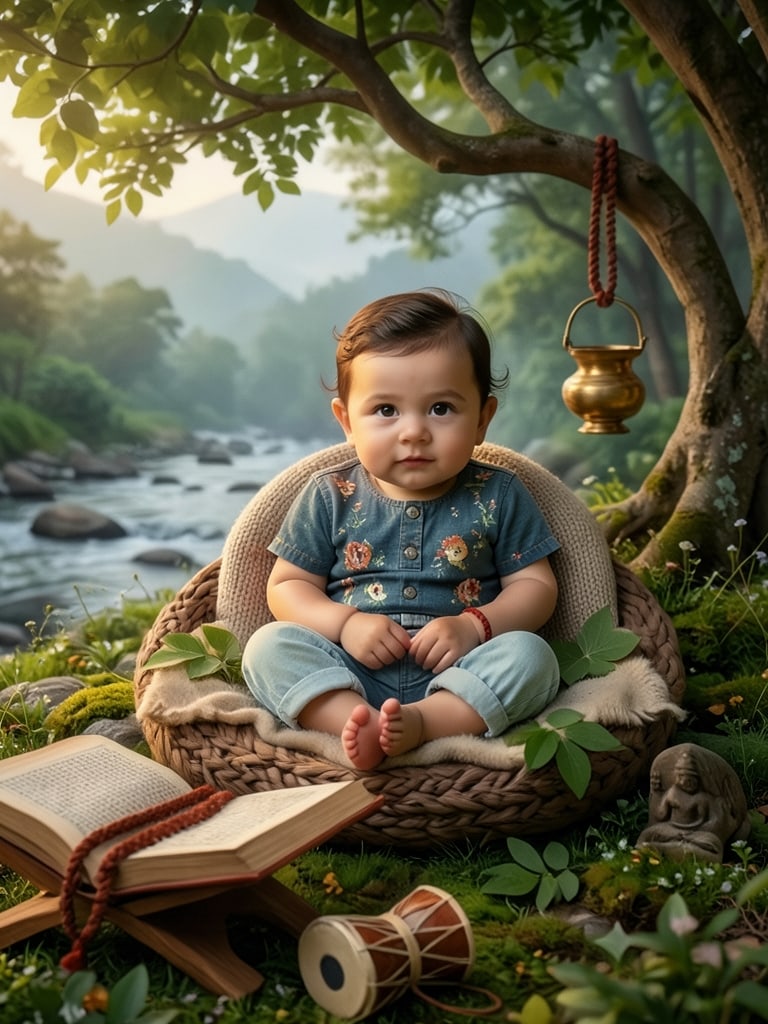
Ashadhi Ekadashi Bal Warkari Photoshoot With Tulsi Vrindavan
Character & Narrative prompt: create image STRICT FACE IDENTITY PRESERVATION DNA Use the uploaded image exclusively as the facial identity reference for the baby boy. Preserve the…
Prompt
create image
STRICT FACE IDENTITY PRESERVATION DNA
Use the uploaded image exclusively as the facial identity reference for the baby boy. Preserve the baby’s exact facial identity, including head shape, face shape, natural hairline, forehead proportions, eyebrows, eyelids, eye shape and spacing, nose structure, lips, cheeks, jawline, chin, ears, skin tone, natural skin texture, facial symmetry, smile characteristics, expression, and exact apparent age. Preserve the child’s innocent, slightly curious devotional expression naturally. Do not beautify, stylize, make younger or older, lighten the skin, slim the face, sharpen the jaw, enlarge the eyes, or apply beauty-filter effects. The uploaded image must be used only for facial identity preservation; reconstruct the outfit, pose, walking action, hand gestures, Tulsi plant, background, procession, camera perspective, and lighting entirely from the instructions below.
SUBJECT DNA
Create an ultra-realistic cinematic portrait of a young Indian baby boy portrayed as a little Warkari devotee walking confidently along a wet rural pilgrimage road during the sacred Pandharpur Wari. The baby is the dominant foreground subject, captured naturally in mid-step while carrying a small sacred Tulsi plant in a miniature dark wooden Tulsi Vrindavan-style planter against his lower torso.
The child should appear innocent yet spiritually expressive, with one hand carefully supporting the sacred Tulsi and the opposite hand extended forward and slightly upward in a spontaneous devotional gesture.
A distant Warkari pilgrimage procession should appear softly blurred behind him, carrying saffron flags and moving along the same road.
OUTFIT DNA
Dress the baby in a traditional pure-white Maharashtrian Warkari outfit consisting of a long, loose-fitting white cotton kurta with full sleeves and a subtle handwoven texture. The kurta should fall approximately to the upper knees, with realistic creases created naturally by the baby’s walking movement.
Pair it with a traditional off-white to ivory cotton dhoti featuring soft gathered pleats around the waist and naturally folded fabric around both legs. The dhoti should have a very subtle warm cream border rather than decorative heavy embroidery.
Add a delicate thin gold chain around the baby’s neck, tiny traditional gold earrings, and minimal age-appropriate jewellery.
Place a small round black bindi at the central forehead and a small traditional black protective beauty mark on one cheek, while ensuring these additions do not modify the baby’s underlying facial identity.
Use simple dark brown or black traditional leather sandals with visible straps and realistic wet-road contact. The footwear must remain proportionate to the baby’s feet.
POSITION DNA
Capture the baby actively walking toward the camera, not standing in a static pose.
The baby’s torso should face almost directly toward the camera with a subtle 5–8 degree rotation caused naturally by the walking motion. Keep the upper body upright with a very slight forward momentum of approximately 4–6 degrees, suggesting the child is confidently progressing along the road.
The baby’s left leg should be the forward leading leg, positioned closer to the camera with the foot moving toward or beginning to contact the wet road surface. The knee should remain naturally slightly flexed.
The right leg should trail approximately 25–35 centimetres behind, with the heel beginning to lift naturally from the ground as the body weight transfers forward.
The hips should display subtle counter-rotation associated with natural walking. Do not create an exaggerated adult runway stride; preserve realistic toddler walking mechanics with a slightly wider stance and shorter step length.
HAND, ARM AND BODY LANGUAGE POSITION DNA
The baby’s left arm should bend naturally across the lower torso, securely holding a miniature Tulsi Vrindavan planter. The left forearm should remain approximately horizontal-to-diagonal, with the elbow positioned close to the side of the body.
The left hand should wrap naturally around the lower side and base of the planter, with all fingers anatomically correct and visibly supporting its weight.
The baby’s right arm should extend forward and slightly upward, with the elbow gently bent rather than locked. Position the right hand approximately at upper-chest to shoulder height and approximately 25–35 centimetres in front of the torso.
Turn the right palm upward and slightly toward the sky. Keep the fingers naturally separated and gently curved, creating a spontaneous devotional gesture resembling a child reaching outward, offering a blessing-like gesture, or joyfully responding to the spiritual procession.
The gesture must remain innocent and childlike rather than formal or theatrical.
TULSI AND RITUAL OBJECT DNA
Place a small sacred Tulsi plant in the baby’s left arm. The Tulsi should grow from a miniature traditional dark brown carved wooden Tulsi Vrindavan-style planter, approximately 18–22 centimetres tall, proportionate to the baby’s torso.
The planter should feature small carved architectural panels and traditional temple-inspired detailing while remaining lightweight and realistically holdable by a toddler.
The Tulsi plant should rise approximately 15–20 centimetres above the planter, with multiple fresh green stems and naturally arranged healthy leaves.
The baby’s left forearm and hand must visibly support the planter from underneath and along one side. The object must have believable physical weight and contact with the child’s body—never floating or loosely attached.
The Tulsi plant symbolizes devotion, purity, and the traditional spiritual identity of the Warkari pilgrimage.
EYE DIRECTION DNA
Direct the baby’s eyes slightly upward and toward camera-left, approximately 10–15 degrees above the camera lens, as though the child is observing something inspiring ahead during the pilgrimage.
Keep the head tilted subtly upward by approximately 5 degrees.
The baby’s expression should combine curiosity, innocence, devotion, and quiet wonder. The mouth may remain gently parted with a subtle natural smile.
CAMERA ANGLE DNA
Photograph the scene from an extremely low near-ground camera position, which is essential to the visual character of the portrait.
Position the camera approximately 15–25 centimetres above the wet road surface, close to the height of the baby’s ankles rather than at adult eye level.
Tilt the camera upward approximately 8–12 degrees, creating a heroic low-angle perspective that makes the small child appear visually prominent against the dramatic sky.
Keep the camera directly ahead of the baby’s walking path but shifted approximately 10–15 centimetres toward camera-right, producing a very subtle three-quarter dimensional perspective.
The low camera position should allow the baby’s approaching front sandal to appear slightly larger through natural perspective while the upper body rises dramatically against the cloudy sky.
CAMERA-TO-SUBJECT DISTANCE DNA
Position the camera approximately 3.0–3.8 metres from the baby at the captured instant.
The baby should occupy approximately 65–72% of the usable vertical frame height, from sandals to the top of the head, while retaining substantial negative space above for typography and dramatic sky.
The closest forward foot should be approximately 2.8–3.4 metres from the camera, while the baby’s face is naturally slightly farther away due to the low upward camera geometry.
Position the distant pilgrimage procession approximately 20–35 metres behind the baby, ensuring strong depth separation and making the child unmistakably dominant in the composition.
LENS DNA
Use a professional full-frame camera with an 85mm lens at approximately f/2.0–f/2.8. Maintain tack-sharp focus on the baby’s eyes and face while retaining sufficient detail across the kurta, Tulsi plant, and forward hand.
Use a shutter speed around 1/800 second to freeze the baby’s walking movement while maintaining crisp facial details.
The road immediately around the baby’s feet should retain visible wet textures, while the distant procession transitions naturally into optical blur.
BOKEH DNA
Create luxurious, creamy, soft background bokeh generated naturally by the distant Warkari procession, saffron flags, vegetation, pilgrimage chariot, and atmospheric landscape.
The distant human figures must remain recognizable only as a devotional procession without individually defined faces.
Saffron flags should appear as softly blurred warm-orange shapes, providing visual contrast against the earthy green landscape and dramatic grey-golden sky.
Maintain exceptionally strong subject isolation around the baby’s face and body while preserving enough environmental context to communicate the Wari pilgrimage.
VISUAL DEPTH DNA
The extreme foreground layer consists of the wet, textured pilgrimage road with tiny puddles, scattered water droplets, darkened gravel, and subtle reflections.
The primary subject layer contains the baby walking toward the camera, sharply rendered with the extended devotional hand, traditional white clothing, and sacred Tulsi plant.
The secondary layer contains the continuation of the road immediately behind the baby and low roadside vegetation.
The background layer contains the distant Warkari procession, a traditional decorated palanquin or pilgrimage structure, multiple devotees dressed predominantly in white, and several saffron flags rising above the crowd.
The atmospheric layer contains dramatic monsoon clouds, warm diffused sunlight, distant haze, and subtle golden illumination breaking through the clouds.
ENVIRONMENT DNA
Set the scene on a narrow rural pilgrimage road in Maharashtra during the monsoon season. The road should appear freshly wet after rain, with realistic darkened soil, gravel texture, tiny puddles, and subtle reflections.
Dense natural green shrubs and trees should line both sides of the road, gradually fading into atmospheric depth.
Behind the child, include a distant traditional Warkari procession approaching along the road. Show softly blurred devotees predominantly dressed in white traditional clothing, several prominent saffron flags, and a partially visible decorated pilgrimage palanquin or chariot-like structure.
Avoid modern vehicles, electrical signage, urban buildings, or contemporary distractions.
LIGHTING DNA
Use dramatic late-afternoon monsoon lighting with a warm golden light source breaking through heavy clouds from the upper-right background.
The baby’s face should receive soft, warm frontal illumination with natural skin rendering and clearly visible facial identity.
Create a delicate golden rim light along the right side of the baby’s hair, shoulder, extended hand, Tulsi leaves, and edges of the white kurta.
The white clothing should retain detailed fabric texture and tonal separation rather than becoming overexposed.
Allow warm sunlight to illuminate portions of the distant procession and saffron flags while keeping the surrounding monsoon clouds darker and moodier.
Create subtle reflections of the warm sky and baby’s feet on the wet road surface.
STORYTELLING DNA
The image should tell the story of “बाल वारकरी — इवलासा वारकरी, मोठी भक्ती”, portraying a tiny Warkari carrying devotion far greater than his physical size.
The baby’s forward walking movement symbolizes the spiritual journey toward Pandharpur. The sacred Tulsi carried close to his heart represents purity and devotion, while the small upward-facing hand expresses innocent surrender, joy, and connection with Vitthal.
The distant procession establishes that the child is part of a much larger centuries-old devotional tradition, while the low camera angle elevates the small devotee into the emotional hero of the photograph.
The overall mood should combine childhood innocence, Maharashtrian cultural identity, monsoon atmosphere, pilgrimage, and deep Vitthal devotion.
TYPOGRAPHY DNA
Reserve substantial clean negative space in the upper centr
Placeholders: [बाल वारकरी]
How to use
Replace [बाल वारकरी] with your own subject, then paste the prompt into Runway. Keep the lighting, lens and style section intact — that is what gives the look.
Use case
Character & Narrative — baby, approximately
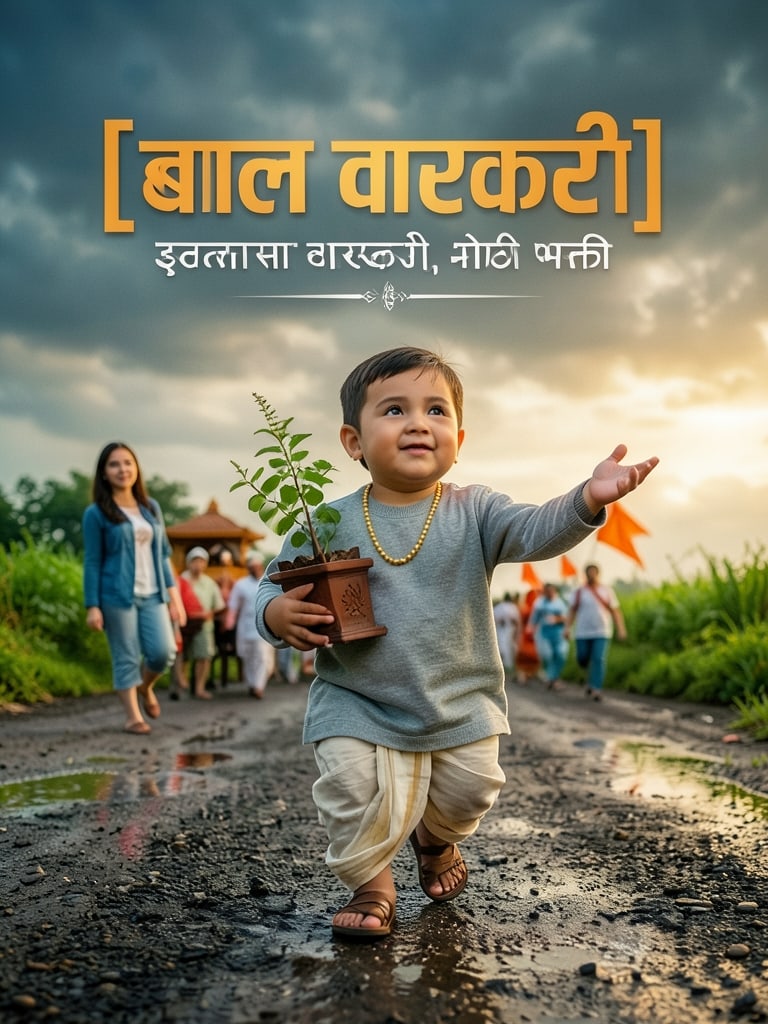 image / ChatGPT
Studio tools
AI Optimizer
Improve, shorten, expand or retarget this prompt for another image or video model. Every result is saved as a new version — the original is never overwritten.
Improve prompt
Produces optimized, concise, detailed, beginner and model-specific versions.
Generate variations
Professional, creative, cinematic, minimal and advanced.
Prompt history
- v1 · Original1 day ago