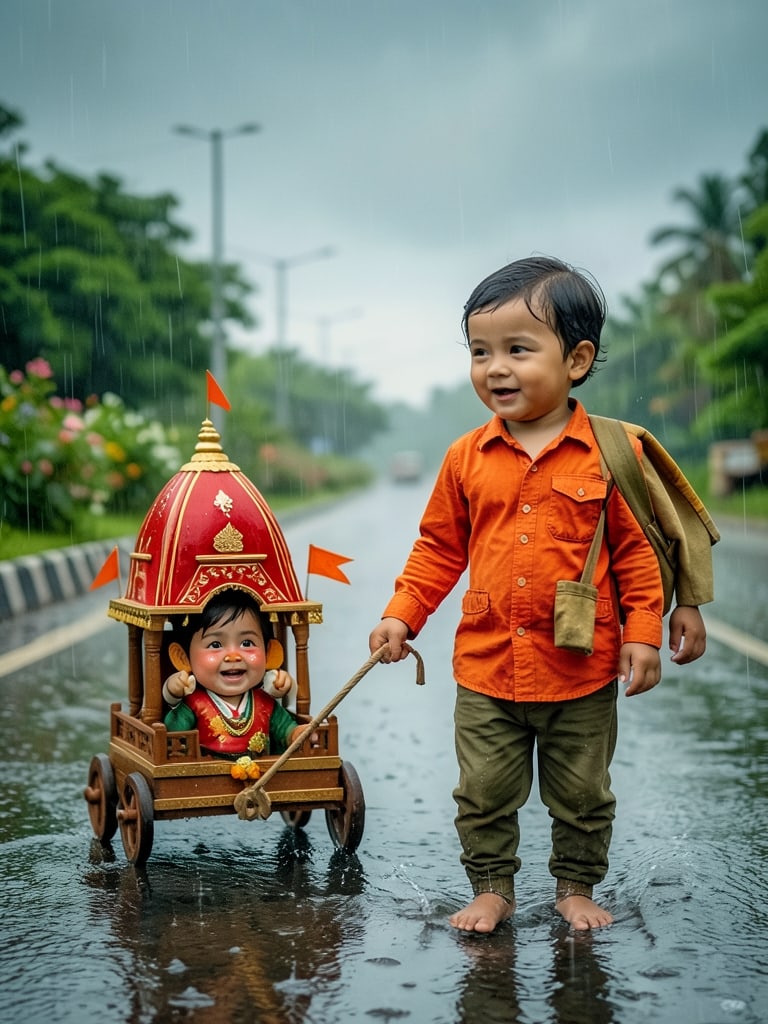
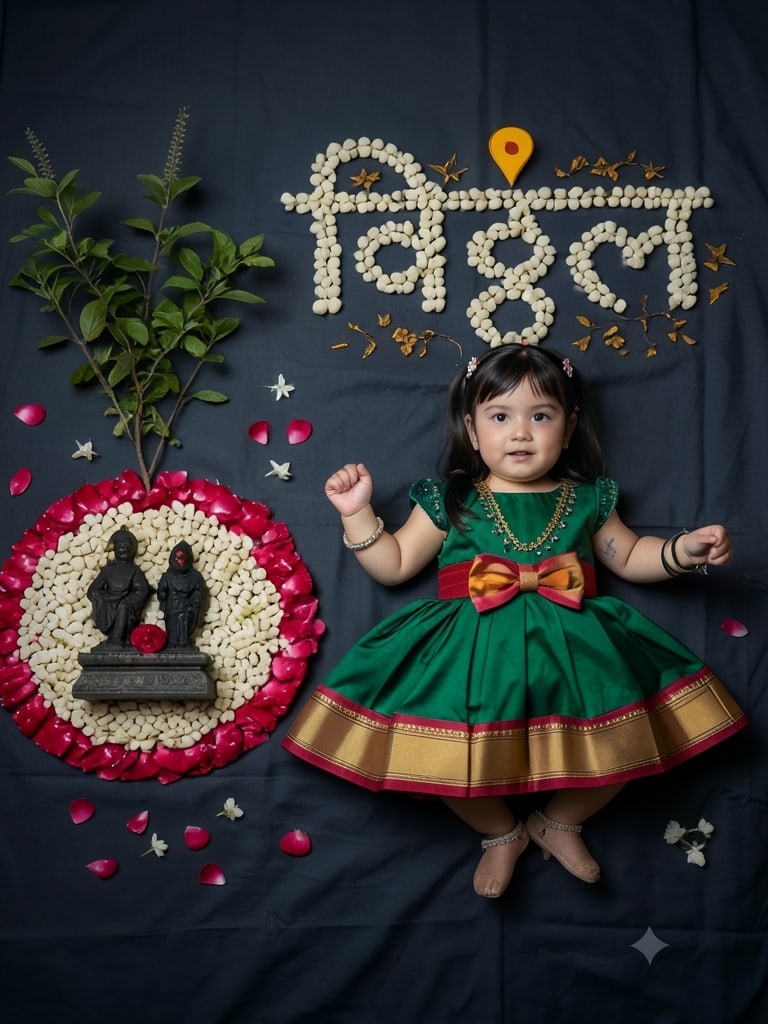
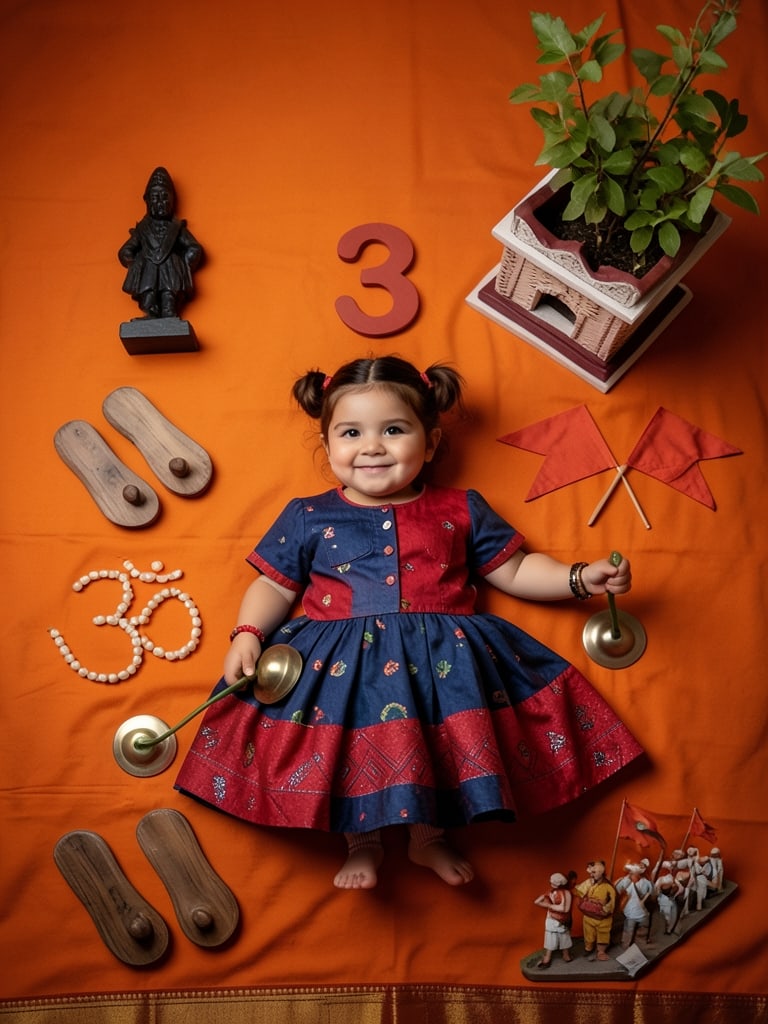
Ashadhi Ekadashi Girl Photoshoot with Vitthal Rakhumai Devotional Flat Lay Theme
Portrait Photography prompt: create image STRICT FACE IDENTITY PRESERVATION DNA Use the uploaded image exclusively as the facial identity reference for the baby. Preserve the…
Prompt
create image
STRICT FACE IDENTITY PRESERVATION DNA
Use the uploaded image exclusively as the facial identity reference for the baby. Preserve the exact facial identity, including the head shape, forehead proportions, hairline, eyebrows, eyelids, eye spacing, eye shape, nose structure, cheeks, lips, jawline, chin, ears, skin tone, skin texture, facial symmetry, and apparent age. Preserve the baby’s calm expression, gentle eyes, soft facial proportions, and natural infant features exactly as shown. Do not beautify, stylize, enlarge the eyes, sharpen facial contours, modify complexion, alter age, or apply beauty-filter effects. The uploaded image serves only as the facial identity reference while every costume, devotional object, typography, and environment is reconstructed entirely through descriptive instructions.

SUBJECT DNA
Create an ultra-realistic premium devotional Ashadhi Ekadashi flat-lay baby photoshoot inspired by the sacred Warkari tradition of Pandharpur. The baby lies peacefully on a beautifully draped saffron devotional fabric, becoming the centre of a carefully designed spiritual artwork. Every surrounding devotional element should celebrate Lord Vitthal, the Pandharpur pilgrimage, Tulsi worship, and the spiritual atmosphere of Ashadhi Ekadashi while maintaining luxury fine-art realism.

OUTFIT DNA
Dress the baby in a traditional Maharashtrian festive outfit consisting of a rich crimson-red Paithani-style infant frock with realistic silk texture, natural pleats, and authentic woven craftsmanship. The lower border should feature luxurious antique gold zari weaving framed with vibrant emerald-green edging. The waist sash wraps diagonally across the baby’s torso with realistic layered folds and subtle fabric tension. The sleeves remain short and softly gathered, while the skirt spreads naturally beneath the baby with realistic radial fabric flow. Add tiny traditional black bangles on both wrists, delicate gold earrings, and a small traditional black bindi centred above the eyebrows.

RITUAL OBJECT DNA
Construct a complete Ashadhi Ekadashi devotional arrangement surrounding the baby. Position handcrafted black stone idols of Lord Vitthal and Goddess Rukmini upon a rustic dark wooden pedestal placed along the lower-left corner of the composition. The idols should display authentic basalt stone texture, naturally polished devotional wear, sacred ornaments, and realistic sculptural proportions.
Position a beautifully handcrafted Tulsi Vrindavan near the upper-right area featuring carved stone detailing, traditional decorative painting, and a healthy green Tulsi plant emerging naturally from the centre.
Arrange a traditional saffron Warkari flag near the upper-left portion with realistic folded cotton fabric and naturally flowing geometry. Add subtle miniature Tulsi leaves, scattered marigold petals, and faint rangoli-inspired motifs woven into the fabric folds rather than appearing separately placed.

POSITION DNA
The baby lies diagonally across the lower-right portion of the composition with the head positioned slightly above the body’s centreline. Approximately ninety-eight percent of the body weight rests naturally against the soft saffron fabric. The spine follows its natural infant curvature while the torso rotates approximately twelve degrees toward camera-left. The pelvis remains relaxed with one leg softly extended and the opposite leg gently bent at the knee, creating realistic infant body mechanics. The shoulders remain completely relaxed while the head turns approximately eight degrees toward camera-left, maintaining a naturally peaceful expression.

HAND POSITION DNA
The baby’s right arm extends gently away from the torso with the elbow softly flexed and the palm remaining naturally open. The fingers display authentic infant relaxation with gentle curvature rather than deliberate posing. The left forearm rests comfortably beside the body with the wrist relaxed and the tiny fingers softly curled inward. Every joint should remain anatomically correct, preserving complete infant realism.

BODY LANGUAGE DNA
The entire posture should communicate peaceful innocence and devotional purity. The baby should appear completely relaxed as though peacefully resting within the sacred Ashadhi Ekadashi celebration. Every limb remains naturally positioned without visible muscular tension, allowing the flowing dress and devotional surroundings to reinforce the feeling of serenity.

EYE DIRECTION DNA
The baby looks gently upward toward the overhead camera with a calm, peaceful expression. The eyes remain naturally open with soft catchlights while maintaining complete infant innocence. The gaze should establish immediate emotional connection with the viewer.

CAMERA DNA
Position the camera exactly perpendicular to the floor in a perfectly vertical 90-degree overhead flat-lay orientation. The sensor remains perfectly parallel with the devotional setup, eliminating all perspective distortion. The camera should be mounted approximately 2.4 metres above the surface, ensuring the entire devotional arrangement remains visible while preserving natural proportions throughout the composition.

CAMERA POSITION DNA
Align the camera precisely above the geometric centre of the saffron devotional arrangement. The optical axis intersects the midpoint between the baby and the surrounding devotional composition, ensuring every ritual object remains proportionally balanced. Maintain zero horizontal deviation and absolute overhead symmetry throughout the frame.

CAMERA DISTANCE DNA
Photograph using a professional full-frame camera equipped with a 50mm premium macro prime lens from approximately 2.4 metres above the setup. This focal length preserves perfect flat-lay geometry without wide-angle distortion while maintaining exceptional sharpness across the complete devotional arrangement.

CAMERA ELEVATION RELATIONSHIP DNA
The perfectly overhead camera transforms the composition into sacred devotional artwork rather than conventional portrait photography. Every object maintains its true geometric relationship while the baby becomes the central visual offering surrounded by carefully balanced symbols of the Warkari tradition.

LENS DNA
Photograph using a professional full-frame camera fitted with a 50mm macro prime lens at f/5.6. This aperture ensures complete edge-to-edge sharpness across the baby, fabric, devotional objects, typography, and surrounding ceremonial elements while preserving realistic optical rendering.

LIGHTING DNA
Illuminate the flat-lay using two oversized overhead softboxes positioned symmetrically on both sides of the setup. The lighting should remain completely diffused, eliminating harsh directional shadows while preserving delicate textile texture and realistic fabric depth. Gentle overhead fill creates smooth tonal transitions throughout the saffron backdrop, allowing every devotional object to appear naturally illuminated with premium studio quality.

BOKEH DNA
Flat-lay photography intentionally minimizes optical blur. Maintain uniform sharpness throughout the entire devotional arrangement while introducing only extremely subtle edge fall-off beyond the outer decorative elements. Every principal devotional object should remain clearly resolved without distracting depth variation.

VISUAL DEPTH DNA
The foreground begins with the richly textured saffron devotional fabric displaying natural woven texture, subtle folds, and realistic textile depth. The primary subject layer consists of the baby rendered with pore-level skin detail, authentic silk Paithani fabric simulation, delicate jewellery, and physically accurate infant anatomy. The secondary layer includes the Vitthal-Rukmini idols, Tulsi Vrindavan, saffron flag, and ceremonial elements positioned with balanced spatial relationships. The final layer consists of subtle woven devotional patterns integrated into the backdrop, preserving visual richness while maintaining complete flat-lay harmony.

ENVIRONMENT DNA
Construct a premium fine-art devotional flat-lay studio environment where the saffron backdrop becomes a sacred ceremonial canvas. The fabric should display luxurious handwoven texture with graceful flowing folds extending naturally across the frame. Every devotional object should appear thoughtfully arranged according to traditional Warkari symbolism, creating the feeling of a sacred offering prepared for Ashadhi Ekadashi.

STORYTELLING DNA
The portrait should celebrate Ashadhi Ekadashi, one of the most sacred festivals dedicated to Lord Vitthal. The baby represents the youngest devotee, peacefully resting within a symbolic pilgrimage created through devotion, Tulsi worship, saffron colours, and the divine presence of Vitthal-Rukmini. The surrounding elements tell the story of generations passing faith from one child to the next. Rather than simply documenting a baby photoshoot, the image should become a timeless devotional artwork celebrating the spiritual heart of Pandharpur.

TYPOGRAPHY DNA
Reserve the upper portion of the composition for elegant Marathi devotional typography. Position “॥ पंढरपूर ॥” in refined white Devanagari calligraphy toward the upper-left corner, incorporating a small saffron Vaishnav tilak above the lettering. Directly beneath, place “आषाढी एकादशी” in larger premium white Marathi typography with balanced spacing and devotional hierarchy. The typography should integrate naturally into the composition without overlapping the baby or ceremonial objects.

COMPOSITION DNA
Construct the composition using classic fine-art flat-lay balance where the baby occupies the lower-right visual quadrant while the Vitthal-Rukmini idols anchor the lower-left corner. The Tulsi Vrindavan balances the upper-right region, while the Marathi typography fills the upper-left, creating harmonious visual equilibrium. The flowing saffron fabric connects every devotional element, guiding the viewer naturally toward the baby before expanding outward through the sacred symbols. Every object, fabric fold, colour relationship, and spatial rhythm should contribute to a museum-quality Ashadhi Ekadashi devotional masterpiece.

FINAL OUTPUT
Create an ultra-realistic premium Ashadhi Ekadashi devotional flat-lay baby portrait in 4K Ultra HD, photographed with a professional full-frame camera using a 50mm macro prime lens at f/5.6, featuring physically accurate optics, authentic silk Paithani textures, handwoven saffron fabric, realistic black stone Vitthal-Rukmini idols, premium Tulsi Vrindavan craftsmanship, elegant Marathi devotional typography, museum-quality flat-lay composition, exceptional edge-to-edge sharpness, emotionally immersive storytelling, and a 9:16 vertical composition.
How to use
Paste the prompt into Midjourney. Swap the subject and keep the lighting, lens and style details for a consistent look.
Use case
Portrait Photography — devotional, baby
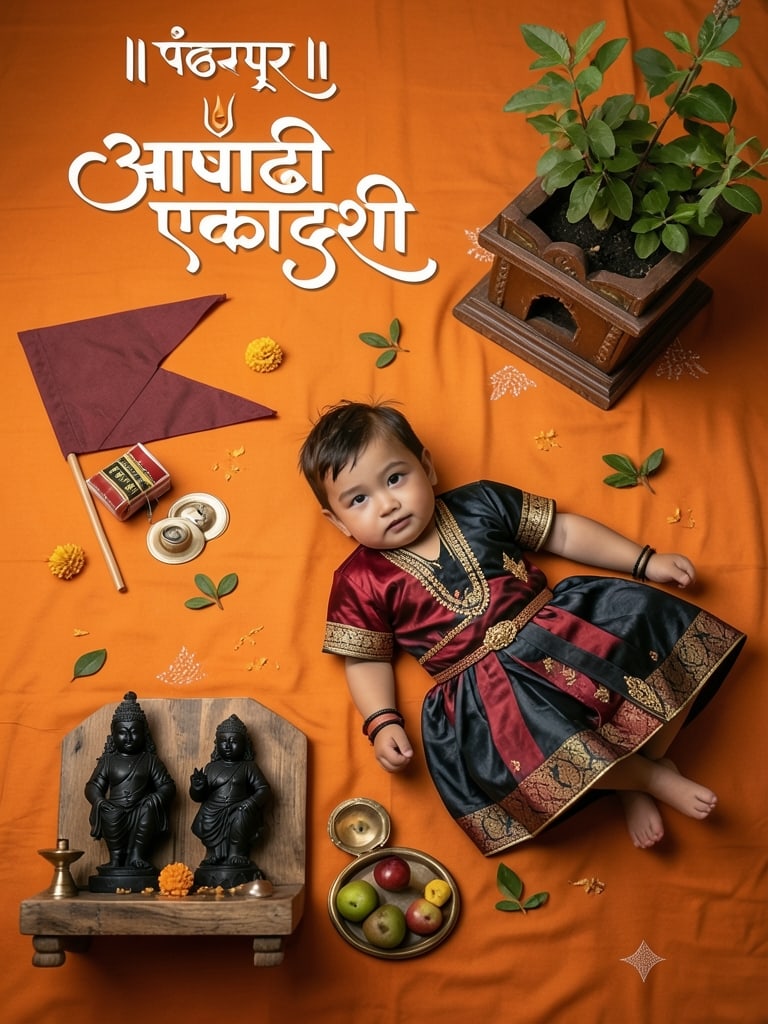 image / ChatGPT
Studio tools
AI Optimizer
Improve, shorten, expand or retarget this prompt for another image or video model. Every result is saved as a new version — the original is never overwritten.
Improve prompt
Produces optimized, concise, detailed, beginner and model-specific versions.
Generate variations
Professional, creative, cinematic, minimal and advanced.
Prompt history
- v1 · Original1 day ago