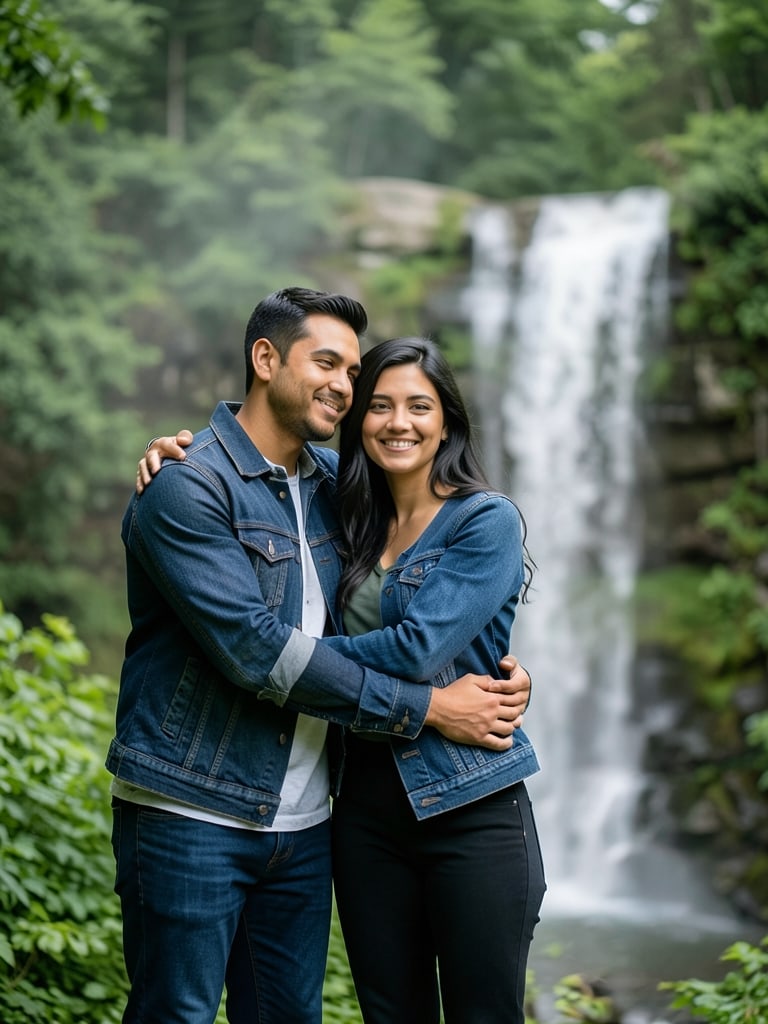
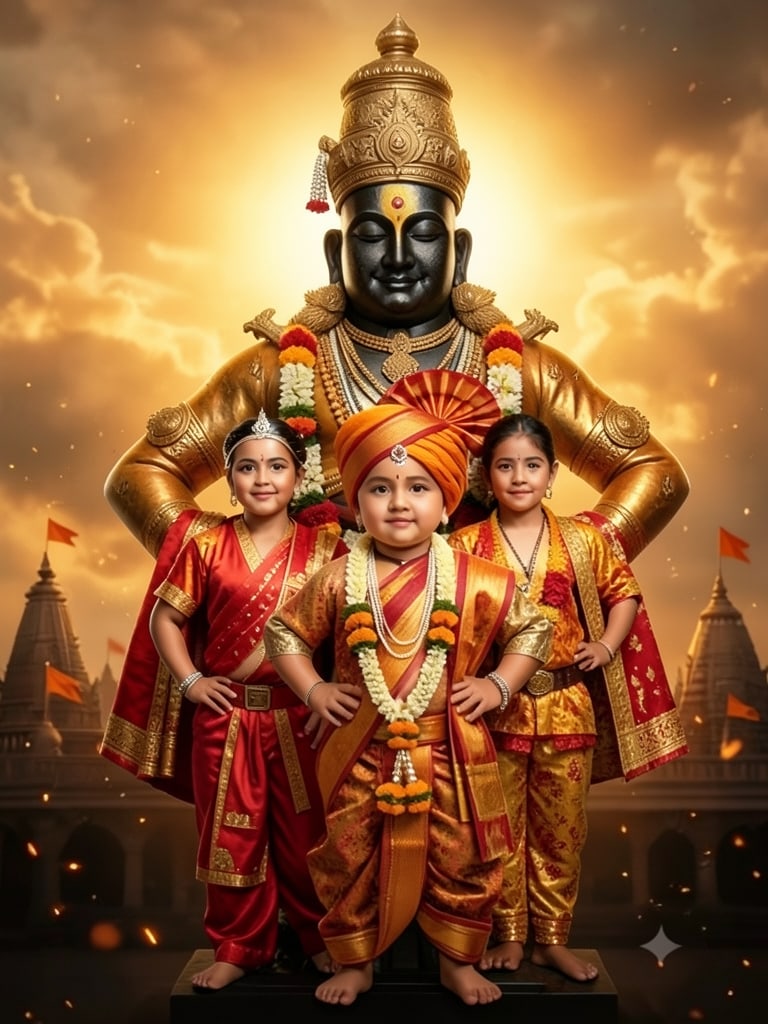
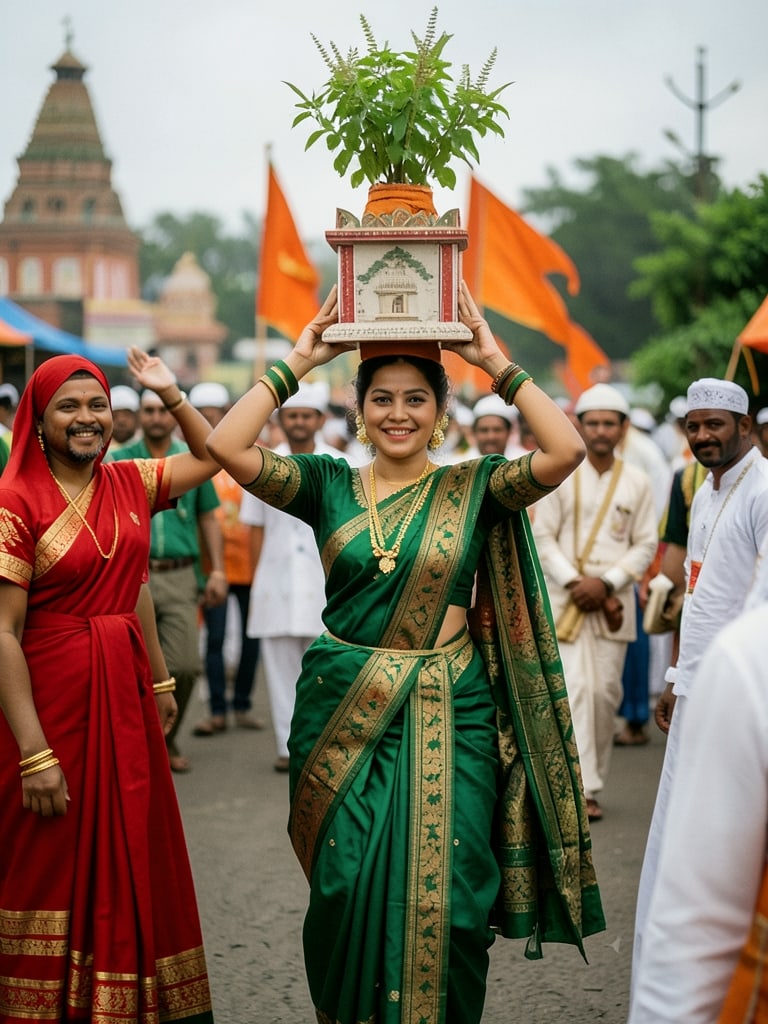
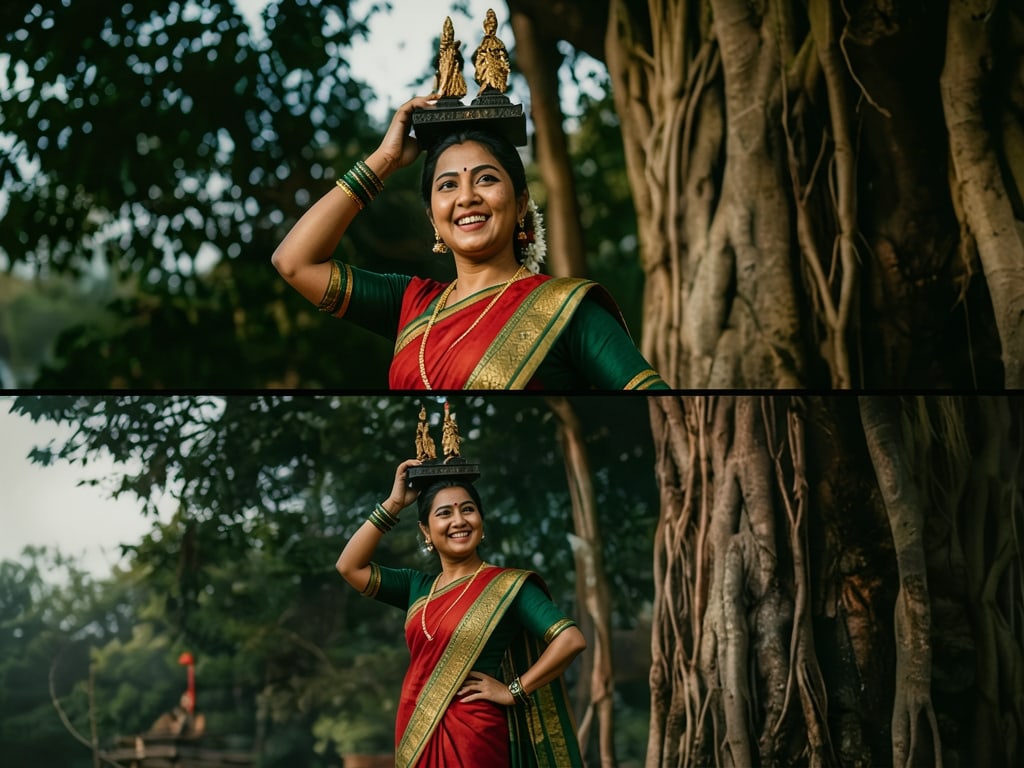
Ashadhi Ekadashi Women Photoshoot with Lord Vitthal Temple Theme
Portrait Photography prompt: create image STRICT FACE IDENTITY PRESERVATION DNA Use the uploaded image exclusively as the facial identity reference for the woman. Preserve her…
Prompt
create image
STRICT FACE IDENTITY PRESERVATION DNA
Use the uploaded image exclusively as the facial identity reference for the woman. Preserve her exact facial identity, including head shape, forehead proportions, natural hairline, eyebrow shape, eyelids, eye size and spacing, nose bridge and structure, lips, cheeks, jawline, chin, ears, skin tone, natural skin texture, facial symmetry, smile characteristics, expression, and apparent age. Do not beautify, stylize, reshape, slim, age, or modify any facial feature. The uploaded image must be used only for exact facial identity preservation. Reconstruct the outfit, hairstyle arrangement, jewellery, body pose, Lord Vitthal statue, temple environment, lighting, camera perspective, and overall composition entirely from the detailed instructions below.
SUBJECT AND CONCEPT DNA
Create an ultra-realistic devotional cinematic portrait of a young Maharashtrian woman standing confidently on a narrow ancient stone temple pathway, with a monumental black-stone statue of Lord Vitthal rising directly behind her. The woman should be the primary human subject in the foreground, while the enormous Vitthal statue creates a powerful spiritual presence immediately behind her.
The visual story should represent devotion to Lord Vitthal and the sacred atmosphere of Pandharpur. Create a majestic yet believable photographic scene where warm golden sunrise light radiates from directly behind the crown and head of the Vitthal statue, producing naturally visible volumetric sun rays. Ancient temple architecture, saffron devotional flags, lush pathway vegetation, and warm morning haze should extend into the background.
OUTFIT DNA
Dress the woman in an authentic traditional deep wine-red to rich maroon Maharashtrian silk saree. The saree should feature a broad antique-gold zari border with intricate traditional woven motifs and subtle fine red detailing.
Drape the saree in an elegant traditional Maharashtrian-inspired style, fitted neatly around the waist and hips while allowing realistic pleats to descend vertically toward the lower body. The pallu should cross diagonally from the lower waist across the torso and over the left shoulder, creating a clearly visible broad golden zari border.
Pair the saree with a fitted short-sleeved deep maroon blouse featuring broad antique-gold woven sleeve borders.
The fabric should display realistic silk weight, fine weave, natural folds, slight compression around the waist, subtle highlights from the sunrise, and physically accurate draping. Avoid artificial plastic-like fabric or excessively saturated red.
JEWELLERY AND CULTURAL STYLING DNA
Style the woman with elegant traditional Maharashtrian gold jewellery. Add a long layered gold necklace descending toward the upper abdomen with a prominent traditional pendant, complemented by a shorter delicate gold chain near the neckline.
Add traditional gold earrings, subtle gold rings, and a delicate traditional gold waist belt encircling the saree at the natural waist.
Place multiple dark green glass bangles on both wrists, arranged densely but naturally, with a few subtle gold bangles mixed between them.
Keep the jewellery culturally authentic and refined rather than excessively bridal.
Her hair should be long, thick, dark, and naturally wavy, styled with a deep side part. Sweep most of the hair over her right shoulder so that soft waves descend across the right side of her chest. Keep the opposite side relatively open to reveal the jewellery and saree drape.
EXACT BODY POSITION AND STANCE DNA
Position the woman centrally in the lower-middle foreground, with the center of her body approximately 48–50% across the image width.
Her body should face almost directly toward the camera with only a subtle 5-degree rotation toward camera-left.
She should stand upright with confident but relaxed posture. Keep the spine straight, shoulders gently pulled back, and chest naturally open.
Place both hands firmly but gracefully on the waist, creating a symmetrical confident stance.
Her elbows should extend diagonally outward on both sides, approximately 30–40 degrees away from the torso, creating a strong triangular body silhouette.
Position her right hand against the right side of her waist with fingers naturally spread and gently curved. Mirror the posture with her left hand resting on the opposite waist.
The hands should not appear stiff or clenched. Maintain anatomically accurate fingers and wrists.
Keep the hips naturally balanced with a very subtle weight shift toward one leg rather than an exaggerated fashion pose.
HEAD, FACE, GAZE AND EXPRESSION DNA
Keep the woman’s head nearly upright with a subtle 5–8 degree tilt toward her right shoulder.
Her face should turn directly toward the camera.
Her eyes should establish clear, warm eye contact with the camera.
Preserve a broad, genuine, joyful smile matching her exact facial identity and natural smile characteristics.
The expression should communicate happiness, devotion, confidence, and warmth without appearing exaggerated or artificially posed.
LORD VITTHAL STATUE DNA
Create a monumental, highly detailed traditional black-stone statue of Lord Vitthal positioned directly behind the woman.
The statue should rise approximately 2.5–3 times the visible height of the woman, creating a powerful sense of spiritual scale.
Lord Vitthal must stand in the iconic traditional pose with both arms bent outward and hands firmly positioned at the waist.
Create a tall, intricately carved cylindrical crown with authentic temple-sculpture detailing.
Place the distinctive bright yellow-orange Vaishnav devotional tilak prominently at the center of the statue’s forehead.
The statue should have authentic dark black basalt or polished black-stone texture with subtle weathering and finely carved jewellery, necklaces, arm ornaments, shoulder decorations, and traditional sculptural garments.
Position the statue directly behind the woman but offset its torso slightly toward camera-left so that the woman’s head does not completely obscure the statue’s face.
The statue’s head and crown should remain completely visible above the woman’s head.
The woman’s head should overlap only the lower central torso region of the statue, preserving clear recognition of Lord Vitthal.
SCALE AND SPATIAL RELATIONSHIP DNA
The woman should occupy approximately 55–65% of the total image height, extending from near the bottom edge toward the middle-upper region.
The Vitthal statue should begin behind her at ground level but extend dramatically upward, with the crown reaching approximately 8–12% below the top edge.
Create enough physical separation between the woman and statue to preserve realistic depth. The woman should stand approximately 3–4 metres in front of the statue.
Despite this separation, use telephoto compression so the statue appears visually close and imposing behind her.
The woman remains the sharpest foreground subject, while the statue should retain substantial detail and recognizable facial and sculptural features.
TEMPLE PATHWAY DNA
Place the woman on an old narrow stone-paved pathway leading through a sacred temple environment.
The pathway should begin at the bottom center of the frame and extend behind the woman toward the temple complex.
Create irregular rectangular stone paving with subtle age, weathering, fine cracks, and a slightly damp surface that reflects small amounts of warm golden sunlight.
The path should feel authentic, ancient, and naturally used rather than perfectly constructed.
Add low green shrubs and leafy vegetation along both edges of the pathway, particularly visible in the lower-right foreground.
Keep the vegetation naturally irregular and softly illuminated by the golden morning light.
TEMPLE ARCHITECTURE DNA
Create a series of ancient dark-stone Maharashtrian temple structures receding into the background, particularly along the right side of the frame.
The temples should feature tall traditional shikhara towers with layered stone carvings and authentic weathered architectural surfaces.
The nearest temple tower should be visible behind the right shoulder region of the Vitthal statue, with additional temple silhouettes progressively fading into atmospheric haze.
Avoid fantasy palace architecture. The structures should resemble historically grounded Indian temple architecture associated with Maharashtra and the devotional atmosphere of Pandharpur.
SAFFRON FLAG DNA
Place several saffron-orange triangular devotional flags throughout the middle and distant background.
Mount the flags on slender poles positioned along the temple pathway and around the temple structures.
Allow the flags to flutter gently in a light morning breeze.
Keep the flags relatively small and secondary within the composition. Their saturated saffron tone should create subtle warm accents against the stone architecture and golden atmospheric haze.
SUNRISE AND BACKLIGHT DNA
Position the rising sun directly behind the upper head and crown of the Lord Vitthal statue.
Create intense but natural warm golden sunrise illumination forming a radiant halo around the crown.
Generate multiple visible volumetric sun rays spreading upward and diagonally outward from behind the statue’s head, producing a symmetrical spiritual radiance without looking like artificial graphic lines.
The brightest light should remain concentrated behind the statue rather than directly overexposing the woman’s face.
Create warm golden rim lighting along the statue’s crown, shoulders, and carved edges.
Add subtle warm rim light along the woman’s hair, shoulders, and saree borders.
Use soft frontal fill illumination on the woman’s face so her facial identity remains perfectly visible despite the strong backlight.
ATMOSPHERIC DNA
Create a warm early-morning atmosphere with delicate golden mist suspended throughout the temple pathway.
The distant architecture should gradually soften into atmospheric perspective.
Add extremely subtle floating dust particles illuminated by the sunlight.
The environment should feel sacred and cinematic while remaining photorealistic.
Avoid excessive fantasy effects, glowing particles, fire, supernatural flames, or unrealistic celestial imagery.
CAMERA ANGLE DNA
Photograph from approximately the woman’s mid-torso to upper-waist height, positioning the camera approximately 100–115 centimetres above the pathway surface.
Use a very subtle low-angle perspective of approximately 3–5 degrees upward, allowing both the woman and monumental Vitthal statue to appear commanding while maintaining natural human proportions.
Keep the camera horizontally centered with the woman.
Do not use an extreme ground-level angle and do not use a high-angle perspective.
Maintain straight architectural verticals and realistic perspective.
CAMERA-TO-SUBJECT DISTANCE DNA
Position the camera approximately 6–8 metres from the woman.
This distance should create a three-quarter to nearly full-body environmental portrait while retaining sufficient surrounding temple context.
The woman should remain prominently framed but should not become an extreme close-up.
Position the Vitthal statue approximately 3–4 metres behind the woman, making the total camera-to-statue distance approximately 9–12 metres.
Use optical compression to visually connect the woman and statue while preserving genuine physical depth.
LENS AND DEPTH OF FIELD DNA
Use a professional full-frame camera with an approximately 70–85mm portrait telephoto lens.
Photograph at approximately f/4–f/5.6, ISO 100–200, and a shutter speed suitable for sharp handheld portrait photography.
Keep the woman’s face, body, jewellery, and saree sharply focused.
Maintain the Lord Vitthal statue in moderately sharp focus so its face, crown, iconic pose, and forehead tilak remain clearly recognizable.
Allow the distant temple towers, saffron flags, and vegetation to transition gradually into soft atmospheric blur.
Avoid extreme shallow depth of field that would erase important d
How to use
Paste the prompt into Midjourney. Swap the subject and keep the lighting, lens and style details for a consistent look.
Use case
Portrait Photography — statue, woman
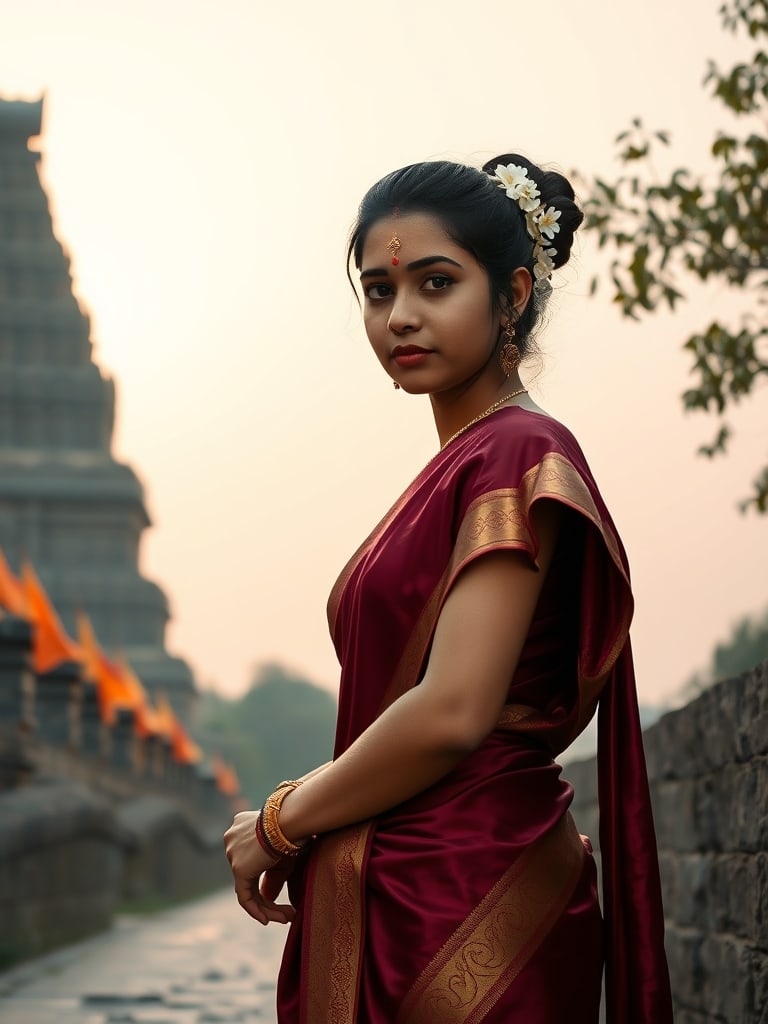 image / ChatGPT
Studio tools
AI Optimizer
Improve, shorten, expand or retarget this prompt for another image or video model. Every result is saved as a new version — the original is never overwritten.
Improve prompt
Produces optimized, concise, detailed, beginner and model-specific versions.
Generate variations
Professional, creative, cinematic, minimal and advanced.
Prompt history
- v1 · Original1 day ago