Couple Eye AI Prompt for Romantic Golden Hour Close-Up Portrait
Portrait Photography prompt: create image STRICT FACE IDENTITY PRESERVATION DNA Use the uploaded image exclusively as the facial identity reference for both individuals: the woman…
Prompt
create image
STRICT FACE IDENTITY PRESERVATION DNA
Use the uploaded image exclusively as the facial identity reference for both individuals: the woman positioned on the left side and the man positioned on the right side. Preserve each person’s exact facial identity independently, including their natural head shape, forehead proportions, hairline, eyebrow shape and density, eyelids, exact eye shape and spacing, iris appearance and natural iris color, nose bridge and structure, lips, cheeks, jawline, chin, visible skin tone, natural skin texture, facial symmetry, expression characteristics, and apparent age. For the man, also preserve his exact natural moustache and beard growth pattern, density, placement, and texture if visible in the identity reference. Do not beautify, reshape, slim, age, stylize, merge, average, or interchange their facial characteristics. Do not change either person’s natural eye color to match the scene. The uploaded image must be used only for exact facial identity preservation; reconstruct the extreme-close pose, hair movement, foreground flowers, lighting, framing, camera distance, and cinematic atmosphere entirely from the detailed instructions below.
CONCEPT AND EMOTIONAL DNA
Create an ultra-realistic cinematic extreme-close-up romantic portrait focused primarily on the couple’s eyes, eyebrows, upper cheeks, and noses. The couple should be positioned extraordinarily close together, creating an intimate composition where their faces nearly meet along the central vertical axis. The emotional atmosphere should feel warm, dreamy, private, and quietly romantic, as though they are hiding together behind delicate dried flowers during golden-hour sunlight. Their expressions should remain subtle and contemplative rather than smiling broadly, allowing their eyes and physical proximity to communicate the emotional connection.
WOMAN POSITION AND BODY LANGUAGE DNA
Position the woman on the left side of the frame, marginally closer to the camera than the man. Her face should fill approximately 43–47% of the total image width, extending beyond the left and bottom boundaries because of the extreme-close crop.
Her head should remain almost upright with a subtle 3–6 degree tilt toward camera-right, gently leaning toward the man. Rotate her face approximately 5–8 degrees toward camera-right, creating a very slight three-quarter orientation while keeping both eyes visible.
Her eyes should look toward camera-left, away from the man and slightly beyond the lens, producing a thoughtful sideways gaze. The pupils should sit naturally toward the left side of her visible irises without an exaggerated eye turn.
Her eyebrows, both eyes, upper and lower eyelids, nose bridge, complete nose, upper cheeks, and a small portion of the area above her upper lip should remain visible. Crop the lower part of her face before the full mouth and chin become prominent.
Her expression should be calm, intimate, and quietly observant, with naturally relaxed facial muscles.
MAN POSITION AND BODY LANGUAGE DNA
Position the man on the right side of the composition, immediately beside the woman, with his face occupying approximately 43–47% of the image width. His outer right temple, ear, and part of the right side of his face should extend beyond the right frame boundary.
Keep his head almost upright but tilted approximately 3–5 degrees toward camera-left, subtly leaning toward the woman. Rotate his face approximately 5–10 degrees toward camera-left, bringing the inner sides of their faces closer together.
Direct the man’s eyes toward camera-right, creating an opposite sideways gaze from the woman. His pupils should naturally shift toward the right side of his irises while preserving his exact eye anatomy and natural eye color.
Show both of his eyes, eyebrows, forehead, nose bridge, complete nose, upper cheeks, and only the upper portion of his moustache and facial-hair region. The lower mouth, chin, and most of the jaw should extend naturally beyond the bottom edge.
His expression should remain calm, serious, and contemplative.
FACE-TO-FACE SPATIAL RELATIONSHIP DNA
Position the couple with only approximately 2–5 centimetres of real physical separation between their closest facial planes. Their inner forehead and temple regions should nearly touch around the central upper portion of the composition.
The woman’s right eye and the man’s left eye should sit close to the central vertical axis, separated visually by only a narrow shadowed region created by their noses and facial depth.
Their faces should overlap slightly in perspective without physically merging. Preserve clear anatomical boundaries between the two individuals.
Align their eyes at approximately the same vertical level, with the man’s eyes positioned no more than 1–3% of the frame height higher than the woman’s.
HAIR MOVEMENT DNA
Style the woman’s dark hair naturally loose, with several thin strands moving horizontally and diagonally across her face. One prominent group of fine hair strands should sweep from the far left across her lower eye and upper-cheek region, continuing toward the bridge of her nose.
Additional loose strands should curve naturally across her forehead near the hairline.
The hair movement should feel caused by a very gentle breeze, with realistic individual strands, natural irregularities, and subtle golden rim highlights.
The man’s dark hair should appear naturally tousled, with several loose wavy strands falling downward across the upper forehead. Preserve realistic hair density, individual strands, and natural texture.
Do not allow hair to obscure either person’s eyes excessively.
FOREGROUND DRIED FLOWER DNA
Place delicate cream-white dried flowers and thin beige stems extremely close to the camera lens, primarily along the right foreground and lower-central foreground.
The flowers should remain heavily out of focus because they are positioned significantly closer to the lens than the subjects. They should create soft organic cream and golden bokeh shapes that partially overlap the man’s outer cheek, lower nose region, and lower-right portion of the frame.
A smaller blurred floral element may enter near the upper-right corner.
Do not allow the flowers to completely cover either person’s eyes. Their purpose is to create natural depth, visual softness, and romantic foreground framing.
CAMERA ANGLE DNA
Position the camera directly in front of the couple at exact eye level, with the lens optical axis pointing toward the narrow central space between their two faces.
Maintain an essentially straight-on perspective with no noticeable high-angle or low-angle distortion. A subtle 1–3 degree horizontal offset toward the woman’s side may be used to make her face appear marginally closer to the lens.
The resulting composition should emphasize the symmetrical relationship between two pairs of eyes while retaining natural asymmetry from their opposite gazes.
CAMERA-TO-SUBJECT DISTANCE DNA
Position the camera approximately 35–50 centimetres from the woman’s closest facial plane and approximately 40–55 centimetres from the man’s closest facial plane.
Place the foreground dried flowers only approximately 5–15 centimetres from the lens, creating strong optical foreground blur.
The extremely close camera position should naturally crop both faces at the outer edges and bottom of the frame. Do not simulate this composition by photographing full faces from a long distance and digitally cropping afterward.
The image must retain authentic close-range perspective while avoiding wide-angle facial distortion.
LENS AND FOCUS DNA
Use a professional full-frame camera with an approximately 85–105mm macro-capable portrait lens. Use approximately f/4 to f/5.6 to maintain sharp focus across both subjects’ eyes despite their slightly different depth positions.
Focus precisely on the eye plane shared by both individuals. Both pairs of eyes should appear sharply resolved, with the woman’s nearest eye and the man’s nearest eye receiving the strongest micro-detail.
Allow the foreground dried flowers to remain deliberately soft and heavily defocused.
Use approximately ISO 200–500 and a shutter speed around 1/200 second.
EYE DETAIL DNA
The eyes are the dominant visual focus and must preserve each person’s exact natural identity. Do not introduce artificial green, hazel, blue, or golden eye colors unless those colors genuinely exist in the uploaded facial identity reference.
Render realistic iris patterns, natural pupil size, individually visible eyelashes, fine lower lashes, subtle eyelid creases, realistic tear-line moisture, and small environmental catchlights.
The woman’s eyes should retain her exact natural shape and spacing. The man’s eyes must independently retain his exact natural shape and spacing.
Do not enlarge the eyes, alter their symmetry, increase iris saturation, or create fantasy-style reflective eyes.
SKIN TEXTURE DNA
Render exceptionally realistic close-range skin detail, including natural pores, fine facial hairs, subtle tonal variations, small natural marks, gentle under-eye texture, and realistic highlights across the nose bridge and upper cheeks.
Maintain the woman’s and man’s exact natural skin tones independently.
Use minimal photographic retouching. Do not create porcelain skin, excessive smoothing, artificial glow, beauty-filter effects, or exaggerated makeup.
Preserve the man’s natural facial-hair texture around the moustache and upper beard region wherever visible within the crop.
LIGHTING DNA
Use soft, warm golden-hour illumination coming primarily from camera-right and slightly above, creating warm amber highlights across the man’s forehead, eyebrow ridge, nose bridge, and upper cheek while softly illuminating the woman’s central face.
Introduce subtle reflected warm fill from camera-left to maintain detail across the woman’s eyes and cheek.
The overall color palette should consist of warm honey, amber, beige, soft brown, and muted gold.
Allow gentle highlights to catch individual strands of the woman’s moving hair and the edges of the blurred dried flowers.
Maintain soft but dimensional shadows between the couple’s faces, especially around the narrow central space between their noses and inner eye regions.
DEPTH AND CINEMATIC OPTICS DNA
Create three distinct depth layers: heavily blurred dried flowers in the extreme foreground, both faces in the sharply focused middle plane, and an indistinct warm neutral background behind them.
Use natural optical depth rather than artificial blur masks.
The blurred flowers should produce creamy circular and irregular bokeh shapes with smooth transitions.
Maintain subtle cinematic lens softness in peripheral areas while preserving exceptional sharpness around both subjects’ eyes.
BACKGROUND DNA
Keep the background completely abstract and heavily blurred in warm dark-brown, muted olive, and golden-beige tones.
Do not include recognizable buildings, furniture, landscapes, text, or decorative objects.
The background should contribute only warm atmospheric color and depth.
COMPOSITION AND CROPPING DNA
Create a 16:9 horizontal extreme-close-up cinematic composition. The woman’s face should dominate the left half while the man’s face dominates the right half. Together, their faces should occupy approximately 85–95% of the total image width.
Position all four eyes across approximately the upper-middle horizontal band of the frame. The woman’s outer eye should sit near the left third, her inner eye near the center-left, the man’s inner eye near the center-right, and his outer eye near the right third.
Crop the top edges of some hair naturally. Crop the woman’s lower face approximately around the upper-lip level and the man’s lower face approximately around the moustache or upper-lip level.
The extreme-close crop must feel deliberate and photographic, with no attempt to include complete faces.
CLEAN IMAGE DNA
Do not include text, logos, watermarks, emojis, social-media interface elements, deco
How to use
Paste the prompt into Stable Diffusion. Swap the subject and keep the lighting, lens and style details for a consistent look.
Use case
Portrait Photography — eyes, woman
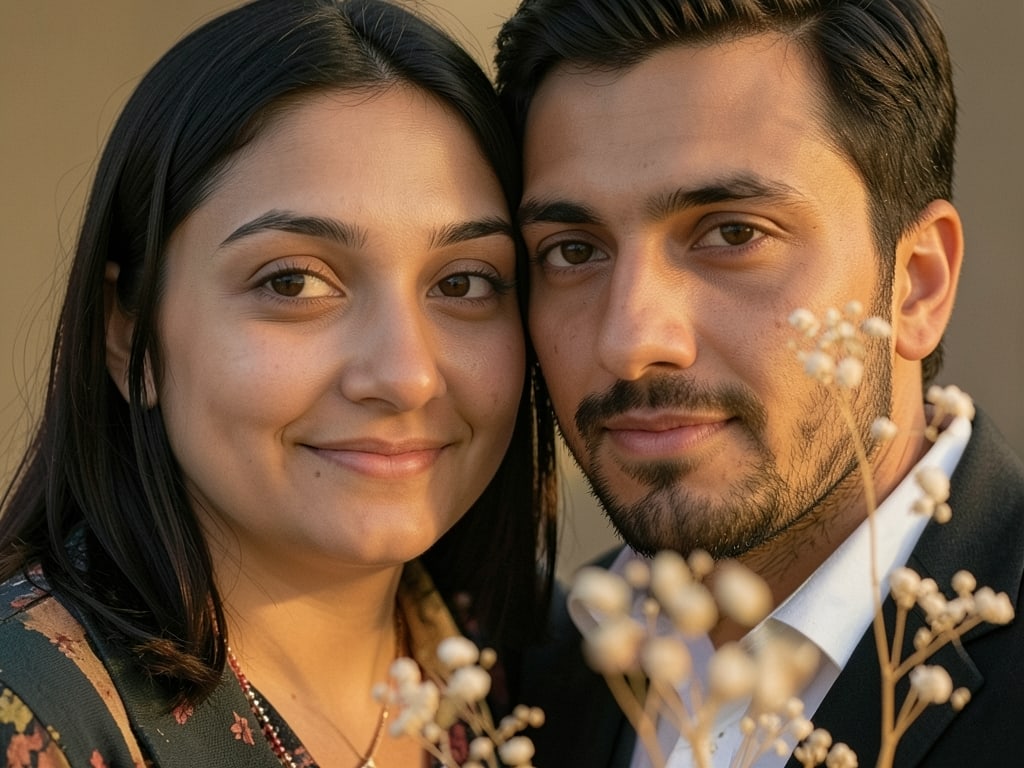 image / ChatGPT
Studio tools
AI Optimizer
Improve, shorten, expand or retarget this prompt for another image or video model. Every result is saved as a new version — the original is never overwritten.
Improve prompt
Produces optimized, concise, detailed, beginner and model-specific versions.
Generate variations
Professional, creative, cinematic, minimal and advanced.
Prompt history
- v1 · Original1 day ago