Couple Eye Trending Prompt for Cinematic Rain Portrait
Portrait Photography prompt: create image STRICT FACE IDENTITY PRESERVATION DNA Use the uploaded image exclusively as the facial identity reference for both individuals: the woman…
Prompt
create image
STRICT FACE IDENTITY PRESERVATION DNA
Use the uploaded image exclusively as the facial identity reference for both individuals: the woman positioned on the left side and the man positioned on the right side. Preserve each person’s exact facial identity independently, including their natural head shape, forehead proportions, hairline, eyebrow shape and density, eyelids, exact eye shape and spacing, iris appearance, nose bridge and structure, lips, cheeks, jawline, chin, visible skin tone, natural skin texture, facial symmetry, expression characteristics, and apparent age. For the man, preserve his exact natural beard and moustache growth pattern, density, placement, and texture as present in the facial identity reference. Do not beautify, reshape, slim, age, stylize, merge, average, or interchange their facial characteristics. The uploaded image must be used only for facial identity preservation; reconstruct the pose, wardrobe, hair styling, environment, rain-covered glass, reflections, lighting, camera position, and cinematic treatment entirely from the detailed instructions below.
CONCEPT AND EMOTIONAL DNA
Create an ultra-realistic cinematic extreme-close-up portrait of a romantic couple standing intimately together behind a rain-covered glass window at night. The visual mood should feel deeply atmospheric, quiet, intimate, mysterious, and emotionally connected. Their faces are extremely close, nearly touching along the temples and cheeks, while both look directly through the wet glass toward the camera with calm, intense expressions. The image should feel like a frame from a sophisticated romantic film photographed during a rainy night, combining cool blue rain reflections with warm amber city lights.
WOMAN POSITION AND BODY LANGUAGE DNA
Position the woman on the left half of the composition, slightly closer to the camera than the man. Her face should occupy approximately 35–40% of the total frame width. Her head is held nearly upright but tilted approximately 5–8 degrees toward camera-right, gently leaning toward the man. Her temple and upper cheek should sit extremely close to his face, visually establishing intimate physical proximity.
Her face should be turned approximately 5–10 degrees toward camera-right, while both eyes remain clearly visible and directed straight through the glass toward the camera. Her expression should be quiet and emotionally restrained, with relaxed eyebrows, softly focused eyes, and naturally closed lips carrying only the faintest suggestion of warmth rather than a broad smile.
Her lower face should disappear partially behind a thick dark charcoal knitted scarf wrapped high around her neck and lower cheeks. Only her face from approximately the lower lip upward should remain clearly visible above the scarf. Loose dark hair strands should fall naturally across her forehead, temple, and cheek, appearing slightly damp from the humid rainy environment.
MAN POSITION AND BODY LANGUAGE DNA
Position the man on the right side, immediately beside the woman and marginally behind her depth plane. His face should occupy approximately 35–40% of the frame width. Tilt his head approximately 4–7 degrees toward camera-left, bringing his temple and cheek close to the woman’s head.
His face should be almost frontal to the camera with only a subtle 3–7 degree turn toward camera-left. Both eyes should remain visible and directed straight toward the lens through the rain-covered glass. Maintain a calm, serious, contemplative expression with relaxed facial muscles and naturally closed lips.
The man’s dark hair should appear naturally tousled, with several soft strands falling across his forehead. Preserve realistic individual hair strands and his exact facial-hair identity from the uploaded facial reference. A thick dark charcoal or deep brown knitted scarf should wrap around his neck and rise across the lower-right foreground, partially obscuring the lower edge of his jaw and clothing.
COUPLE INTERACTION AND SPATIAL RELATIONSHIP DNA
Place the couple extremely close together, with almost no visible negative space separating their faces. The woman’s right temple should sit close to the man’s left temple and cheek area. Their faces should form a unified horizontal composition while remaining clearly distinguishable as two independent individuals.
Position their eyes at approximately similar vertical height, with the man’s eyes only marginally higher than the woman’s. Their shared body language should communicate warmth and emotional intimacy through proximity rather than overt gestures.
Neither subject should touch the glass directly. Their faces should remain approximately 10–20 centimetres behind the wet glass surface, allowing droplets and reflections on the glass to exist on a distinct foreground focal plane.
OUTFIT AND TEXTURE DNA
Dress both individuals in dark, heavy cold-weather clothing that remains mostly hidden by the extreme-close framing. Wrap the woman in a thick charcoal-grey textured knitted scarf with realistic woven fibres, soft folds, and slightly fuzzy wool texture. The scarf should rise around her neck and lower face.
Wrap the man in a similarly thick dark charcoal-to-deep-brown knitted scarf, creating a substantial textured foreground element across the lower-right corner.
Keep clothing understated and monochromatic so the faces, eyes, rain droplets, and cinematic lighting remain the primary visual elements.
RAIN-COVERED GLASS FOREGROUND DNA
Place a transparent glass pane directly between the camera and the couple. Cover the glass with realistic rain droplets of multiple sizes, tiny condensation beads, irregular water trails, and occasional elongated droplets moving downward due to gravity.
The droplets should be especially visible across the upper-left, left edge, and peripheral regions of the frame. Some droplets should catch cool cyan-blue reflections while others catch warm amber-orange highlights.
The central facial areas must remain sufficiently clear to preserve both identities. Do not cover either person’s eyes with large opaque droplets. Allow a few softly blurred droplets and reflections to overlap portions of their cheeks and hair to reinforce the feeling that the photograph is genuinely captured through wet glass.
REFLECTION AND BOKEH DNA
Introduce cinematic reflections of warm city or café lights across the wet glass. Place several soft amber and golden circular bokeh reflections along the right edge, lower-right foreground, and scattered peripheral areas.
Include one larger diffused warm light source near the upper-left corner, partially distorted through the wet glass.
Add subtle cool cyan and teal reflections across the upper-left and left side, contrasting against the warm orange illumination on the couple’s faces.
Reflections must appear optically integrated into the glass surface rather than digitally overlaid. Maintain irregular brightness, partial transparency, and natural distortion caused by water droplets.
CAMERA ANGLE DNA
Position the camera directly in front of the rain-covered glass at approximately the couple’s eye level. Keep the optical axis nearly perpendicular to the glass, with a subtle 2–4 degree lateral angle to prevent the image from feeling mechanically symmetrical.
The camera should look straight through the glass toward the narrow central region between the couple’s faces.
Use an intimate eye-level perspective without noticeable upward or downward distortion.
CAMERA-TO-SUBJECT DISTANCE DNA
Position the camera approximately 40–60 centimetres from the exterior surface of the glass. Position the couple approximately 10–20 centimetres behind the interior surface of the glass, producing an approximate total camera-to-face distance of 50–80 centimetres.
Frame the subjects as an extreme close-up extending from approximately the upper forehead and hairline to just below the scarf-covered mouth and jaw region. Both faces should fill most of the horizontal image area.
The camera distance must feel physically close and intimate rather than like a telephoto crop from far away.
LENS AND PHOTOGRAPHIC DNA
Use a professional full-frame cinema camera or high-end mirrorless camera with an approximately 65–85mm portrait lens. Use approximately f/2.8 to f/4, balancing shallow cinematic depth of field with sufficient facial sharpness to keep both pairs of eyes clearly resolved.
Focus primarily on the subjects’ eyes through the glass while allowing foreground droplets at the extreme edges to fall selectively in and out of focus.
Use approximately ISO 800–1600 to preserve the natural low-light nighttime atmosphere and a shutter speed around 1/125–1/200 second.
Maintain realistic optical softness around reflected lights while preserving exceptional micro-detail in the eyes, eyelashes, eyebrows, skin, and nearby water droplets.
LIGHTING DNA
Illuminate the couple using a sophisticated cinematic mixed-color lighting setup. Use a soft warm amber key light coming primarily from camera-right and slightly above eye level, creating golden highlights across the man’s right cheek, forehead, nose, and facial hair while softly illuminating the woman’s central face.
Introduce a subtle cool cyan-blue fill from camera-left, creating gentle cool reflections along the woman’s hair, left temple, and the rain-covered glass.
Maintain rich shadow depth without crushing facial details. The overall color contrast should balance warm amber skin illumination against cool teal-blue environmental reflections.
Allow warm golden bokeh lights to glow naturally through the wet glass while keeping the couple’s eyes as the sharpest emotional focal points.
SKIN AND EYE DETAIL DNA
Render both individuals with highly realistic natural skin texture, including visible pores, tiny facial hairs, subtle moisture, fine under-eye texture, natural tonal variation, and realistic highlights.
Preserve each person’s exact natural eye anatomy and iris appearance from the uploaded facial identity reference. Render individually visible eyelashes, natural eyelid folds, realistic moisture along the waterline, and small cinematic catchlights reflecting the surrounding warm and cool light sources.
Do not enlarge, recolor, brighten artificially, or cosmetically alter the eyes. Do not apply beauty filters, excessive skin smoothing, porcelain textures, or artificial facial sharpening.
BACKGROUND DNA
Keep the environment behind the couple almost completely dark and indistinct. Suggest a nighttime urban, café, or vehicle-window environment only through abstract warm lights and cool reflections.
Do not include recognizable buildings, furniture, signage, landscapes, or other people.
The environmental storytelling should come entirely from rain, glass reflections, darkness, and scattered cinematic lights.
COMPOSITION AND CROPPING DNA
Create a 16:9 horizontal cinematic extreme-close-up composition. Position the woman’s face across the left-central region and the man’s face across the right-central region. Their faces together should occupy approximately 70–80% of the image width, leaving only limited peripheral space for wet-glass texture and bokeh reflections.
Crop the upper portions of their hair slightly near the top edge if necessary, and allow the thick scarves to fill the lower edge naturally.
Keep the woman’s eyes approximately around the left-middle third and the man’s eyes around the right-middle third, forming a strong horizontal visual relationship.
Use foreground droplets and warm bokeh reflections as framing devices around the couple without obscuring their identities.
CLEAN IMAGE DNA
Do not include text, captions, logos, watermarks, social-media interface elements, emojis, decorative borders, artificial lens-flare graphics, or recognizable brand elements. The rain droplets, condensation, and bokeh must appear physically authentic and optically integrated.
FINAL OUTPUT DNA
Create an ultra-realistic 4K Ultra HD, 16:9 horizontal cinematic romantic portrait using the up
How to use
Paste the prompt into Midjourney. Swap the subject and keep the lighting, lens and style details for a consistent look.
Use case
Portrait Photography — glass, approximately
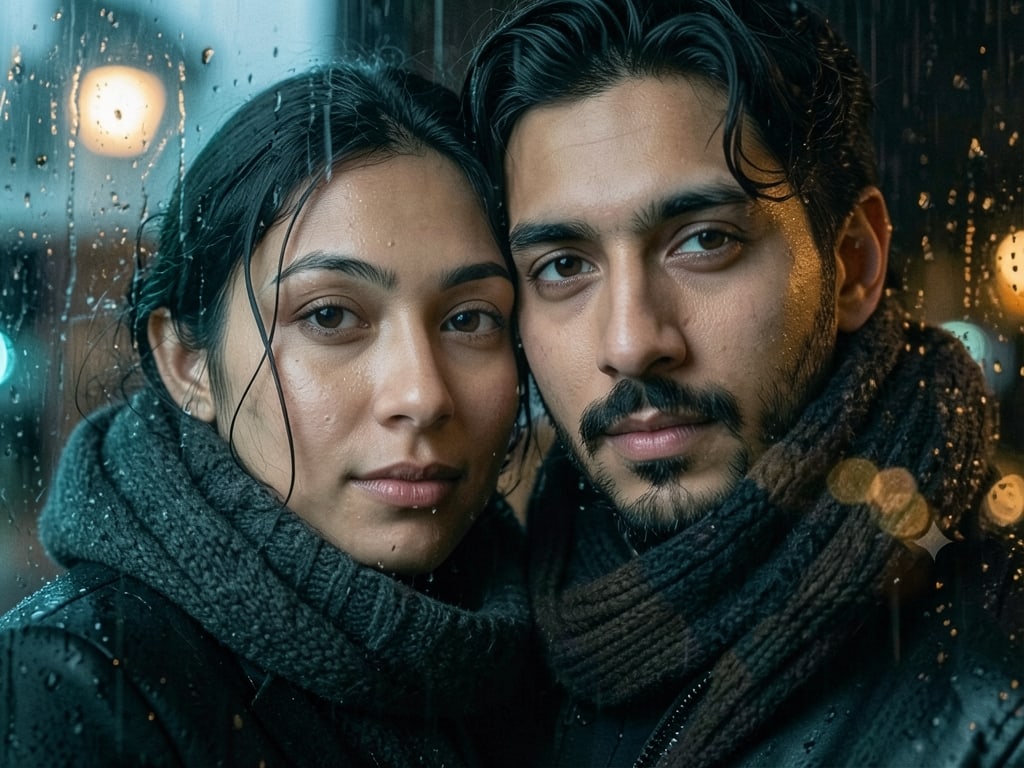 image / ChatGPT
Studio tools
AI Optimizer
Improve, shorten, expand or retarget this prompt for another image or video model. Every result is saved as a new version — the original is never overwritten.
Improve prompt
Produces optimized, concise, detailed, beginner and model-specific versions.
Generate variations
Professional, creative, cinematic, minimal and advanced.
Prompt history
- v1 · Original1 day ago