Patriotic Baby Flat‑Lay Portrait
An ultra‑realistic overhead portrait of an Indian baby celebrating Independence Day, featuring traditional attire, a handcrafted “I LOVE INDIA” banner and a miniature flag, all set on deep‑blue fabric. Ideal for festive family collections or cultural commemorations.
Prompt
create image
STRICT FACE IDENTITY COPY DNA
Maintain the exact facial characteristics of the uploaded baby photo. Preserve every detail of the infant’s face—head shape, forehead, hairline, eyebrows, eye shape and spacing, eyelids, nose, lips, cheeks, chin, ears, natural skin tone, texture, proportions, apparent age, and all recognizable traits—without any beautification, reshaping, stylization, smoothing, aging, de‑aging, or other alterations. The uploaded picture must serve solely for facial replication; it must not influence clothing, pose, props, background, composition, camera setup, or lighting.
VISUAL RECONSTRUCTION DNA
Render a premium, hyper‑realistic Indian Independence Day baby photoshoot as an overhead flat‑lay portrait. Position the infant on a deep‑blue fabric surface, surrounded by patriotic décor. The scene should convey a handcrafted, festive, innocent atmosphere and appear as a professionally captured photograph rather than a digital illustration.
SUBJECT & COMPOSITION DNA
Place the baby slightly to the right of the vertical centre, lying diagonally across the lower‑middle region. The head should sit about 42‑45 % down from the top edge, with the feet extending toward the lower‑middle area. Reserve the entire upper third for the patriotic title and keep the left side open for a miniature Indian flag and swing‑rope element. The baby’s height should occupy roughly 35‑40 % of the total frame, while the surrounding decorations remain secondary.
POSE & BODY LANGUAGE DNA
Lay the infant on its back on the blue fabric, rotating the torso about 10‑15° from the vertical axis. Turn the head slightly toward the camera‑right, maintaining a relaxed upward gaze. Both arms should be lifted outward from the shoulders in a playful, relaxed manner, elbows gently bent, hands open with natural baby fingers. Knees are bent naturally, one knee a bit higher than the other to create subtle asymmetry; lower legs angle inward slightly, with bare feet resting softly on the fabric. The overall posture must exude joy, innocence, comfort, and playful patriotism without appearing staged.
OUTFIT DNA
Dress the baby in a sweet white kurta‑style top featuring faint light‑blue decorative trims and small saffron‑green accents. Pair it with bright saffron‑orange traditional lower garments, loose and comfortable, showing realistic folds and a soft cotton texture. Add a tiny tricolour cap or headpiece blending saffron, white, and green in a tasteful miniature design. Ensure the clothing looks realistic, age‑appropriate, soft, and naturally wrinkled.
PATRIOTIC ACCESSORY DNA
Position small green fabric accents near each raised hand, resembling delicate patriotic wrist ribbons, without covering the fingers. Include a subtle saffron‑white‑green decorative element on the outfit that enhances the theme without overwhelming the composition.
“I LOVE INDIA” TYPOGRAPHY DNA
Across the upper portion, create large handmade‑style lettering that reads exactly:
I LOVE INDIA
The text should span about 55‑60 % of the frame width and be centred horizontally. Use chunky, tactile lettering with visible textured fibres or tiny decorative particles rather than smooth digital fonts. Render the “I” in saffron/orange, the heart symbol in a blend of saffron, white, and green, and “INDIA” primarily in saffron, white, and green. Ensure perfect spelling and clear readability.
INDIAN FLAG DNA
Depict an authentic Indian flag (not plastic) as it appears in office dhwaj‑vandana displays, with a rope‑like support, fully unfurled and appearing to wave in the air. Render the flag using grain‑style engraving to convey texture.
BACKGROUND & SURFACE DNA
Cover the entire scene with a rich deep navy‑blue cotton fabric backdrop, showing subtle natural wrinkles, folds, and woven texture. The blue surface must provide strong contrast against the white, saffron, and green elements. Avoid walls, furniture, floor edges, or visible studio gear.
CAMERA ANGLE & HEIGHT DNA
Employ a true overhead flat‑lay camera position at 90°, directly above the infant. Position the camera sensor roughly 2.8‑3.2 metres above the fabric, with the optical axis pointing straight down and a deviation of no more than 0‑1°. No eye‑level, three‑quarter, diagonal, or low‑angle views are allowed; exact overhead geometry is critical.
CAMERA DISTANCE & FRAMING DNA
Place the camera about 3 metres vertically above the centre of the baby’s torso. Use a distance that captures the entire infant, the full “I LOVE INDIA” title, the miniature flag, the swing‑rope decoration, and generous blue negative space, while preserving natural proportions without head enlargement or wide‑angle distortion.
LENS & OPTICAL DNA
Utilize a professional full‑frame 50 mm lens set to approximately f/5.6, mounted directly overhead. Maintain precise geometry and realistic proportions. Keep the baby’s face, clothing, flag, and primary decorations sharply in focus, with only a very subtle softness toward the farthest background.
LIGHTING DNA
Apply bright, soft, evenly distributed high‑key studio lighting to illuminate the scene uniformly.
How to use
Paste the prompt into Midjourney. Swap the subject and keep the lighting, lens and style details for a consistent look.
Use case
Portrait Photography — baby, fabric
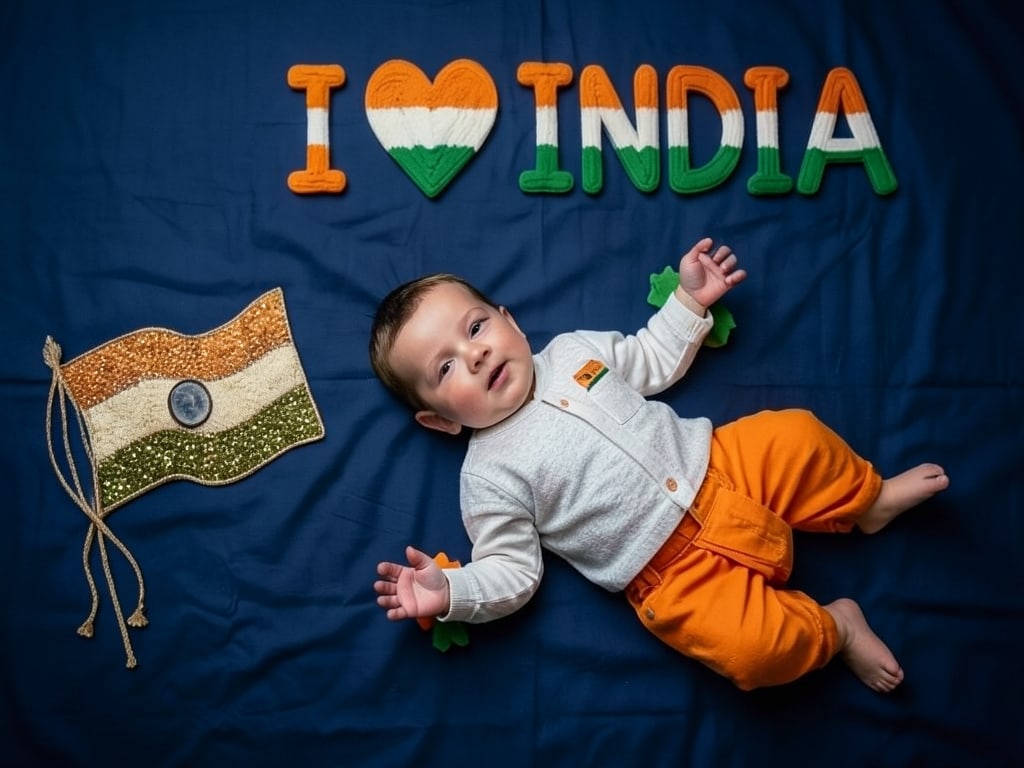 image / ChatGPT
Studio tools
AI Optimizer
Improve, shorten, expand or retarget this prompt for another image or video model. Every result is saved as a new version — the original is never overwritten.
Improve prompt
Produces optimized, concise, detailed, beginner and model-specific versions.
Generate variations
Professional, creative, cinematic, minimal and advanced.
Prompt history
- v1 · Original1 month ago