Monsoon Baby Photoshoot With Four Rainy Season Poses
Portrait Photography prompt: create image STRICT FACE IDENTITY PRESERVATION DNA Use the uploaded image exclusively as the facial identity reference for the young girl. Preserve…
Prompt
create image
STRICT FACE IDENTITY PRESERVATION DNA
Use the uploaded image exclusively as the facial identity reference for the young girl. Preserve her exact facial identity, including natural head shape, forehead proportions, hairline, eyebrow shape and density, eyelids, exact eye shape and spacing, iris appearance, nose bridge and structure, lips, cheeks, jawline, chin, ears, visible skin tone, natural skin texture, facial symmetry, expression characteristics, and apparent age. Do not beautify, reshape, slim, age, stylize, or modify any facial feature. Preserve authentic child proportions and age-appropriate anatomy consistently across all four frames. The same exact child identity must appear in every frame. Use the uploaded image only for facial identity preservation; reconstruct the hairstyle, outfit, poses, umbrella, backpack, rainy campus environment, composition, lighting, and photographic treatment entirely from the instructions below.
CONCEPT AND STORYTELLING DNA
Create an ultra-realistic cinematic four-frame rainy-day childhood photo story arranged as a clean 2×2 photographic grid. All four frames must depict different sequential candid moments of the same young girl enjoying a rainy day on a beautiful tree-lined school or heritage campus pathway. The visual narrative should progress naturally from standing beneath an umbrella, to happily walking through the rain, to crouching and touching a puddle, and finally walking away from the camera with a small backpack. The overall atmosphere should communicate innocent childhood curiosity, monsoon happiness, playful exploration, and nostalgic school-day memories.
FOUR-FRAME STRUCTURAL COMPOSITION DNA
Divide the final vertical canvas into four equal photographic panels arranged in a precise 2×2 grid, with two frames across the top and two frames across the bottom. Use extremely thin, clean dividing lines between the photographs without thick decorative borders. Each frame should function as a separate professionally photographed moment while maintaining exactly the same location, weather, outfit, hairstyle, child identity, lighting direction, and overall color treatment.
The upper-left frame should show the girl standing beneath a transparent umbrella. The upper-right frame should show her walking toward the camera without the umbrella. The lower-left frame should show her crouching beside a puddle and touching the rainwater. The lower-right frame should show her from behind walking away along the wet campus pathway while wearing a small backpack.
Do not place any title, caption, typography, or text over the center intersection of the four images. Keep the collage entirely photographic and clean.
CONSISTENT SUBJECT APPEARANCE DNA
Style the girl’s naturally curly or softly wavy dark hair in a loose, slightly tousled shoulder-length hairstyle. The hair should look mildly damp from the rainy weather, with realistic curls and individual strands around the forehead, temples, cheeks, and neck. Maintain exactly the same hairstyle and hair length across all four frames, allowing only physically natural movement caused by walking, rain, and body position.
Dress her consistently in a pastel pink long-sleeved button-front shirt made from lightweight cotton or linen-blend fabric. Keep the collar open and relaxed, with the sleeves casually rolled or gathered to approximately the forearms. Tie the lower front ends of the shirt into a small soft knot around the waist.
Pair the shirt with loose-fitting high-waisted white trousers extending to the ankles. The trousers should show realistic folds around the knees and ankles, with subtle dampness near the lower hems from walking through puddles. Add simple white child-sized sneakers with realistic wet surfaces and slight reflections.
Do not copy clothing from the facial identity reference.
FRAME 1 — UPPER-LEFT UMBRELLA PORTRAIT DNA
In the upper-left frame, position the girl centrally on the wet pathway, facing almost directly toward the camera. She should stand upright with both feet naturally planted close together and her knees relaxed.
Place a medium-to-large transparent dome umbrella directly above her head. The umbrella canopy should measure approximately 1.6–1.8 times her shoulder width. Cover the transparent surface with clearly visible rain droplets and fine streams of water. Show realistic metallic ribs and a dark or neutral central shaft.
Have the girl hold the umbrella shaft and handle with both hands positioned together at approximately upper-chest height. Keep her elbows gently bent inward and shoulders relaxed. Her head may tilt subtly by approximately 3–5 degrees, creating a natural childlike pose. She should look directly toward the camera with a cheerful, spontaneous smile.
Position the camera approximately 5–7 metres from the girl at roughly 70–90 centimetres above ground level, producing a nearly eye-level perspective relative to the child. Use approximately an 85mm-equivalent focal length so her complete body and most of the umbrella remain visible without wide-angle distortion.
FRAME 2 — UPPER-RIGHT WALKING DNA
In the upper-right frame, remove the umbrella and capture the same girl walking energetically toward the camera along the rain-soaked pathway.
Position her body almost front-facing with a slight rotational angle of approximately 5–10 degrees caused naturally by her walking stride. Capture one leg stepping forward while the opposite foot pushes away from the wet pavement. Her arms should move naturally in opposite rhythm with the legs, hanging freely rather than appearing deliberately posed.
Her shoulders should be relaxed, her torso upright with a subtle forward momentum, and her head held naturally. Capture a broad spontaneous smile with her mouth slightly open as though laughing while enjoying the rain.
The wet pathway should show small splashes beneath her shoes and clear reflections of her white trousers and pink shirt.
Position the camera approximately 7–9 metres from the child at approximately 70–90 centimetres above the ground. Use an 85–105mm-equivalent telephoto focal length to create gentle background compression while preserving the full-body walking composition.
FRAME 3 — LOWER-LEFT PUDDLE EXPLORATION DNA
In the lower-left frame, show the same girl crouching low beside a shallow rain puddle.
Her body should be positioned in a deep childlike squat with both knees bent naturally. One foot should remain planted more firmly while the opposite leg opens slightly outward for balance. Her torso should lean diagonally forward approximately 20–30 degrees from the hips.
Extend one arm downward so her fingertips gently touch or skim the surface of the shallow puddle, creating small circular ripples and a subtle splash. Her opposite hand should rest naturally near her bent knee or thigh for balance.
Turn her upper body and head partially back toward the camera so her face remains clearly visible in a three-quarter view. She should look toward the camera with a curious, delighted smile, as though momentarily interrupted while playing with the rainwater.
Position the camera approximately 4–6 metres away at a low viewpoint approximately 40–60 centimetres above the wet pathway. Use an approximately 70–85mm-equivalent focal length. Keep her complete crouched body visible together with enough foreground puddle to show reflections, ripples, and raindrop impacts.
FRAME 4 — LOWER-RIGHT WALKING-AWAY DNA
In the lower-right frame, photograph the same girl entirely from behind as she walks away from the camera along the wet campus pathway.
Her back should face the camera with her head oriented naturally forward toward the distant pathway. Do not turn her face toward the camera in this frame.
Add a small child-sized pastel cream or pale beige backpack positioned centrally on her back. The backpack should be appropriately scaled at approximately 35–40% of her torso height, with two shoulder straps and a simple front pocket or subtle bow-like decorative detail.
Capture her mid-stride with one foot forward and the opposite heel slightly raised. Her arms should hang naturally beside her body with a subtle walking swing. Her damp curly hair should be visible from behind, resting around the upper shoulders and moving slightly with her stride.
Position the camera approximately 7–10 metres behind the girl at approximately 70–90 centimetres above the ground, using an 85–105mm-equivalent focal length. Allow the wet pathway to extend deeply into the distance, creating strong leading lines and a sense of the child continuing her journey through the rainy campus.
RAINY CAMPUS ENVIRONMENT DNA
Use one consistent outdoor environment across all four frames: a broad rain-soaked pedestrian pathway running through a peaceful heritage-style educational campus or institutional garden.
Line the pathway with mature green trees and dense foliage. Include softly blurred flowering trees with clusters of muted pink blossoms along portions of the background. Along one side of the pathway, show a long heritage-style stone or brick building with repeating arched openings, columns, or corridor architecture receding naturally into the distance.
The architecture must remain secondary to the child and should become progressively softer through shallow depth of field.
The pathway should be completely wet from recent and ongoing rain, with irregular shallow puddles, subtle reflections, scattered droplets, and occasional small fallen leaves or flower petals.
Do not include clearly identifiable school logos, signs, readable text, crowds, vehicles, or distracting modern objects.
RAIN AND WATER DNA
Create steady but gentle monsoon rainfall visible throughout all four frames. Use fine natural rain streaks and individually frozen droplets where appropriate.
Show realistic water beads across the umbrella in the first frame. In the walking frame, create small splashes around the child’s shoes rather than exaggerated water explosions. In the crouching frame, show detailed puddle ripples radiating outward from her fingertips alongside circular impacts from falling raindrops. In the rear walking frame, show subtle reflections and small shoe disturbances in the water.
Maintain physically believable wet surfaces, reflections, water depth, and splash scale throughout the collage.
CAMERA AND PHOTOGRAPHY DNA
Use professional full-frame portrait photography with approximately 70–105mm-equivalent focal lengths depending on each frame’s composition. Maintain consistent optical character and color rendering throughout all four photographs.
Use approximately f/2.8–f/4 for moderate shallow depth of field, keeping the girl sharply defined while creating smooth separation from the tree-lined campus background. Use a shutter speed around 1/500–1/1000 second for the standing and walking frames, with sufficient speed to retain visible rain droplets and natural movement. Keep ISO appropriate for soft overcast daylight.
The camera-to-subject distance must change naturally according to each composition rather than forcing the same distance across all four images: approximately 5–7 metres for the umbrella portrait, 7–9 metres for the walking-toward-camera scene, 4–6 metres for the crouching puddle scene, and 7–10 metres for the rear walking scene.
Avoid wide-angle distortion. Maintain realistic child body proportions in every panel.
LIGHTING AND COLOR DNA
Use soft diffused daylight from a bright overcast monsoon sky. Maintain gentle, flattering illumination across the girl’s face in the first three frames without artificial beauty lighting.
Use natural muted monsoon colors: fresh deep greens, soft grey skies, reflective charcoal-grey pavement, pastel pink clothing, and clean white trousers. Keep the overall grade cinematic but realistic, with slightly softened highlights, naturally rich greens, subtle contrast, and authentic wet-weather atmosphere.
Avoid excessive saturation, orange-and-teal grading, artificial glow, fantasy lighting, or
How to use
Paste the prompt into Stable Diffusion. Swap the subject and keep the lighting, lens and style details for a consistent look.
Use case
Portrait Photography — frame, approximately
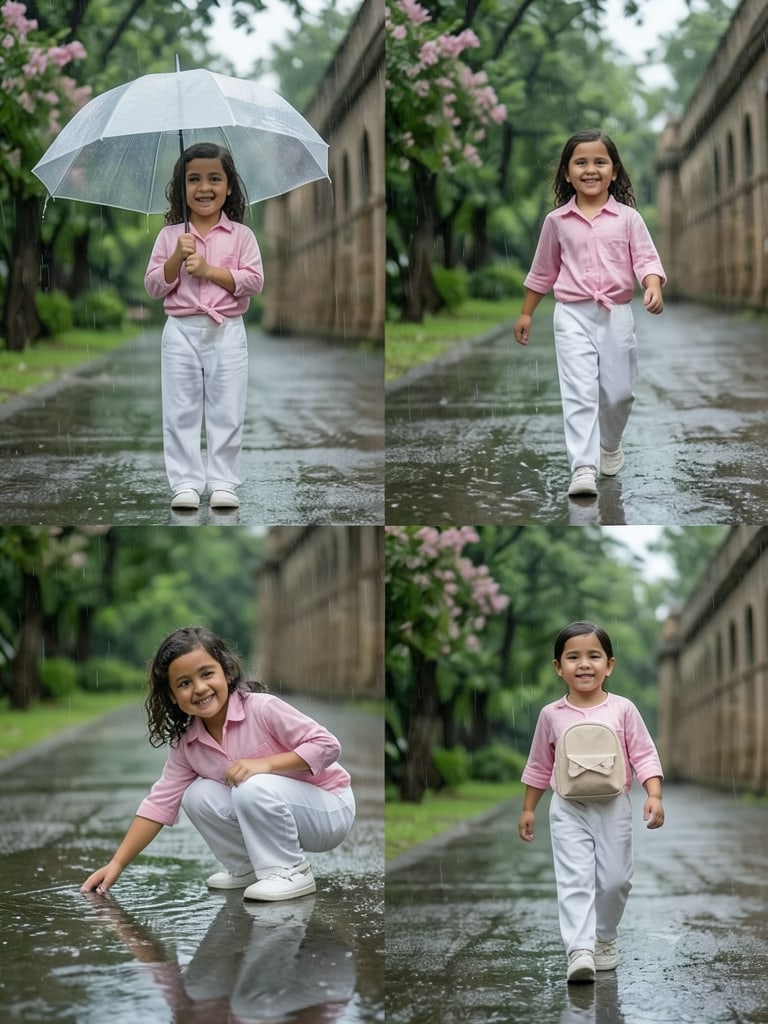 image / ChatGPT
Studio tools
AI Optimizer
Improve, shorten, expand or retarget this prompt for another image or video model. Every result is saved as a new version — the original is never overwritten.
Improve prompt
Produces optimized, concise, detailed, beginner and model-specific versions.
Generate variations
Professional, creative, cinematic, minimal and advanced.
Prompt history
- v1 · Original1 day ago