Elegant First Rakhi Baby Flat Lay
A photorealistic overhead scene of an infant in a royal‑blue romper beside a large handcrafted Rakhi, ideal for festive family memories.
Prompt
IDENTITY PRESERVATION
Maintain the baby's facial characteristics exactly as provided in the reference photo—head shape, proportions, forehead, hairline, eyebrows, eyes, eyelids, spacing, nose, cheeks, lips, chin, jawline, ears, skin tone, natural texture, apparent age, symmetry and any other identifying details. No beautification, smoothing, stylization, aging, de‑aging or any alteration is allowed. Use the reference solely for the face; clothing, pose, background, props and composition must be created independently.

VISUAL STYLE
Create a premium photorealistic “My First Rakhi” scene in a traditional Indian overhead flat‑lay manner. The atmosphere should feel simple, elegant, handmade, intimate and festive, with the baby and an oversized Rakhi telling the main story.

COMPOSITION
- Use a vertical 9:16 frame captured from a true 90° overhead perspective.
- Position the infant in the lower‑right corner, lying on the back at a slight diagonal.
- Show the entire body from head to feet, with natural infant proportions and a relaxed, playful pose; one arm may be gently lifted while the legs stay naturally bent.
- Place a large decorative Rakhi across the upper‑middle to center‑left area, its thread extending horizontally toward both edges, leaving ample negative space between the Rakhi and the baby.

OUTFIT
Dress the child in a bright royal‑blue traditional Indian romper made of soft cotton, featuring subtle tonal patterns and realistic folds. Add a matching blue headband or bow with a neat festive look. The clothing should be comfortable, cute, age‑appropriate and textured convincingly.

RAKHI DETAILS
- Craft a large handmade Rakhi as the central decorative element.
- Use deep‑red braided thread running horizontally across the frame.
- The circular centerpiece should be 2–3 × the width of the baby’s head, with a golden‑yellow and green base, intricate floral motifs, tiny white pearl‑like beads, red and gold accents, and a decorative central motif.
- Inside the centre, embed white Devanagari lettering “राखी” that appears physically part of the Rakhi, not digitally pasted.

ACCESSORIES
Position two small traditional bowls to the right of the Rakhi: one filled with white rice grains, the other with bright red kumkum/roli. Use tiny round ceramic or metallic bowls with realistic material texture, spaced neatly and clearly visible.

TYPOGRAPHY
On the left side, arrange dark‑blue calligraphic lettering vertically:
My
First
Rakhi
Render the text in an elegant handwritten brush style with natural stroke‑width variation; it should be readable yet secondary to the baby and Rakhi.

BACKGROUND
Cover the entire surface with a soft pale cream/yellow satin fabric. The fabric must display realistic silky folds, gentle wrinkles, subtle highlights and natural shadows, arranged to create a soft diagonal flow without distracting from the main subjects.

HIERARCHY
Maintain the visual order: Baby → Large Rakhi → “My First Rakhi” lettering → small accessories. The infant remains the emotional focal point while the Rakhi serves as the strongest decorative element.

LIGHTING
Employ soft, bright, diffused overhead studio lighting. Produce subtle realistic contact shadows beneath the baby, Rakhi and bowls. The satin should exhibit gentle natural highlights without excessive gloss, preserving authentic baby skin tones and texture.

CAMERA
Use professional full‑frame flat‑lay photography with a true 90° overhead view, delivering edge‑to‑edge clarity, accurate scale relationships and natural object placement.

COLOUR PALETTE
Apply a refined festive palette of royal blue, deep red, golden yellow, green, cream, white and subtle gold, keeping colors vibrant yet naturally photographed.

PHOTOREALISM
Render the scene in 4K Ultra HD with ultra‑realistic professional baby‑photography quality: authentic skin texture, natural hair strands, realistic cotton fabric, detailed Rakhi threads, individual beads, believable kumkum and rice grains, realistic satin folds, physically accurate shadows and natural proportions. Avoid cartoon styling, plastic skin, facial modification, distorted anatomy, extra limbs, floating objects, unrealistic Rakhi details, messy typography, over‑saturation, artificial HDR or visible AI artifacts.

FINAL OUTPUT
Produce a premium “My First Rakhi” baby photoshoot featuring the identity‑preserved infant lying naturally in the lower‑right on a soft pale cream satin backdrop, dressed in a royal‑blue romper and matching headband. A large handcrafted red‑thread Rakhi with an ornate golden‑green circular centre and white “राखी” lettering occupies the center‑left, accompanied by small bowls of rice and kumkum on its right. Elegant handwritten “My First Rakhi” text appears on the left. The composition is a clean overhead flat‑lay with authentic Indian festive details, soft lighting, natural shadows and 4K photorealistic quality.
How to use
Paste the prompt into Stable Diffusion. Swap the subject and keep the lighting, lens and style details for a consistent look.
Use case
Viral Trends & Formats — rakhi, baby
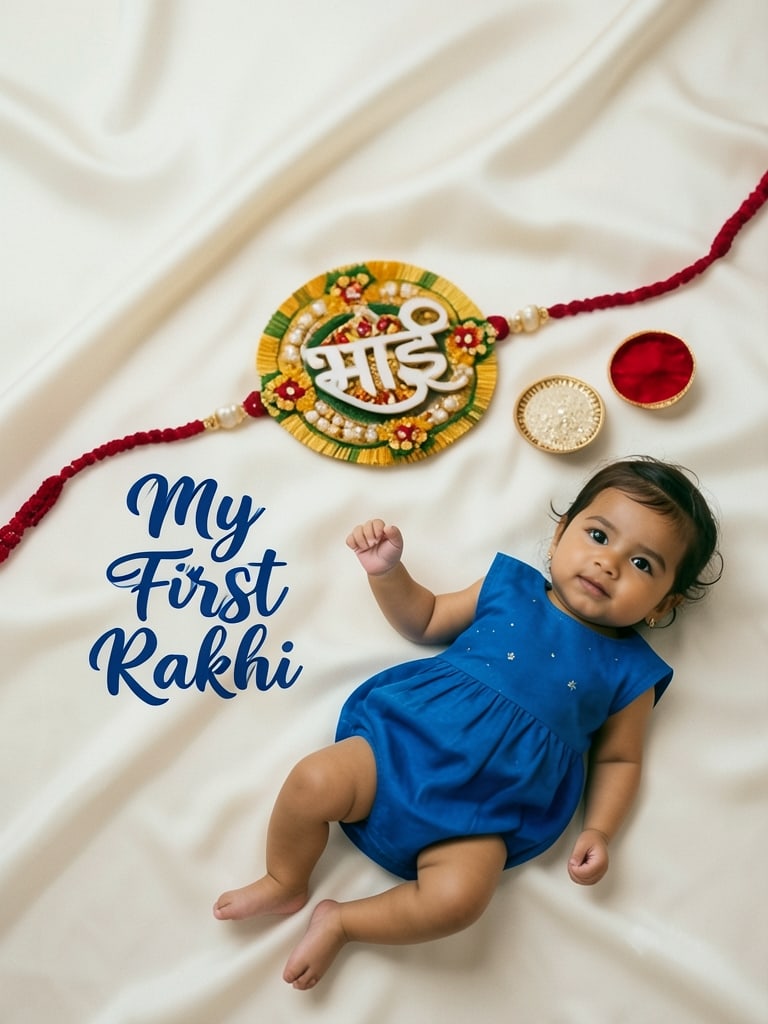 image / ChatGPT
Studio tools
AI Optimizer
Improve, shorten, expand or retarget this prompt for another image or video model. Every result is saved as a new version — the original is never overwritten.
Improve prompt
Produces optimized, concise, detailed, beginner and model-specific versions.
Generate variations
Professional, creative, cinematic, minimal and advanced.
Prompt history
- v1 · Original1 month ago