Rainy Season Photoshoot for Baby Boy With Umbrella
Portrait Photography prompt: create image STRICT FACE IDENTITY PRESERVATION DNA Use the uploaded image exclusively as the facial identity reference for the child. Preserve the…
Prompt
create image
STRICT FACE IDENTITY PRESERVATION DNA
Use the uploaded image exclusively as the facial identity reference for the child. Preserve the child’s exact facial identity, including natural head shape, forehead proportions, hairline, eyebrow shape and density, eyelids, exact eye shape and spacing, iris appearance and natural eye color, nose bridge and structure, lips, cheeks, jawline, chin, ears, visible skin tone, natural skin texture, facial symmetry, expression characteristics, and apparent age. Do not beautify, reshape, slim, age, stylize, or modify any facial feature. Preserve the child’s authentic proportions and age-appropriate anatomy. The uploaded image must be used only for exact facial identity preservation; reconstruct the hairstyle, outfit, umbrella, running pose, rainy environment, composition, lighting, and photographic treatment entirely from the detailed instructions below.
CONCEPT AND EMOTIONAL DNA
Create an ultra-realistic cinematic monsoon photoshoot of a young child joyfully running toward the camera along a rain-soaked outdoor pathway while holding a large cream-white umbrella. Capture a playful, spontaneous childhood moment filled with movement, happiness, and monsoon atmosphere. The child should appear genuinely in motion, with one foot planted into a shallow puddle while the opposite leg lifts dynamically forward, creating a dramatic splash of rainwater around the feet. The overall image should feel candid and energetic rather than like a rigid posed portrait.
CHILD POSITION AND BODY LANGUAGE DNA
Position the child approximately in the central vertical axis of the composition, running directly toward the camera. Keep the torso mostly upright but leaning approximately 5–8 degrees forward to communicate natural forward momentum.
The child’s shoulders should remain relaxed while both arms actively stabilize the umbrella. Position one hand higher on the umbrella’s central shaft at approximately upper-chest height, while the second hand grips the curved handle or lower shaft near the center of the torso. The elbows should remain naturally bent rather than held rigidly against the body.
Turn the child’s head almost directly toward the camera with only a subtle 2–5 degree natural rotation. Direct both eyes toward the lens. Preserve the child’s natural expression from the facial identity reference, allowing a gentle, cheerful, age-appropriate smile without exaggerating the mouth or altering facial anatomy.
The running movement should feel physically believable. The child’s upper body should remain balanced beneath the umbrella while the lower body captures an energetic mid-stride moment.
LEG POSITION AND RUNNING MOTION DNA
Capture the child at the exact moment one foot lands firmly in a shallow rain puddle beneath the body, generating a broad outward splash of water.
The supporting leg should be slightly bent at the knee to absorb the impact of the running stride. Position the opposite leg lifted prominently forward, with the knee bent approximately 70–90 degrees and the sole of the shoe partially visible toward the camera.
The raised foot should sit approximately 20–30 centimetres above the wet pathway, creating a clear sense of motion without making the pose appear like jumping or floating.
The planted foot should create realistic radial water displacement, with droplets and thin arcs of water rising approximately 10–25 centimetres around the lower legs. Include smaller suspended droplets throughout the immediate foreground.
Maintain accurate child anatomy, natural joint articulation, correct foot orientation, and believable balance.
UMBRELLA POSITION AND SCALE DNA
Place a large classic cream-white umbrella directly above the child. The umbrella canopy should be approximately 1.5–1.8 times the width of the child’s shoulders, making it visibly oversized relative to the child’s small body while remaining physically believable.
Tilt the umbrella canopy approximately 8–12 degrees toward camera-left, with its center positioned slightly left of the child’s head. The umbrella’s outer edge should extend horizontally beyond both shoulders.
Use a slim dark central shaft running downward from the canopy toward the child’s hands. Include a dark curved J-shaped handle held securely by the child.
Render realistic umbrella ribs subtly visible beneath the cream fabric. The canopy should show soft rain moisture, scattered droplets, gentle fabric tension, and slightly darker wet areas without appearing dirty or damaged.
The umbrella must remain fully separated from the child’s head and should not intersect unnaturally with the hair or face.
OUTFIT DNA
Dress the child in a simple warm cream or pale beige long-sleeved knitted pullover with a soft round neckline. The sweater should have realistic lightweight knit texture, subtle natural folds around the shoulders, elbows, waist, and torso, and slight dampness from the rainy environment.
Pair the sweater with medium-blue denim jeans featuring realistic child-sized proportions, natural creasing around the knees and hips, and slightly darker damp areas near the lower legs.
Add light beige or off-white child-sized slip-on rain-friendly shoes with small ventilation holes and textured soles. The shoes should appear naturally wet, with tiny droplets and subtle mud or water marks from running through puddles.
Do not copy clothing from the facial identity reference.
HAIR DNA
Style the child’s hair naturally short and slightly tousled by the humid rainy weather. Allow several small damp strands to fall gently across the forehead.
The hair should have realistic moisture and slight strand separation caused by humidity without appearing completely soaked.
Do not change the child’s natural hairline or any identity-defining characteristics.
CAMERA ANGLE DNA
Position the camera directly in front of the running child at a low child-level perspective, approximately 45–60 centimetres above the wet pathway. Tilt the camera upward very subtly by approximately 2–4 degrees so the child feels energetic and prominent without creating exaggerated distortion.
Keep the optical axis aligned toward the child’s upper torso and face.
The low viewpoint should make the lifted shoe and foreground water splash slightly more prominent while preserving natural facial proportions.
CAMERA-TO-SUBJECT DISTANCE DNA
Position the camera approximately 5–7 metres from the child at the captured moment. Use a moderate telephoto perspective rather than placing the camera physically too close.
The child, including the umbrella, should occupy approximately 65–75% of the inner portrait composition’s height, leaving enough environmental space above the umbrella and beneath the splashing feet.
The distance should preserve realistic body proportions while visually compressing the softly blurred pathway and green foliage behind the child.
LENS AND MOTION DNA
Use a professional full-frame camera with an approximately 85–105mm portrait telephoto lens at around f/2.8 to f/4. Use a fast shutter speed of approximately 1/1000–1/1600 second to freeze the child’s running movement and individual airborne water droplets.
Use ISO 400–800 depending on available overcast monsoon light.
Focus precisely on the child’s eyes and face while maintaining sufficient depth of field to keep the torso and umbrella handle clearly readable. Allow the raised shoe and extreme foreground water droplets to become marginally softer because of depth separation.
Freeze the central water splash sharply enough to reveal individual droplets while preserving a subtle sense of dynamic motion.
RAIN AND WATER DNA
Create visible fine monsoon rainfall throughout the scene, with thin natural rain streaks against the darker green background.
The asphalt pathway should be thoroughly wet, darkened by rain, and covered with irregular shallow puddles. Include realistic reflections of the child, umbrella, and surrounding greenery across the wet surface, but keep reflections naturally distorted by ripples and splashing water.
The strongest splash should occur directly around the child’s planted foot, spreading outward in a broad semicircular pattern.
Do not create an artificial storm, flooding, or excessively dramatic rainfall. The atmosphere should feel like a pleasant moderate monsoon shower suitable for a joyful outdoor childhood portrait.
BACKGROUND AND ENVIRONMENT DNA
Create a narrow rain-soaked pathway extending behind the child into a lush green outdoor environment. Surround the pathway with dense trees, leafy vegetation, and dark green foliage.
Use strong natural depth of field so the background becomes progressively softer with distance. The distant pathway should dissolve into creamy green and muted brown bokeh.
Keep the environment uncluttered. Do not include other people, vehicles, buildings, signs, street furniture, or distracting objects.
The pathway should create subtle leading lines directing visual attention toward the child.
LIGHTING DNA
Use soft diffused natural daylight from an overcast monsoon sky. Illuminate the child’s face evenly with gentle frontal and slightly upper-left ambient light.
Add subtle soft highlights to the child’s eyes, wet hair, umbrella edges, and airborne water droplets.
Maintain natural skin tone and realistic contrast. The cream umbrella should softly reflect ambient light onto the child’s face, functioning as a natural overhead fill source.
Avoid harsh direct sunlight, dramatic artificial rim lighting, flash-heavy illumination, or unrealistic glowing effects.
COMPOSITION AND WHITE FRAME DNA
Create the primary photograph as a vertical portrait composition, then present it as a physical photographic print surrounded by a thick clean white rectangular border.
Rotate the entire bordered photograph approximately 5–7 degrees counterclockwise, creating a casually placed printed-photo effect.
The white border should have consistent thickness and crisp straight edges. The bordered photograph should occupy approximately 85–90% of the final canvas, with all four edges of the white frame remaining visible.
Behind the tilted print, fill the full canvas with a heavily enlarged and strongly blurred version of the same rainy green environment, creating layered photographic depth.
The outer blurred background should remain visually secondary and must not contain duplicate visible subjects.
CLEAN IMAGE DNA
Do not include text, captions, logos, watermarks, social-media interface elements, arrows, decorative icons, artificial stickers, or additional graphic elements. The only graphic-style element should be the realistic thick white photographic border surrounding the tilted central image.
FINAL OUTPUT DNA
Create an ultra-realistic 4K Ultra HD vertical cinematic monsoon child portrait using the uploaded image exclusively for exact facial identity preservation of the child. Capture the child running joyfully toward the camera on a wet rain-soaked pathway while holding a large cream-white umbrella with both hands. Position the torso with a subtle forward lean, one foot planted forcefully into a shallow puddle and the opposite leg lifted forward with the knee bent, freezing a dramatic but physically realistic splash of rainwater around the feet. Dress the child in a cream long-sleeved knitted pullover, medium-blue denim jeans, and light beige rain-friendly shoes. Photograph from approximately 5–7 metres away using a low child-level camera position and an 85–105mm telephoto portrait lens with a fast shutter speed. Surround the pathway with lush softly blurred green foliage and visible natural monsoon rainfall. Present the finished portrait inside a thick white photographic border rotated approximately 5–7 degrees counterclockwise over a heavily blurred enlarged version of the same rainy environment. Preserve exact facial identity, natural child anatomy, realistic running mechanics, authentic rain droplets, detailed water splashes, wet-surface reflections, soft overcast lighting, and professional phot
How to use
Paste the prompt into Midjourney. Swap the subject and keep the lighting, lens and style details for a consistent look.
Use case
Portrait Photography — child, umbrella
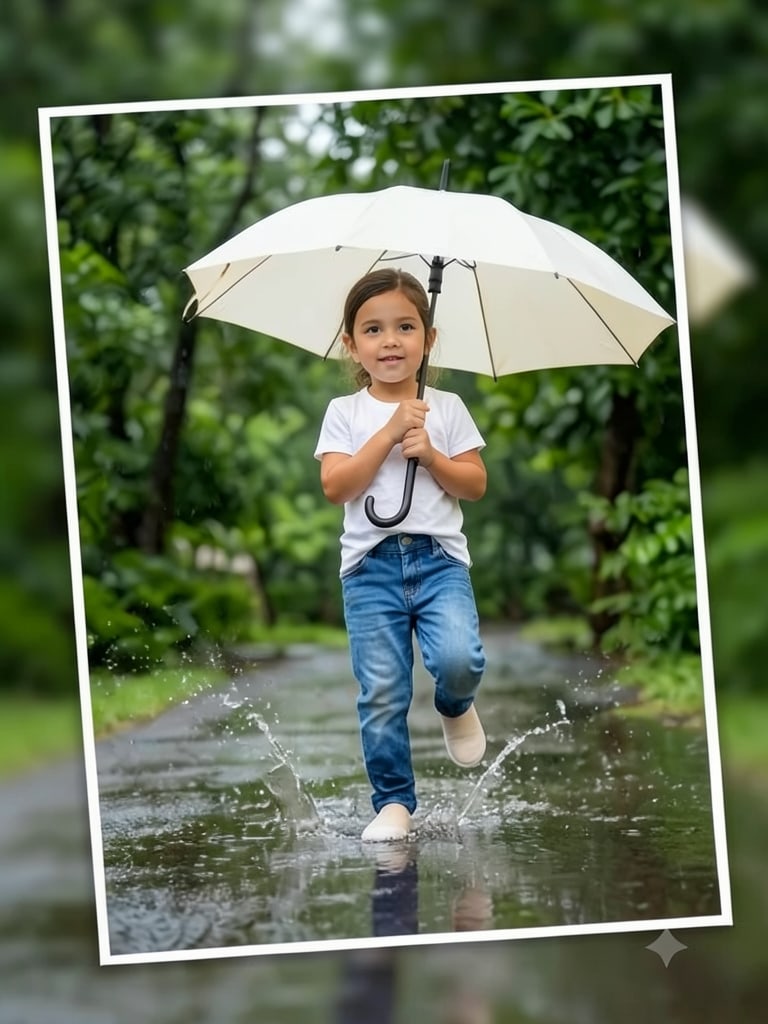 image / ChatGPT
Studio tools
AI Optimizer
Improve, shorten, expand or retarget this prompt for another image or video model. Every result is saved as a new version — the original is never overwritten.
Improve prompt
Produces optimized, concise, detailed, beginner and model-specific versions.
Generate variations
Professional, creative, cinematic, minimal and advanced.
Prompt history
- v1 · Original1 day ago