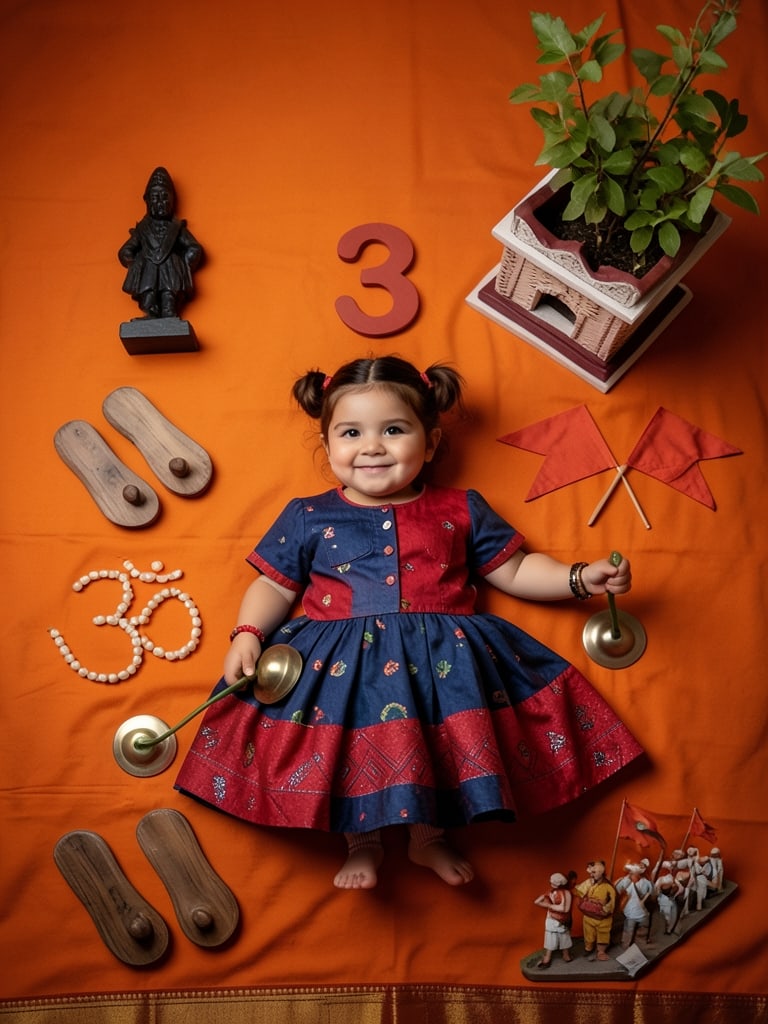
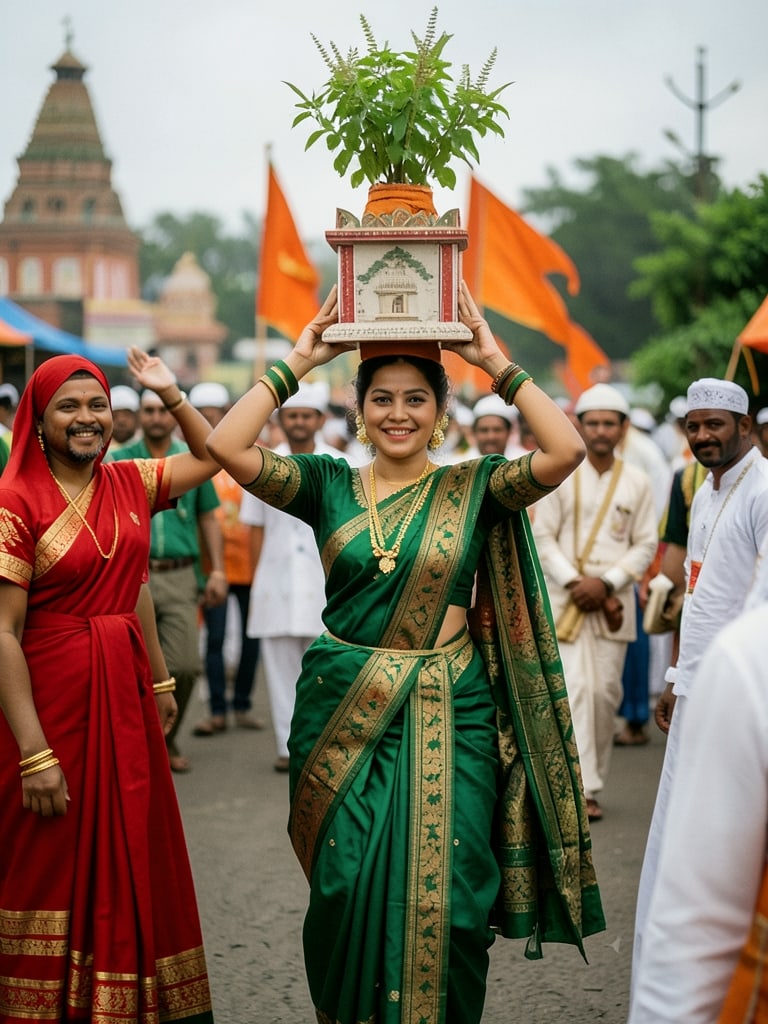
Vitthal Devotional Ashadhi Ekadashi Girl Photoshoot with Floral Flat Lay
Portrait Photography prompt: create image STRICT FACE IDENTITY PRESERVATION DNA Use the uploaded image exclusively as the facial identity reference for the baby. Preserve the…
Prompt
create image
STRICT FACE IDENTITY PRESERVATION DNA
Use the uploaded image exclusively as the facial identity reference for the baby. Preserve the exact facial identity, including the head shape, forehead proportions, hairline, eyebrows, eyelids, eye spacing, eye shape, nose structure, cheeks, lips, jawline, chin, ears, skin tone, skin texture, facial symmetry, and apparent age. Preserve the baby’s calm innocent facial expression, soft cheeks, natural infant smile, and delicate facial proportions exactly as shown. Do not beautify, stylize, enlarge the eyes, sharpen facial contours, modify complexion, alter age, or apply beauty-filter effects. The uploaded image serves only as the facial identity reference while every devotional object, floral arrangement, fabric relationship, and environmental element is reconstructed entirely through descriptive instructions.

SUBJECT DNA
Create an ultra-realistic premium Tulsi Vivah-inspired devotional baby flat-lay portrait, celebrating the sacred relationship between Lord Vitthal, Tulsi Mata, and Maharashtrian devotional traditions. The baby becomes the heart of a handcrafted spiritual artwork where every surrounding element contributes to a balanced devotional narrative rather than appearing as randomly placed props.

OUTFIT DNA
Dress the baby in a luxurious traditional Maharashtrian infant frock stitched from rich emerald-green silk with realistic woven texture and naturally flowing pleats. The neckline and sleeves remain softly gathered with premium tailoring. Around the waist, attach a handcrafted Paithani silk belt featuring vibrant magenta, saffron, and antique gold zari weaving finished with an oversized decorative silk bow positioned centrally. The lower border of the dress should display broad antique gold zari weaving framed with royal magenta edging, while the skirt spreads naturally around the baby’s body through realistic silk folds. Add delicate silver anklets on both feet, black infant bangles on both wrists, tiny traditional earrings, and a vertical white Vaishnav tilak with saffron centre on the forehead.

RITUAL OBJECT DNA
Construct a handcrafted devotional arrangement inspired by Tulsi worship.
Position a fully grown Tulsi plant along the left side of the composition with naturally branching stems, healthy green leaves, realistic flowering spikes, and authentic botanical structure.
Below the Tulsi plant create a handcrafted floral altar using densely arranged white jasmine blossoms surrounded by a thick border of vibrant pink rose petals. At the centre of this floral mandala place beautifully sculpted miniature black stone idols of Lord Vitthal and Goddess Rukmini, standing upon a realistic carved stone pedestal with authentic basalt texture.
Above the baby create a large handcrafted Marathi devotional rangoli spelling “विठ्ठल”, formed entirely from densely packed fresh white jasmine buds with naturally scattered saffron-orange marigold petals decorating the lettering. Integrate a saffron-yellow Vaishnav tilak into the centre of the typography.
Arrange subtle loose rose petals and jasmine blossoms naturally across the fabric to soften transitions between devotional objects.

POSITION DNA
Lay the baby diagonally across the lower-right portion of the flat-lay arrangement. Approximately ninety-eight percent of the baby’s body weight rests gently upon the soft fabric surface. The spine follows its natural infant curvature while the torso rotates approximately six degrees toward camera-left. The head turns gently toward camera-right by approximately eight degrees while remaining comfortably supported by the fabric. The left leg extends naturally downward with slight knee relaxation, while the right knee bends softly outward, creating realistic infant body mechanics. Both shoulders remain completely relaxed without tension.

HAND POSITION DNA
The baby’s right forearm bends naturally upward beside the shoulder with the tiny hand forming a relaxed partial fist. The left arm extends slightly outward from the torso with the elbow softly flexed and the fingers naturally separated according to authentic infant anatomy. Every joint should remain loose and anatomically correct, creating the appearance of spontaneous movement rather than instructed posing.

BODY LANGUAGE DNA
The baby should communicate peaceful curiosity and devotional innocence. The relaxed posture, softly lifted arms, naturally separated legs, and calm facial expression create the feeling of a child peacefully resting within a sacred ceremonial space prepared with love and devotion. Every body mechanic should remain physically accurate for an infant.

EYE DIRECTION DNA
The baby looks directly upward toward the overhead camera with calm, attentive eyes filled with soft natural catchlights. The gaze establishes an immediate emotional connection while preserving complete innocence.

CAMERA DNA
Position the camera exactly 90 degrees overhead, perfectly perpendicular to the floor with zero perspective distortion. Mount the camera approximately 2.3 metres above the devotional arrangement, ensuring complete visibility of the baby together with every ritual object while maintaining symmetrical flat-lay geometry.

CAMERA POSITION DNA
Align the optical centre directly above the baby’s chest while balancing the Tulsi plant, floral altar, and Marathi floral typography around the composition. Maintain perfectly parallel sensor alignment with the fabric surface to eliminate distortion and preserve museum-quality flat-lay precision.

CAMERA DISTANCE DNA
Capture using a professional full-frame camera fitted with a 50mm macro prime lens positioned approximately 2.3 metres above the arrangement. This focal length preserves true proportions while delivering edge-to-edge sharpness throughout every devotional object.

CAMERA ELEVATION RELATIONSHIP DNA
The perfectly overhead camera transforms the scene into sacred devotional artwork where every ceremonial object becomes equally important within the visual narrative. The baby serves as the spiritual centre while the surrounding devotional symbols radiate harmoniously throughout the composition.

LENS DNA
Photograph using a professional full-frame camera equipped with a 50mm macro prime lens at f/6.3, ensuring complete sharpness across the baby, floral arrangements, Tulsi plant, Vitthal-Rukmini idols, typography, fabric textures, and every handcrafted devotional element.

LIGHTING DNA
Illuminate the flat-lay using two oversized overhead diffused softboxes positioned symmetrically above the arrangement. The lighting should remain shadow-free while preserving realistic silk reflections, botanical textures, flower petals, stone sculpture details, and premium infant skin rendering. Gentle overhead illumination should produce smooth tonal transitions without harsh contrast.

BOKEH DNA
Flat-lay compositions require consistent optical sharpness rather than background blur. Maintain uniform focus across the entire devotional arrangement with only extremely subtle edge softness beyond the outer decorative elements.

VISUAL DEPTH DNA
The foreground begins with premium charcoal-grey cotton fabric displaying realistic woven texture and naturally flowing folds. The primary subject layer consists of the baby rendered with pore-level skin detail, luxurious silk clothing, authentic jewellery, and realistic infant anatomy. The secondary layer includes the Tulsi plant, jasmine floral typography, Vitthal-Rukmini idols, floral mandala, and ceremonial petals arranged with handcrafted precision. The final layer consists of the remaining fabric surface, maintaining visual harmony while reinforcing the sacred atmosphere.

ENVIRONMENT DNA
Construct a premium handcrafted indoor devotional flat-lay inspired by traditional Maharashtrian Tulsi worship. The fabric should resemble a ceremonial altar prepared lovingly for Lord Vitthal, where every flower, leaf, and devotional object is intentionally positioned according to spiritual symbolism. The entire environment should communicate serenity, purity, and traditional craftsmanship.

STORYTELLING DNA
This portrait celebrates the baby’s place within the sacred Warkari tradition. The Tulsi plant represents devotion, the jasmine typography glorifies the holy name of Vitthal, the floral altar symbolizes worship, and the miniature Vitthal-Rukmini idols remind viewers of Pandharpur’s timeless spiritual heritage. The baby peacefully resting among these devotional symbols represents the passing of faith from one generation to the next. Rather than documenting a milestone, the portrait should become a timeless devotional artwork filled with cultural authenticity and emotional warmth.

TYPOGRAPHY DNA
Create the Marathi word “विठ्ठल” entirely from densely arranged fresh white jasmine buds positioned above the baby’s head. Scatter vibrant saffron-orange marigold petals naturally across the lettering without obscuring readability. Integrate a traditional saffron-yellow Vaishnav tilak at the centre of the typography. The floral lettering should appear handcrafted, symmetrical, and naturally integrated into the ceremonial arrangement rather than digitally placed.

COMPOSITION DNA
Construct the composition using balanced devotional geometry. The floral Marathi typography anchors the upper portion, the Tulsi plant balances the left side, the floral Vitthal-Rukmini altar occupies the lower-left corner, and the baby rests diagonally across the lower-right region. Every object should maintain equal visual spacing, creating elegant negative space between devotional elements. The viewer’s eye should naturally travel from the floral typography to the Tulsi plant, then to the baby, and finally to the Vitthal-Rukmini altar, producing a museum-quality devotional flat-lay masterpiece.

FINAL OUTPUT
Create an ultra-realistic premium Tulsi Vivah-inspired devotional baby flat-lay portrait in 4K Ultra HD, photographed with a professional full-frame camera using a 50mm macro prime lens at f/6.3, featuring physically accurate optics, luxurious Maharashtrian silk attire, authentic Tulsi botanical textures, handcrafted jasmine floral typography, realistic Vitthal-Rukmini stone idols, premium ceremonial flower arrangements, edge-to-edge optical sharpness, emotionally immersive devotional storytelling, museum-quality flat-lay photography, and a 9:16 vertical composition.
How to use
Paste the prompt into Stable Diffusion. Swap the subject and keep the lighting, lens and style details for a consistent look.
Use case
Portrait Photography — baby, devotional
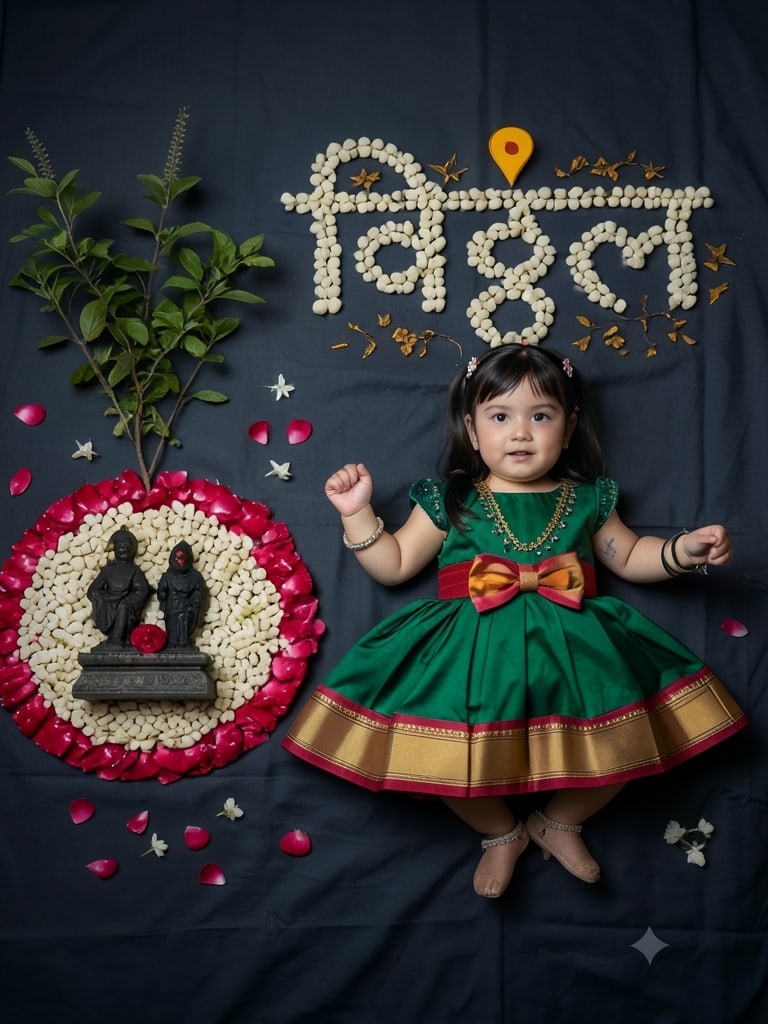 image / ChatGPT
Studio tools
AI Optimizer
Improve, shorten, expand or retarget this prompt for another image or video model. Every result is saved as a new version — the original is never overwritten.
Improve prompt
Produces optimized, concise, detailed, beginner and model-specific versions.
Generate variations
Professional, creative, cinematic, minimal and advanced.
Prompt history
- v1 · Original1 day ago