PromptBehind
Use case

Prompts for devotional

27 prompts tagged devotional.

27 prompts for devotional, each shown with a rendered example. Copy one, swap the details in brackets for your own, and run it in the model of your choice.

PromptBehind's discovery engine writes and vets these automatically around the clock, then ranks them by how often people actually copy them — so this page changes as tastes do.

Preview of Devotional Night Vigil Couple at Temple
image / Gemini
Street & DocumentaryGemini · ChatGPT

Devotional Night Vigil Couple at Temple

Preserve the facial identity of both individuals from the reference image without any enhancement or modification, ensuring 100% exact likeness. Close-up framing of the pair standing inside a temple courtyard after dark on Mahashivratri. Together they carry a ceremonial metal tray laden with bilva leaves and lit oil lamps. The background features ancient temple architecture illuminated by countless flickering lamps that dissolve into soft, creamy bokeh against the pitch-black evening. Natural photojournalistic illumination casts a warm, flickering glow across the scene, contrasting with the dark night. Atmosphere is serene, deeply spiritual, and tranquil, capturing the essence of an authentic nocturnal prayer. Shot in a candid documentary aesthetic, featuring ultra-realistic textures, intricate details, and crisp edge definition throughout.

10 0 0
5d
Preview of Sunset River Offering Ritual
image / Gemini
Festivals & OccasionsGemini · ChatGPT

Sunset River Offering Ritual

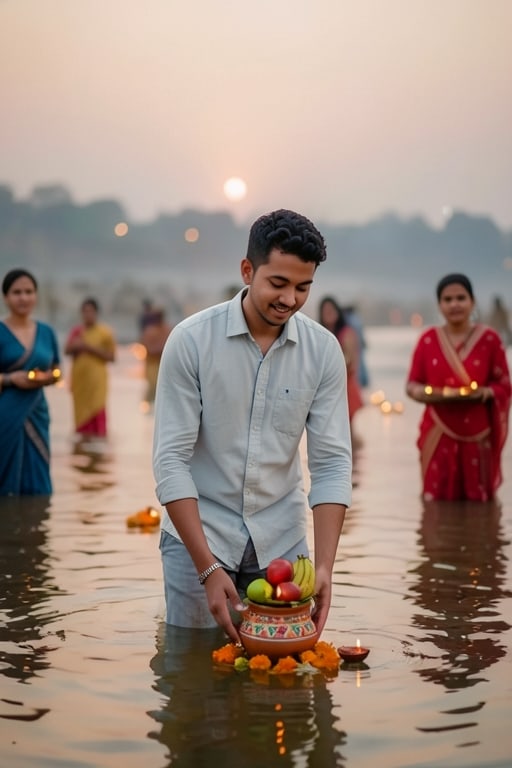
Subject: a youthful Indian male with a neat haircut and a calm, focused smile, standing knee‑deep in a river or pond at sunset. Attire: bright yellow kurta paired with white trousers, both partially submerged in the water. Action: gently placing a traditional clay basket (dala/soop) filled with fresh apples, bananas, pomegranates and marigold blossoms onto the water’s surface. Props: a small lit earthen lamp (diya) floating beside the offering. Background: softly blurred group of additional devotees, primarily women dressed in vivid red and maroon sarees, also holding their own offerings and lit diyas, contributing to a communal atmosphere. Lighting: warm golden glow from the setting sun, creating reflective highlights on the water. Mood: tranquil, reverent, and devotional. Composition: medium shot, eye‑level perspective with shallow depth of field, emphasizing the central figure while keeping the crowd out of focus. Colour palette: warm yellows, earthy tones, and deep reds. Aspect ratio: 3:4. Quality: high detail, realistic rendering.

10 0 0
5d
Preview of Festive River Ritual in Green Saree
image / Gemini
Festivals & OccasionsGemini · ChatGPT

Festive River Ritual in Green Saree

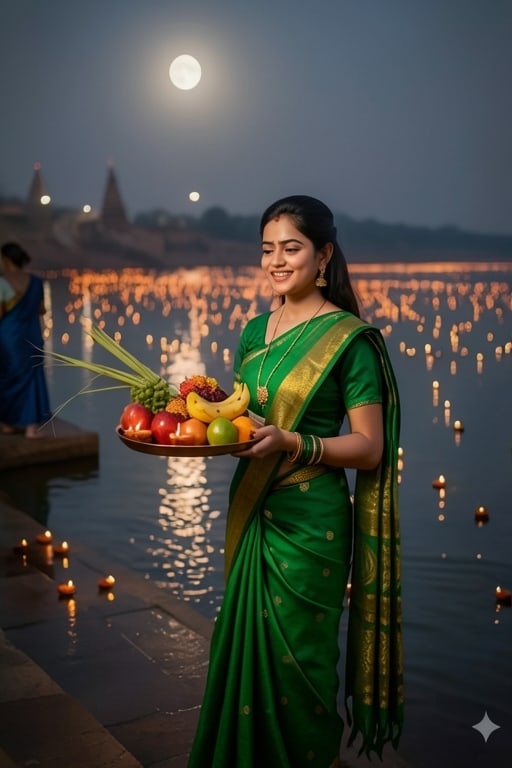
Generate an image using the uploaded portrait of an Indian woman dressed in a green saree, standing beside a river where countless glowing diyas float on the water. A full moon shines in the sky above, and she holds a puja thali filled with fruit and sugarcane. Render the scene with realistic lighting, a richly detailed background, a devotional expression, and the overall feel of a traditional cultural festival.

10 0 0
5d
Preview of Devotional Portrait of Young Man and Goddess
image / Gemini
Festivals & OccasionsGemini · ChatGPT

Devotional Portrait of Young Man and Goddess

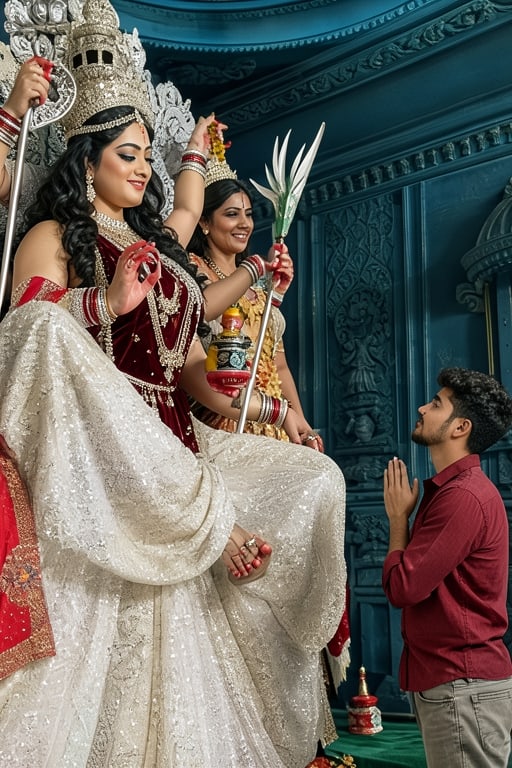
Primary Subject: A young South Asian male with short, dark, wavy hair and a neatly trimmed beard, dressed in a white patterned long‑sleeve shirt and grey jeans, stands in profile. His hands are pressed together in a respectful Namaste pose, his gaze lifted upward in reverence. Divine Presence: Adjacent to him sits an imposing, intricately detailed statue of the Hindu goddess Durga. She is portrayed with long, dark, curly hair, crowned by an elaborate silver and jeweled headdress and multiple necklaces. Her attire includes a deep maroon velvet blouse and a heavily sequined, shimmering silver saree. Red alta/henna motifs decorate her hands. Environment: The scene unfolds within a meticulously carved interior rendered in a monochrome palette of deep teal‑blue or cyan, resembling a temple or pandal. Traditional architectural panels and pillars frame the space, evoking a solemn devotional setting. Lighting & Style: Cinematic illumination casts soft highlights that catch the sequined fabric and metallic ornaments, delivering a realistic, high‑detail portrait photography aesthetic.

7 0 1
3w
Preview of Devotional Vat Purnima Emerald Saree Portrait
image / Gemini
Photo Edits & TrendsGemini · ChatGPT

Devotional Vat Purnima Emerald Saree Portrait

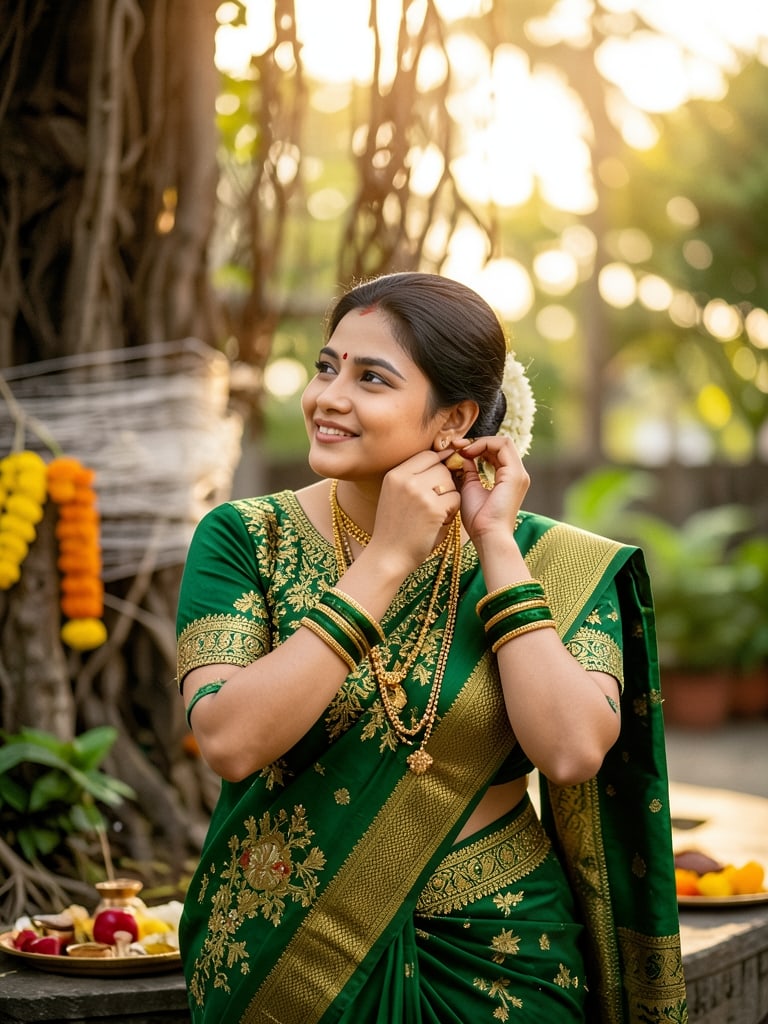
Generate a visual artwork depicting a Vat Pournima Photoshoot in a vertical 9:16 aspect ratio, captured through ultra-realistic photography at 4K Ultra HD quality. This premium cultural portrait photograph radiates an authentic Vat Savitri ritual ambiance coupled with elegant devotional storytelling. CRITICAL IDENTITY LOCK Strictly maintain the exact facial features from the provided reference photo. Replicate with total precision the face shape, forehead structure, hairline, eyebrows, eyes, eyelids, eye spacing, nose shape, lips, smile formation, jawline, chin, ears, skin tone, skin texture, symmetry, age, and expression. Absolutely prohibit any beautification, stylistic alterations, complexion modifications, eye enlargement, feature sharpening, age shifting, or beauty filter application. FRAMEWORK BLUEPRINT The piece is fundamentally a tight upper-body cultural portrait where the subject fills roughly 70 to 75 percent of the vertical frame. She wears an emerald green saree featuring an ornate gold zari border, paired with a maroon blouse with gold embroidered sleeves. She is adorned with gold jhumka earrings and green glass bangles, maintaining a gentle natural smile with her face angled slightly towards camera-left. Both hands are positioned by her ear in a graceful earring-adjustment pose, set against a blurred outdoor natural background illuminated by warm golden-hour light, all maintaining a luxury portrait aesthetic. CHARACTER WARDROBE A traditional married Maharashtrian woman styled for the Vat Pournima festival. She is draped in a rich, emerald Paithani-style silk saree with an opulent gold zari border. Traditional ornaments include a delicate nath, a mangalsutra, a crescent-shaped chandrakor bindi, a gold necklace, gold jhumkas, emerald green glass bangles, and a subtle application of sindoor. Her locks are gathered into a traditional low bun wrapped in a fragrant jasmine gajra, retaining an exquisite face-framing silhouette. POSTURE AND POSE Replicate the upper-body torso angle turned roughly 15 degrees toward camera-right, with relaxed shoulders and the head gently canted to camera-left. The chin is slightly dipped, projecting an aura of grace, devotion, and tranquil assurance. No full-body or leg positioning is implied. HAND PLACEMENT The right hand is lifted near the ear, delicately touching and adjusting a jhumka earring, while the left hand is held underneath to softly support the motion. Fingers are naturally curved without holding any thread, thali, or ritual objects, keeping the earring adjustment as the central narrative gesture. GAZE AND EXPRESSION Her eyes are directed softly toward camera-left, mirroring the reference precisely. She is not looking straight at the lens, downward, or at ritual paraphernalia. Her expression remains serene, warm, graceful, and deeply devotional. CAMERA SPECIFICATIONS Vertical 9:16 framing at eye-level perspective from a front three-quarter portrait angle. The tight upper-body crop mirrors the proportions of the reference visual. SPATIAL DISTANCES The lens-to-subject distance is set at 1.2 to 1.5 meters for an intimate close portrait with natural facial dimensions. The subject-to-background distance ranges between 12 and 20 meters, yielding stark depth separation and rich background blur. Foreground-to-subject distance is minimal at 0 to 0.5 meters, employing telephoto compression, strong subject isolation, and lush creamy bokeh. OPTICAL CONFIGURATION Captured using a 135mm portrait lens at an f/1.8 aperture, delivering razor-sharp focus on the eyes, ornaments, skin texture, and saree border with high-end optical compression. BOKEH AND LIGHTING Luxurious creamy bokeh formed by banyan canopy leaves, aerial roots, soft marigold florals, foliage, and dappled sunlight. Produces large circular light highlights, profound subject separation, and a dreamy spiritual mood. DEPTH LAYERS The foreground features soft floral highlights and understated devotional petals. The subject layer highlights the woman adjusting her ornament. Secondary layers showcase blurred banyan foliage and dangling roots, backed by a sacred garden environment under a grand banyan tree, all enveloped in a warm devotional illumination, faint morning haze, and spiritual aura. SETTING AND ATMOSPHERE The sacred banyan tree environment is woven into the backdrop without overpowering the tight portrait framing. Festive marigold blooms and subtle cultural markers enhance the scene while preserving the core portrait composition and serene mood. NARRATIVE INTENT A refined Maharashtrian woman captured candidly mid-gesture as she arranges her earring prior to commencing sacred rites. The portrait prioritizes elegance, spiritual anticipation, and cultural beauty over a literal depiction of the ritual itself, remaining faithful to the reference portrait style. VISUAL HIERARCHY Eyes lead to the smile, followed by the earring, nath, saree border, bangles, and finally the soft devotional backdrop, emphasizing facial focus and upscale portrait storytelling without expanding into a full-body ritual layout. FINAL RENDERING Ultra-realistic Vat Pournima photoshoot, strict facial identity preservation from uploaded image, close-up cultural portrait, elegant Maharashtrian married woman, emerald-green Paithani saree, gold zari border, nath, mangalsutra, chandrakor bindi, jasmine gajra, natural earring-adjustment pose preserved from visual reference, warm golden-hour lighting, sacred banyan-inspired background, luxury creamy bokeh, realistic skin rendering, telephoto portrait compression --ar 9:16

7 0 2
1mo
Preview of Sacred Swami Samarth Devotional Baby Milestone Portrait
image / Gemini
Baby & KidsGemini · ChatGPT

Sacred Swami Samarth Devotional Baby Milestone Portrait

BIOMETRIC IDENTITY MANDATE – ABSOLUTE TOP PRIORITY The provided infant photograph acts as the singular biometric blueprint for the output image. Every facial feature—including head shape, forehead proportions, hairline, hair volume, eyebrow architecture, eye contours, inter-eye distance, eyelid details, nose structure, cheek roundness, lip dimensions, jawline, ear contour, complexion, natural asymmetry, and overall cranial geometry—must be replicated with absolute precision. The resulting child must be instantaneously recognizable as the exact infant from the reference image. Facial verification supersedes body positioning, wardrobe, ornaments, religious symbols, lighting, and creative styling. Avoid any beautification, alterations, age progression, stylized rendering, or cartoon effects. The finished picture must show the identical infant without any deviation in identity. ASPECT RATIO Render the visual in a 16:9 widescreen format. Ensure an uncluttered milestone layout where the infant serves as the main focal point, leaving adequate negative space for spiritual iconography, Marathi script, sacred motifs, and floral embellishments. The arrangement should appear balanced, luxurious, and expertly composed. CAMERA AND FRAMING Produce an expert overhead milestone flat-lay shot captured via a direct top-down perspective. The lens must be positioned squarely over the setup to form a symmetrical, artisanal composition. Place the child in the top-right quadrant, surrounded symmetrically by religious art and Marathi lettering. The result should mimic an upscale milestone session styled by a professional newborn photographer and botanical designer. SETTING AND BACKGROUND Lay down a deep matte-black fabric base across the entirety of the frame. The material ought to look smooth, high-end, and immaculately draped. This dark canvas must dramatically accentuate the luminosity of the bright saffron garments, emerald foliage, blossoms, and sacred iconography. The environment should exude elegance, spirituality, craftsmanship, and visual impact. INFANT POSE AND FACIAL EXPRESSION Position the baby comfortably flat on the backdrop in a vertical layout. The child should radiate joy, serenity, and natural emotion with a cheerful smile directed upward toward the lens. Limbs should rest naturally while keeping the face entirely unobstructed. The countenance must convey purity, happiness, reverence, and festivity. TRADITIONAL SWAMI SAMARTH WARDROBE Clothe the infant in a brilliant saffron-yellow traditional dhoti and spiritual attire characteristic of Swami Samarth followers. Adorn the neck with multiple authentic rudraksha bead necklaces. Mark the forehead with a classic tilak. The styling must remain culturally faithful, devotional, and fitting for a holy milestone portrait, complete with lifelike creases and high-quality fabric textures in the saffron textiles. SWAMI SAMARTH SPIRITUAL ARTWORK Construct an intricate, hand-assembled devotional portrait of Shri Swami Samarth on the left side of the scene. The likeness must be meticulously formed using sorted grains, seeds, legumes, and organic elements rather than paints or digital illustrations. This craftsmanship should look authentic and highly intricate while honoring spiritual traditions. Drape a fresh flower garland gracefully over the portrait. SACRED BOTANICAL INSTALLATION Directly behind the Swami Samarth art piece, build a large sacred banyan tree composed entirely of fresh green leaves. The flora should feature a sprawling canopy, believable foliage density, and ornamental hanging roots. This crafted botanical structure represents blessings, wisdom, longevity, and divine shielding. DEVOTIONAL ACCESSORIES Position a traditional prayer rosary artfully upon the background just beneath the Swami Samarth portrait. Near the infant’s feet, arrange a pair of traditional wooden holy sandals to signify spiritual respect and heavenly grace. These props must look authentic, handmade, and culturally accurate. MARATHI SCRIPT TYPOGRAPHY At the very bottom of the composition, spell out the Marathi inscription: “श्री स्वामी समर्थ” The letters must be painstakingly formed using saffron-yellow flower petals, seeds, and natural botanical items. The text needs to be bold, exceptionally legible, luxurious, and expertly arranged, serving as a primary decorative anchor for the milestone design. LIGHTING AND MOOD Employ soft, directional studio illumination with gentle overhead casting. The light should forge a striking contrast between the black foundation and the vibrant sacred elements. Skin tones must stay lifelike and authentic. The ambiance should feel sacred, warm, holy, and celebratory, retaining the polish of high-end milestone photography. EMOTIONAL ATMOSPHERE Emit a vibe of divine blessings, worship, innocence, holiness, security, thankfulness, and cultural heritage. The overall mood should mirror a hallowed milestone celebration dedicated to Shri Swami Samarth, presenting the infant as blessed, elated, and spiritually anchored within the handcrafted sacred space. VISUAL FIDELITY AND PRODUCTION STANDARDS Generate an ultra-authentic luxury spiritual milestone photograph boasting professional DSLR clarity, true-to-life skin texture, realistic textile rendering, intricate grain-mosaic art, precise botanical typography, premium foliage displays, and deep spiritual storytelling. Maintain strict biometric fidelity to the reference baby's face without any identity drift, ensuring sharp facial features, anatomically correct proportions, religious accuracy, and elite milestone photography benchmarks. The ultimate picture must look like a genuinely handcrafted sacred milestone portrait suitable for framing and family archiving.

7 0 2
1mo
Preview of Sacred Warkari Infant Devotional Flat Lay
image / Gemini
Baby & KidsGemini · ChatGPT

Sacred Warkari Infant Devotional Flat Lay

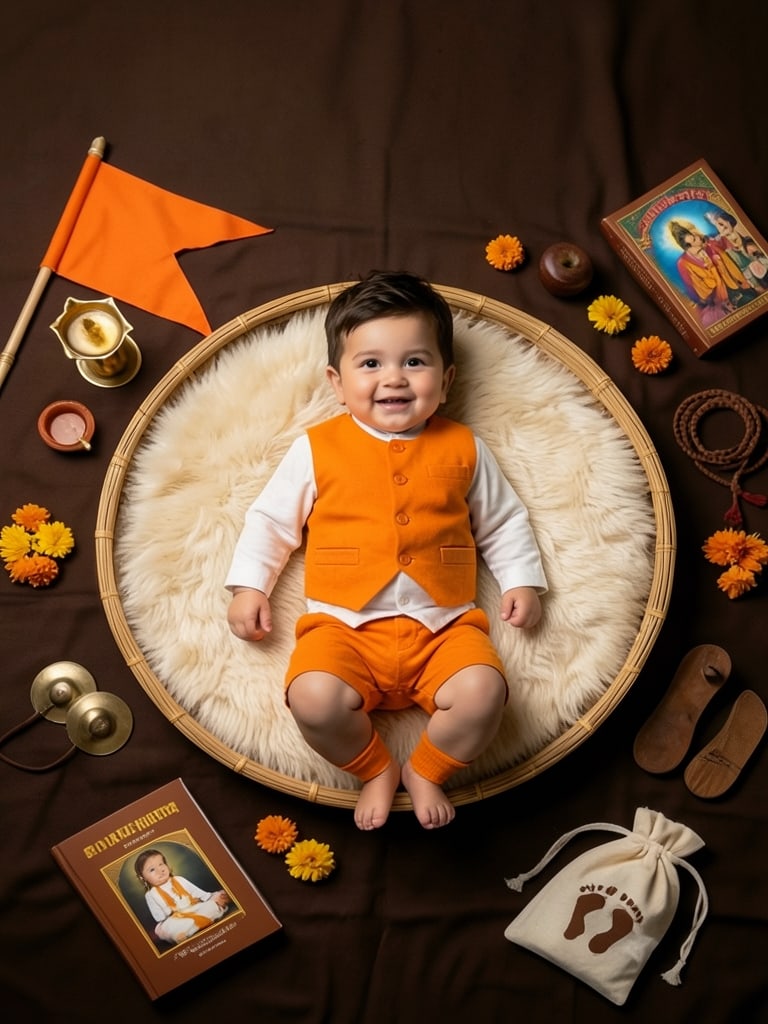
generate image of “Sant Tukaram Maharaj Palakhi Sohala Baby Photoshoot”, vertical 9:16 composition, ultra-realistic photography, 4K Ultra HD quality, premium cultural portrait photography, authentic Warkari devotional atmosphere, elegant spiritual storytelling. Use the attached photo as the person identity reference. Do not change the expression or face at all. Use the below description for image generation while preserving the exact facial identity from the attached photo. STRICT FACE IDENTITY PRESERVATION The uploaded baby’s face is used exclusively as the facial identity reference. Preserve the forehead, eyebrows, eyes, nose, lips, cheeks, ears, jawline, hairstyle, skin tone, facial proportions, baby age, expression, and natural innocence exactly as they appear in the uploaded image. No beautification, reshaping, stylization, or artistic reinterpretation is permitted. The final image must clearly depict the same baby. VISUAL RECONSTRUCTION DNA Recreate the composition exactly as a premium overhead flat-lay cultural baby photoshoot captured from a perfectly vertical 90-degree top-down camera angle. The camera is positioned approximately 2.0–2.2 metres above the baby using a 50 mm equivalent focal length, ensuring natural proportions with no perspective distortion. The baby occupies approximately 28–30% of the frame, leaving generous balanced negative space around the circular arrangement. SUBJECT POSITION DNA Place the baby perfectly centred inside a large circular woven bamboo basket filled with soft cream-coloured plush fur. The head rests near the upper portion of the basket while the feet point downward. The baby sits comfortably with both legs gently folded. The right hand naturally holds a small traditional wooden chipli (Warkari devotional clapper), while the left hand rests comfortably beside the lap, matching the visual reference. The baby looks directly upward toward the camera with the same calm, innocent expression. OUTFIT DNA Dress the baby exactly as shown in the reference with a traditional Maharashtrian Warkari outfit consisting of a crisp white kurta, matching white dhoti with narrow saffron-golden borders, a neatly fitted white Gandhi cap, and a saffron devotional stole draped around the neck. The stole bears vertically printed Marathi devotional text “राम कृष्ण हरी” in saffron. Preserve realistic cotton texture, garment folds, and authentic tailoring. OBJECT PLACEMENT DNA Maintain the exact symmetrical arrangement of devotional objects surrounding the basket. On the upper left place a large saffron Warkari flag mounted on a short wooden pole. Around it position a traditional brass oil lamp (samai), a lit clay diya, scattered marigold flowers, and a pair of brass hand cymbals. At the lower left place a brown devotional book featuring Sant Tukaram Maharaj artwork on its cover. On the upper right place another devotional book with colourful religious artwork, a small wooden container, scattered marigold flowers, and a neatly coiled Tulsi mala. Along the right side position a pair of traditional wooden paduka. At the lower right place a cream cloth pouch printed with sacred footprints, tied with a drawstring. Every prop should maintain identical scale, spacing, orientation, and visual balance exactly as observed in the reference. TYPOGRAPHY DNA At the top centre reproduce the devotional heading exactly as shown. Display “॥ विठ्ठल रखुमाई ॥” in elegant Marathi Devanagari calligraphy using cream-white lettering with subtle embossed texture and decorative styling. Above the heading recreate the identical sequence of small devotional symbols including the saffron location pin, sacred footprints, Vaishnav tilak, Swastik, and decorative circular emblem, preserving their exact order, size, spacing, colours, and placement. Typography must faithfully replicate the original font style, hierarchy, alignment, proportions, and decorative appearance. BACKGROUND DNA The entire background consists of a rich chocolate-brown fabric extending edge-to-edge with realistic woven texture and natural cloth folds. No additional scenery, flooring, or environmental elements should be introduced beyond the visual reference. LIGHTING DNA Use soft diffused overhead studio lighting with gentle shadow transitions. The basket, baby, and devotional objects should be evenly illuminated with warm natural tones, realistic highlights on brass objects, and soft shadows that enhance depth without creating harsh contrast. COLOR PALETTE DNA Maintain the original devotional palette consisting of chocolate brown, saffron orange, cream white, natural bamboo, brass gold, marigold yellow, warm wood tones, and subtle earthy colours. Preserve the harmonious visual balance exactly as shown. PHOTOGRAPHY DNA Create the final image as a premium professional cultural flat-lay baby portrait with exceptional sharpness, realistic textile rendering, handcrafted devotional object detailing, authentic material textures, high dynamic range, and true-to-life lighting. The finished image should resemble an expertly styled devotional newborn photoshoot rather than AI-generated artwork.

7 0 1
1mo
Preview of Devotional Warkari Infant Overhead Flat-Lay Portrait
image / Gemini
Baby & KidsGemini · ChatGPT

Devotional Warkari Infant Overhead Flat-Lay Portrait

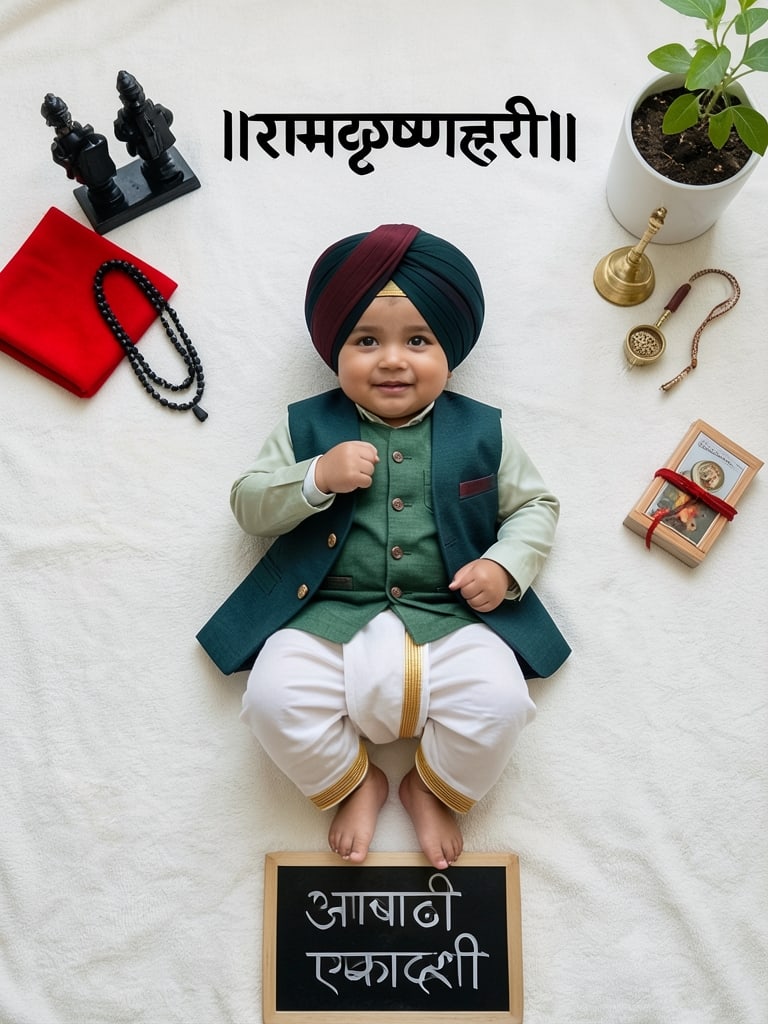
vertical 9:16 composition, ultra-realistic photography, 4K Ultra HD quality, premium cultural portrait photography, authentic Wari devotional atmosphere, elegant spiritual storytelling. Use attached photo as the person identity reference. Do not change the expression or face at all. Use the below description for image generation while preserving the exact facial identity from the attached photo. STRICT FACE IDENTITY PRESERVATION The uploaded baby’s face is used only as the facial identity reference. Preserve the face exactly without any modification. Maintain identical facial proportions, forehead shape, eyebrows, eyes, eyelids, iris size, nose structure, lips, cheeks, chin, jawline, ears, skin tone, baby age appearance, facial expression, hairline, hairstyle, and natural baby innocence. No beautification, stylization, aging, slimming, reshaping, or artistic reinterpretation is permitted. The final image must clearly appear as the same baby from the uploaded reference. VISUAL RECONSTRUCTION DNA Recreate the composition as an overhead flat-lay baby photoshoot captured from a perfectly vertical top-down camera angle (approximately 90 degrees). The baby lies precisely at the center of the frame on a large soft white plush blanket covering the entire background. The composition is highly symmetrical with generous negative space surrounding the baby. The camera is positioned approximately 2.2 to 2.5 meters above the baby, using a normal focal length equivalent to 35–50mm, producing natural proportions without wide-angle distortion. The baby occupies roughly 28–32% of the total frame height, leaving balanced spacing for surrounding devotional objects. SUBJECT POSITION AND BODY DNA The infant rests comfortably supine with the body aligned straight down the vertical axis of the frame. The head sits near the upper-middle section while the legs reach toward the lower center. The ankles cross softly with relaxed feet. One tiny fist rests naturally close to the chest while the opposite hand remains slightly lower near the waist with softly curled fingers. The face points straight upward toward the lens with calm eye contact and a peaceful devotional expression. OUTFIT DNA Dress the infant in traditional Maharashtrian Warkari-inspired ceremonial garments exactly matching the visual reference. The outfit features a crisp white full-sleeve upper tunic paired with traditional white dhoti-style trousers finished with a thin golden border near the edges. A beautifully wrapped traditional Maharashtrian pheta turban sits neatly on the baby’s head, featuring cream, saffron, olive-green, black, and golden woven stripe patterns exactly as shown. A matching patterned shawl crosses diagonally over one shoulder and wraps gracefully around the upper torso, harmonizing with the turban. The fabrics appear as soft, clean, premium cotton with natural folds and realistic textile texture. PROP PLACEMENT DNA Every object should remain positioned exactly as seen in the reference image. In the upper left area place two small black devotional saint idols on a rectangular pedestal. Below them position a neatly folded bright red cloth with a black tulsi mala resting on top. Above the baby, centered near the upper edge, include large black Devanagari text reading “॥रामकृष्णहरी॥”. On the upper right side place a small white square planter containing dark soil with a fresh green sapling. Below it arrange a polished golden ritual bell and a traditional brass puja accessory connected with golden thread. Slightly below that position a small devotional book tied with a red sacred thread. Near the lower center beneath the baby’s feet place a rectangular black chalkboard displaying handwritten white Marathi text reading “आषाढी एकादशी” in authentic chalk handwriting. Maintain identical spacing, scale relationships, and visual balance between every surrounding object. TYPOGRAPHY DNA The upper devotional heading “॥रामकृष्णहरी॥” should appear centered horizontally near the top edge in bold black Devanagari calligraphy with clean high-contrast strokes, generous letter spacing, and strong visual clarity. The lower chalkboard typography must faithfully replicate authentic handwritten Marathi chalk writing with naturally uneven brush pressure, textured white strokes, and centered alignment. Preserve the hierarchy exactly, with the upper heading visually separated from the baby and the lower chalkboard serving as the primary textual anchor beneath the subject. LIGHTING DNA Use soft diffused indoor lighting from directly above with extremely gentle shadow transitions. The illumination evenly covers the blanket, costume, accessories, and infant’s face while maintaining subtle depth and realistic fabric texture. White balance remains neutral with slightly warm skin tones and soft highlights without harsh reflections. BACKGROUND DNA The backdrop consists entirely of a luxurious white plush blanket with visible soft fabric texture and natural folds. The blanket fills the complete frame edge-to-edge without interruption. No additional decorations, patterns, or environmental scenery should be introduced beyond the objects present in the visual reference. COLOR PALETTE DNA Maintain a minimal devotional color palette dominated by white, cream, saffron, muted olive green, black, red, gold, and natural wood tones. The restrained palette emphasizes purity and spiritual simplicity while allowing the devotional objects to stand out naturally. PHOTOGRAPHY DNA Capture the scene as a premium professional flat-lay newborn photography setup with razor-sharp focus across the entire arrangement. Preserve realistic fabric textures, handcrafted devotional object details, natural skin texture, accurate depth rendering, and high dynamic range. The image should resemble an authentic studio-quality cultural baby portrait rather than AI-generated artwork. WATERMARK DNA P

7 0 2
1mo
Preview of Devotional Warkari Pilgrimage Infant Photoshoot
image / Gemini
Baby & KidsGemini · ChatGPT

Devotional Warkari Pilgrimage Infant Photoshoot

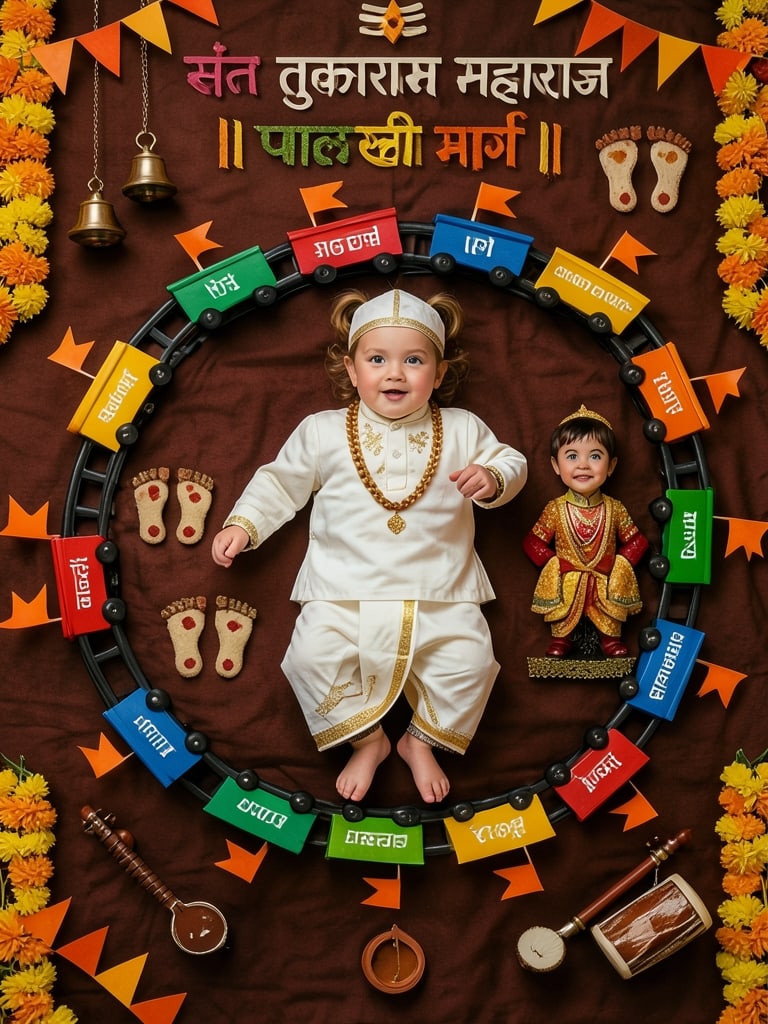
create image of “Sant Tukaram Maharaj Palakhi Sohala Baby Photoshoot”, vertical 9:16 composition, ultra-realistic photography, 4K Ultra HD quality, premium cultural portrait photography, authentic Warkari devotional atmosphere, elegant spiritual storytelling. Use the attached photo as the person identity reference. Do not change the expression or face at all. Use the below description for image generation while preserving the exact facial identity from the attached photo. STRICT FACE IDENTITY PRESERVATION The uploaded baby’s face is used exclusively as the facial identity reference. Preserve the exact forehead, eyebrows, eyes, eyelids, nose, lips, cheeks, chin, ears, skin tone, hairstyle, baby age, facial proportions, expression, and natural innocence. No beautification, stylization, reshaping, or age modification is permitted. The final result must clearly appear as the same baby from the uploaded image. VISUAL RECONSTRUCTION DNA Recreate the scene as a premium overhead flat-lay cultural baby photoshoot captured from a perfectly vertical 90° camera angle. The camera is positioned approximately 2.4–2.6 metres above the baby using a 45–50 mm equivalent focal length, producing natural proportions without perspective distortion. The baby lies exactly at the centre of the composition on a chocolate-brown cotton fabric background with realistic wrinkles and soft folds. The baby occupies approximately 34–36% of the frame height, leaving balanced space for the circular pilgrimage route. SUBJECT POSITION DNA The baby lies comfortably on the back in the exact pose visible in the reference. The head is positioned slightly above the geometric centre of the composition while the feet point toward the bottom edge. Both hands remain naturally bent beside the torso with relaxed fingers. The legs remain comfortably extended with slight separation between the feet. The baby looks directly upward with the same joyful smiling expression shown in the visual reference. OUTFIT DNA Dress the baby exactly as shown in the reference with a traditional white Maharashtrian Warkari costume consisting of a white cotton kurta, traditional white dhoti finished with a narrow golden border, a neatly fitted white Gandhi cap, and a medium-length brown Tulsi mala around the neck. Preserve the authentic cotton texture, garment folds, proportions, and traditional simplicity exactly as visible. PALAKHI ROUTE DNA Surround the baby with a perfectly circular miniature toy railway representing the complete Sant Tukaram Maharaj Palakhi route. The colourful wagons should remain evenly spaced with identical scale and each wagon carrying a small upright saffron triangular flag. Replace the existing route labels so that the wagons follow this pilgrimage sequence continuously around the circle: Dehu -> Akurdi -> Pune -> Loni Kalbhor -> Yavat -> Varvand -> Baramati -> Belsar -> Indapur -> Akluj -> Borgaon -> Wakhari -> Pandharpur. Arrange the locations sequentially around the complete circular railway so the visual clearly represents the devotional journey from Dehu to Pandharpur. The wagon colours should alternate naturally between green, blue, red, yellow, and orange while maintaining balanced visual rhythm. TYPOGRAPHY DNA At the upper centre reproduce the devotional heading exactly in Marathi. Display “संत तुकाराम महाराज” as the primary title with identical font style, colour hierarchy, weight, spacing, alignment, and decorative finish as seen in the reference. Directly below it display “॥ पालखी मार्ग ॥” in matching decorative Marathi typography with identical colour treatment and ornamental separators. Above the heading place the traditional Vaishnav tilak symbol with three sacred horizontal lines and a central saffron tilak exactly matching the reference. Every wagon label must use clean white Devanagari lettering centred on the coloured wagon while maintaining identical typography, size, spacing, and alignment. DECORATION DNA Maintain the complete decorative arrangement visible in the reference. Dense marigold garlands frame both vertical borders. Alternating saffron and yellow triangular buntings decorate the upper edge and lower corners. Two brass temple bells hang naturally from chains at the upper left. Small saffron flags appear rhythmically around the train circle. Two pairs of traditional sacred footprints remain on the left side within the circular composition. On the right side recreate the handcrafted bead-art style devotional figures of Lord Vithoba and Goddess Rukmini exactly as positioned in the visual reference. Along the bottom edge place the traditional tanpura on the left, an earthen oil lamp in the centre, and the traditional dholki with accompanying folk instrument on the right exactly matching the original layout. BACKGROUND DNA The background consists entirely of rich chocolate-brown fabric extending edge-to-edge with visible woven texture, natural cloth folds, and soft wrinkles. No additional scenery, flooring, walls, or environmental elements should be introduced. LIGHTING DNA Use soft overhead diffused studio lighting producing gentle natural shadows beneath the train, devotional objects, and clothing folds. Maintain warm devotional colour tones with evenly balanced exposure, preserving high detail across every object without harsh highlights. PHOTOGRAPHY DNA Create the final image as a premium professional cultural flat-lay newborn portrait with ultra-realistic textile rendering, handcrafted prop detailing, accurate material textures, true-to-life lighting, exceptional sharpness, and high dynamic range. The finished result should resemble an authentic professionally styled Sant Tukaram Maharaj Palakhi devotional baby photoshoot rather than AI-generated artwork.

7 0 3
1mo
Preview of Devotional Warkari Infant Portrait in Green Meadow
image / Gemini
Baby & KidsGemini · ChatGPT

Devotional Warkari Infant Portrait in Green Meadow

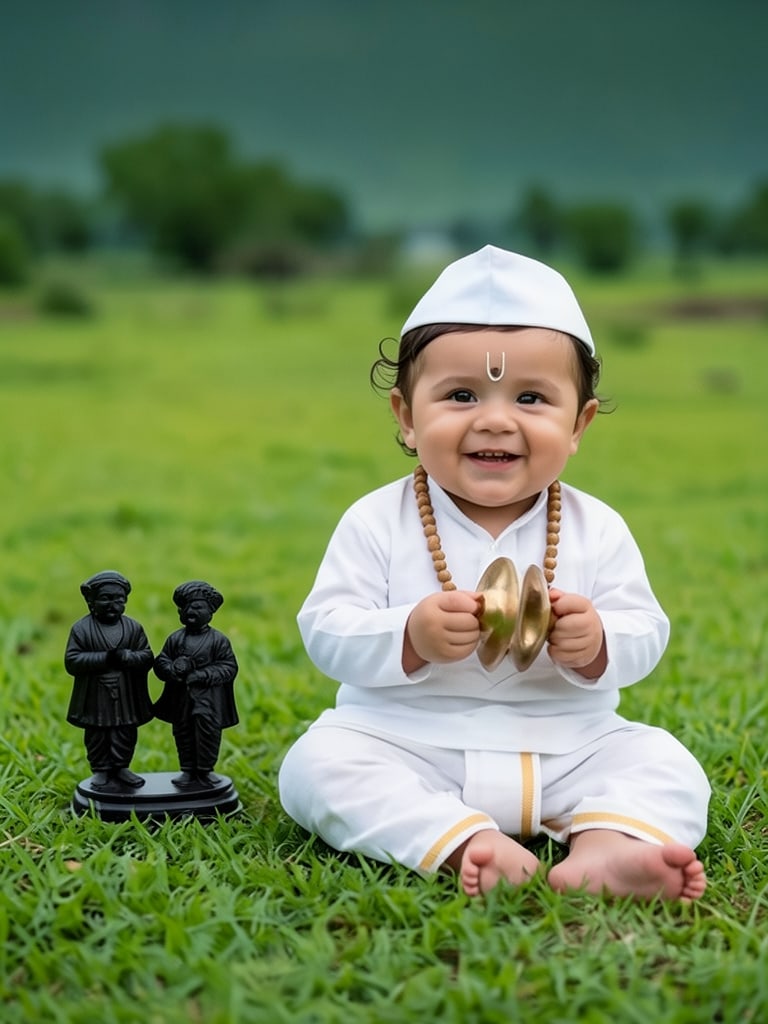
Generate a visual artwork titled Sant Tukaram Maharaj & Sant Dnyaneshwar Maharaj Palakhi Sohala Baby Portrait, rendered in a 9:16 vertical frame. Apply ultra-realistic photography principles at 4K Ultra HD resolution, aiming for an upscale devotional baby portrait that exudes a genuine Warkari spiritual aura and sophisticated cultural narrative. Strictly utilize the provided photograph exclusively as a biometric blueprint: maintain the infant's exact facial structure, smile, eye architecture, eyebrow contours, nose, lips, cheek volume, ear shape, forehead dimensions, skin coloration, curly hairline showing under the cap, and developmental age. Absolutely zero beautification, artistic stylization, structural alteration, or facial modification is allowed; the child's identity must match the reference without deviation. COMPOSITION AND FRAMING Replicate the spatial layout of the source photo closely. The infant is seated comfortably on a vibrant patch of green turf, legs folded forward, torso canted slightly to the left while the head angles toward the lens. The subject fills roughly 42 to 46 percent of the vertical frame, leaving an expansive, soft green backdrop identical to the original image. Capture the scene from a distance of about 2.2 meters using an 85mm full-frame portrait lens equivalent, shooting from the child's eye level with a downward tilt of roughly 5 degrees, preserving the identical shallow depth of field and professional composition. SUBJECT POSTURE AND EXPRESSION The baby sits upright independently, displaying the original cheerful, open grin. The eyesight is directed slightly upwards toward the camera. Both arms are lifted before the chest, hands grasping miniature traditional brass hand cymbals (Taal/Chipli) in a relaxed, joyful, devotional gesture. ATTIRE AND ADORNMENTS Clothe the infant in a genuine white cotton Maharashtrian Warkari ensemble crafted from soft handwoven fabric, consisting of a classic white kurta and dhoti featuring a delicate golden trim along the hem. A pristine white Gandhi cap rests naturally on the head just like in the reference. A traditional Tulsi bead necklace with authentic wooden texture hangs around the neck. A classic Vaishnav tilak mark is drawn upon the forehead, comprising a white U-shape intersected by a thin black center line, positioned precisely as seen in the source image. DEVOTIONAL ARTIFACTS In both hands, the infant holds gleaming, traditional brass hand cymbals (Taal/Chipli) that show authentic metallic glints and appear held as if taking part in a Warkari hymn. SPIRITUAL SCULPTURES Positioned on the turf to the baby's left are two finely sculpted black stone figures depicting revered historical saints on individual stands. Keep the relative height, spacing, orientation, and placement consistent with the reference material. The statues should feature detailed stone carvings reflecting Warkari devotion while remaining visually subordinate to the central infant subject. ENVIRONMENTAL SETTING Set the scene on a broad, verdant lawn that fades into the distance. The background scenery exhibits a soft blur with faint suggestions of distant foliage and open fields, evoking the tranquil mood of a traditional pilgrimage. Omit any extra decorative props or festive items not present in the reference. LIGHTING SETUP Employ gentle ambient daylight beneath a lightly overcast sky. The illumination is evenly diffused, casting soft highlights across the child's face, white garments, cap, brass instruments, wooden beads, and black stone carvings, avoiding harsh shadows and maintaining a natural outdoor colour balance. COLOR PALETTE Retain the authentic color harmony comprising lush green turf, soft-focus green background, bright white traditional garments, warm wood-toned Tulsi beads, polished golden brass, dark matte stone sculptures, and realistic infant skin tones. TECHNICAL PHOTOGRAPHIC QUALITY Produce a top-tier professional devotional infant portrait characterized by lifelike skin texturing, visible cotton weave patterns, realistic brass reflections, tangible grass blade details, intricate stone sculpture carvings, smooth cinematic background bokeh, razor-sharp focus strictly on the child's face, and museum-grade cultural realism.

7 0 2
1mo
Preview of Divine Warkari Floral Flat Lay Baby Photoshoot
image / Gemini
Baby & KidsGemini · ChatGPT

Divine Warkari Floral Flat Lay Baby Photoshoot

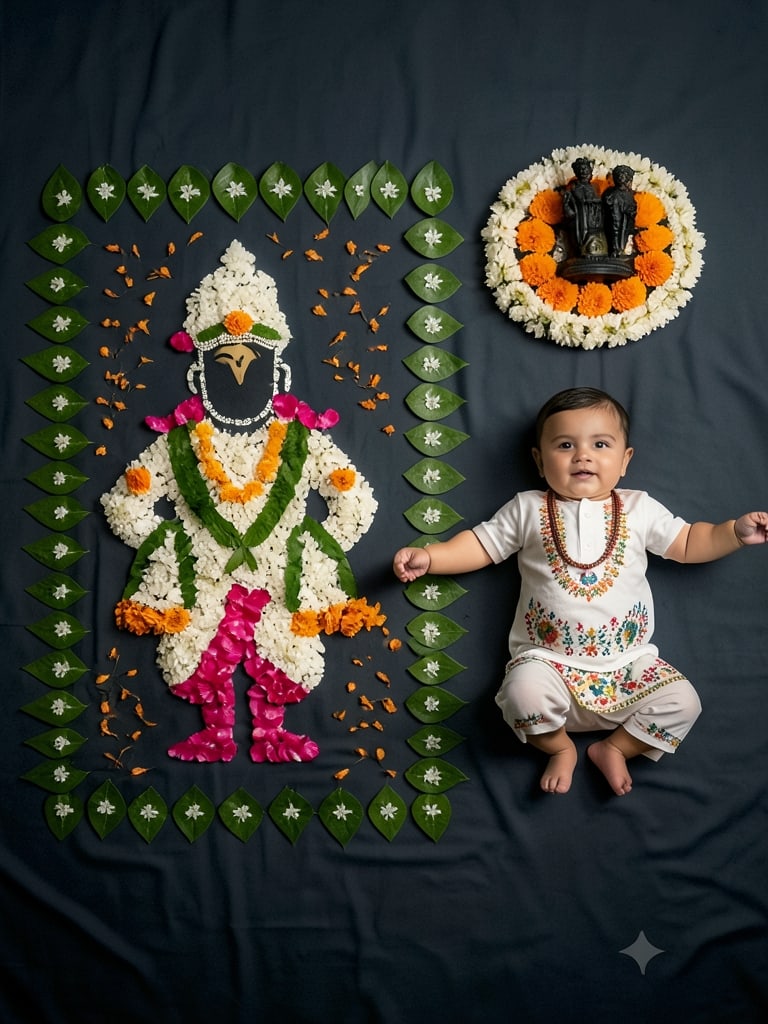
generate a picture entitled “Sant Tukaram Maharaj & Sant Dnyaneshwar Maharaj Palakhi Sohala Baby Flat Lay Photoshoot”, vertical 9:16 frame, ultra-realistic photography, 4K Ultra HD resolution, high-end spiritual flat-lay baby portraiture, traditional Warkari cultural artistry, sophisticated ethnic storytelling. Utilize the provided image solely as the facial identity template. Do not alter the infant's facial features, look, body scale, or posture. Follow the specification below while keeping the exact face from the source photograph. STRICT FACE IDENTITY PRESERVATION The uploaded infant picture functions exclusively as the facial template. Retain the child's eyes, brows, forehead, nose, lips, cheeks, ears, complexion, facial proportions, baby age, hairline, and serene natural look identically as presented. No beautification, artistic reshaping, or facial changes are allowed. The infant must be instantly recognizable as the uploaded kid. VISUAL REFERENCE DNA Recreate the top-down arrangement closely matching the layout reference. The photo is shot straight down from a precise overhead 90-degree angle, with the camera set roughly 2.2 to 2.4 meters above the scene utilizing a 50mm full-frame equivalent lens to avoid perspective warping. The infant takes up around 34 to 38 percent of the total vertical canvas, situated on the right portion of the shot, while the large spiritual floral portrait sits on the left half. Preserve the ample negative space, harmonious composition, and artisan flat-lay aesthetic identical to the sample. SUBJECT DNA The infant rests comfortably upon a matte dark charcoal textile ground in the identical relaxed pose as the template. Keep the exact arm placement with both arms softly stretched out, the relaxed leg stance with one limb naturally flexed, and the calm forward gaze. The child serves as the secondary focal point following the artisan spiritual artwork, matching the visual weight of the reference. OUTFIT DNA Clothe the infant in a traditional white Maharashtrian Warkari garment crafted from gentle handloom cotton. The classic white kurta and dhoti must showcase realistic textile grain and organic cloth folds. Around the neck, position a genuine Tulsi seed necklace featuring realistic wooden bead work. Apply a traditional Vaishnav tilak comprising a white U-shaped sign featuring a thin black central stripe placed on the forehead precisely matching the sample. DEVOTIONAL RANGOLI DNA On the left portion of the composition, build a large artisan floral rangoli portraying Lord Vitthal (Vitthoba). The creation must be built entirely from fresh white petals for the figure outline, vibrant pink petals for the feet and lower highlights, rich green foliage forming the garland and decorative accents, and scattered orange petals placed throughout precisely like the original. The rangoli should keep the identical scale, handmade look, and visual hierarchy as the base layout. BORDER DNA Encircle the rangoli with a continuous rectangular ornamental border built from fresh green leaves arranged edge-to-edge. Tiny white blossoms should sit centered on each leaf at regular intervals identically matching the artisan border style seen in the reference. Maintain the identical spacing, symmetry, and handmade texture. FLORAL DECORATION DNA Scatter fresh orange petals organically across the rangoli zone while leaving the right side surrounding the infant relatively clean. The petals ought to look randomly spread yet visually balanced identically as observed in the sample. DEVOTIONAL EMBLEM DNA At the top-right corner, construct a round floral design composed of fresh white blossoms framing vivid orange flowers. In the middle of this floral ring, position a delicately carved black miniature statue depicting Sant Tukaram Maharaj and Sant Dnyaneshwar Maharaj standing together on a shared base. Keep the identical proportion relationship and positioning as the visual template. BACKGROUND DNA Keep a smooth dark charcoal-grey cloth ground spanning the entire frame. The material should exhibit subtle natural creases and soft fabric grain while staying visually clean and uniform, identically matching the reference. LIGHTING DNA Employ high-grade diffused overhead softbox illumination delivering even brightness across the entire flat-lay setup. Shadows must remain exceptionally soft with no harsh directional rays, enabling every artisan floral element, leaf grain, cotton textile, and the infant's facial details to stay distinctly clear. COLOR RELATIONSHIP DNA Retain the refined devotional palette of charcoal grey, pure white, natural green, vivid orange, bright pink, warm brown Tulsi beads, natural baby skin tones, and matte black spiritual sculpture. Maintain realistic color harmony without oversaturation. PHOTOGRAPHY DNA Output as an ultra-luxurious professional flat-lay devotional infant portrait showcasing photorealistic skin texture, realistic cotton textiles, authentic flower petal grain, fresh green foliage, artisan rangoli detailing, razor-sharp focus across the entire layout, perfectly aligned overhead geometry, museum-grade cultural styling, and highly detailed professional realism.

7 0 2
1mo
Preview of Devotional Newborn Warkari Festival Photoshoot Portrait
image / Gemini
Baby & KidsGemini · ChatGPT

Devotional Newborn Warkari Festival Photoshoot Portrait

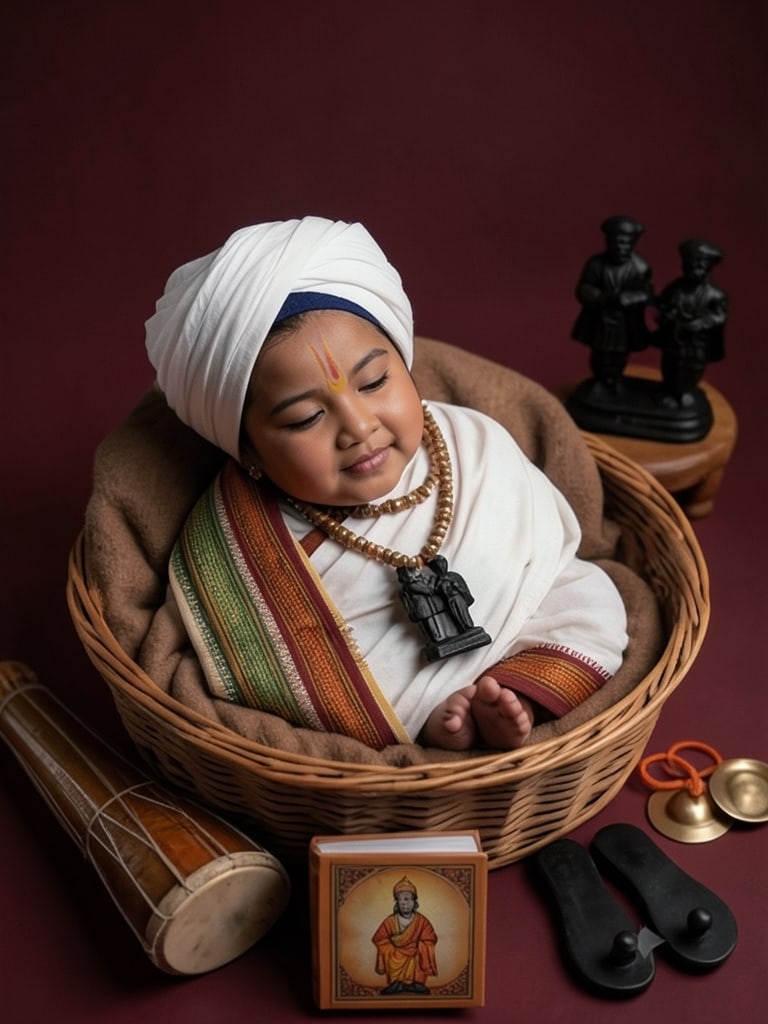
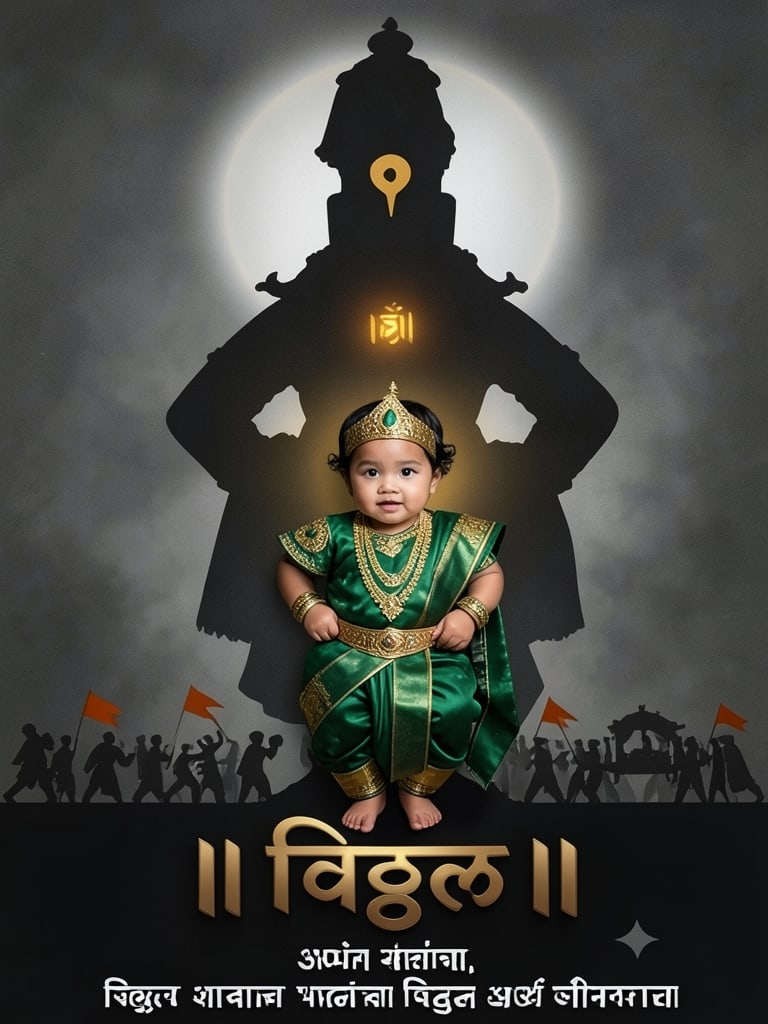
generate image of "Sant Tukaram Maharaj & Sant Dnyaneshwar Maharaj Palakhi Sohala Sleeping Baby Photoshoot", vertical 9:16 aspect ratio, ultra-realistic photography, 4K Ultra HD resolution, premium spiritual newborn portraiture, authentic Warkari devotional atmosphere, elegant cultural storytelling. Use the uploaded photograph strictly as the personal identity reference. Do not alter the sleeping posture, facial features, or closed expression in any way. Follow the specifications below while keeping the exact facial identity from the provided image. STRICT FACE IDENTITY PRESERVATION The source image serves solely as the facial identity reference. Maintain the infant's closed eyes, serene sleeping demeanor, forehead structure, brows, eyelashes, nose, lips, cheeks, ears, skin tone, facial proportions, age, hairline, and natural softness precisely as depicted. Zero beautification, stylization, reshaping, or facial alteration is allowed. The baby must stay instantly recognizable as the uploaded infant. VISUAL REFERENCE DNA Recreate the visual layout closely matching the reference. The baby slumbers deeply inside a rustic woven wicker bassinet situated right in the middle of the frame. A thick, warm brown wool blanket lines the basket, gently cradling the infant and forming a comfortable backrest. The baby takes up roughly 55 to 60 percent of the total frame height, leaving ample surrounding sacred objects visible just like the reference. The camera sits approximately 1.2 meters away from the subject utilizing an 85mm full-frame portrait lens equivalent, captured from a slightly elevated frontal vantage point roughly 12 to 15 degrees above the bassinet. The framing is symmetrical with thoughtfully balanced holy artifacts arranged around the baby. SUBJECT DNA The infant sleeps naturally with the head inclined slightly toward the left precisely as shown. Eyes remain gently shut with a tranquil devotional look. Hands are hidden entirely underneath the traditional wrap. Only the feet show subtly below the bottom fold of the white garment, perfectly mirroring the visual guide. OUTFIT DNA Dress the child in a genuine white Maharashtrian Warkari garment crafted from soft handspun cotton. The baby wears an intricately tied white traditional Maharashtrian pheta featuring layered folds identical to the reference. A pure white holy wrap softly covers the baby's body. Across the chest lies a richly woven traditional Maharashtrian shoulder cloth adorned with deep saffron, maroon, mustard, olive green, and cream woven stripe patterns showing realistic handloom texture. DEVOTIONAL ACCESSORY DNA Position multiple natural Tulsi bead malas around the infant's neck exactly as seen in the source image. Suspended from the main necklace is a finely carved dark miniature sculpture showing Sant Tukaram Maharaj and Sant Dnyaneshwar Maharaj standing together on a single base, substituting any standard pendant. Apply a traditional Vaishnav tilak composed of a thin saffron-yellow U-shaped mark featuring a delicate central red vertical line upon the baby's forehead. PROP DNA Reconstruct all sacred items from the reference with high precision. On the lower left of the bassinet, set a real wooden Tambora (Tanpura) leaning diagonally against the container. Several loops of Tulsi beads naturally spill over the rim of the basket. At the front center, position a traditional Warkari devotional book displaying Lord Vitthal on the cover featuring realistic Marathi cover art. On the lower right, place a set of traditional brass hand cymbals (Taal/Chipli) tied with orange cords beside a pair of black wooden padukas. Behind the basket on the right, include a blurred dark sculpture of Sant Tukaram Maharaj and Sant Dnyaneshwar Maharaj atop a small wooden pedestal. Every item must remain in roughly the same placement, scale, and spatial relation as the reference. BACKGROUND DNA Keep a smooth deep maroon seamless studio backdrop exactly matching the reference. The background stays clean, minimalist, and distraction-free while highlighting the devotional portrait. LIGHTING DNA Apply premium soft diffused studio illumination from the upper left, casting delicate highlights across the infant's face, turban folds, blanket fabric, sacred shawl, and wooden holy objects. Shadows remain gentle with gradual tonal shifts, maintaining the peaceful slumbering mood. COLOR RELATIONSHIP DNA Preserve the warm sacred palette of ivory white, soft cream, saffron, maroon, mustard, olive green, warm brown wood, dark black devotional figures, natural Tulsi wood beads, polished brass highlights, and rich chocolate-maroon background tones precisely as portrayed in the source. TYPOGRAPHY DNA Embed elegant Marathi sacred typography at the top center of the composition strictly adhering to the visual hierarchy of the reference. Render the holy phrase: ॥ रामकृष्णहरी ॥ utilizing traditional Devanagari calligraphic lettering in warm ivory-white with a subtle handcrafted texture. Preserve centered alignment, generous spacing, balanced proportions, and a premium spiritual aesthetic without extra decorative text. PHOTOGRAPHY DNA Render as an ultra-premium spiritual newborn portrait featuring photorealistic skin texture, realistic woven cotton fabrics, authentic wood grain, natural Tulsi bead texture, polished brass reflections, razor-sharp focus on the baby's face, creamy background separation, museum-quality cultural styling, and highly detailed professional studio realism.

7 0 2
1mo
Preview of Sacred Warkari Infant Milestone Flat Lay
image / Gemini
Baby & KidsGemini · ChatGPT

Sacred Warkari Infant Milestone Flat Lay

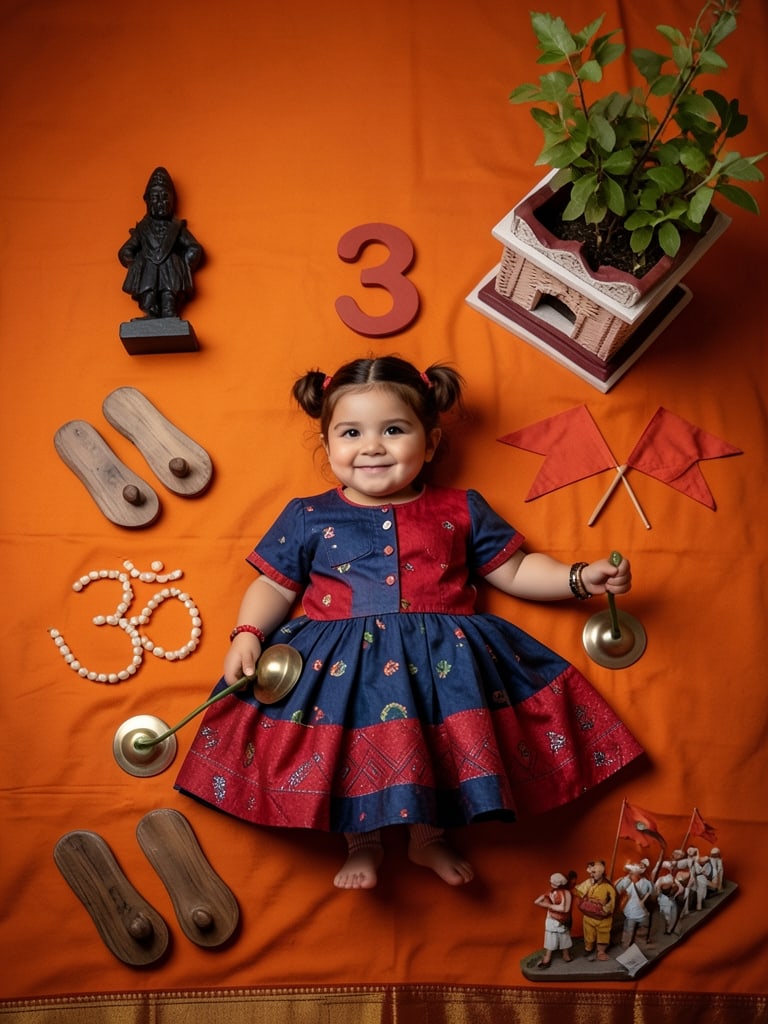
generate image STRICT FACE IDENTITY PRESERVATION DNA Maintain the exact facial structure of the baby from the reference image without alteration, ensuring identical cranial shape, forehead dimensions, hairline, brow arches, eyelid structure, inter-pupillary distance, ocular contours, nasal architecture, cheek fullness, lip morphology, jawline curvature, chin shape, auricular anatomy, pigmentation, dermal texture, bilateral symmetry, and estimated age. Keep the infant's genuine gentle smile, serene baby expression, naturally plump cheeks, and proportions precisely intact. Avoid any aesthetic enhancement, stylistic changes, eye magnification, reshaping, skin smoothing, age modification, or filtering. The reference image solely dictates the facial features, whereas all spiritual artifacts, surroundings, garments, and artistic compositions are built entirely through descriptive directions. SUBJECT DNA Produce an exceptionally detailed, high-end Ashadhi Ekadashi infant three-month milestone flat-lay drawing inspiration from the holy Warkari heritage of Pandharpur. The infant serves as the focal point of a bespoke devotional creation where every surrounding element honors Lord Vitthal, sacred basil devotion, the pilgrimage to Pandharpur, and Warkari customs. The arrangement should emulate a gallery-grade spiritual flat-lay rather than a standard developmental photo. OUTFIT DNA Clothe the infant in an upscale, classic Paithani baby garment from Maharashtra. The bodice is crafted from rich crimson silk featuring intricate metallic gold zari floral embroidery that exhibits authentic woven textures and a genuine silk sheen. The lower portion transitions into a deep navy-blue Paithani silk fabric decorated with bold geometric zari patterns and delicate antique gold details stretching across the material. The skirt fans out smoothly around the baby in soft, radial folds while retaining a high-end silk appearance. Include miniature black infant bangles on both wrists, dainty gold earrings, a traditional white Vaishnav tilak mark centered with a black dot on the forehead, and softly brushed baby hair. MILESTONE DNA Construct the milestone numeral "3" from a matte deep saffron material and place it directly above the infant's head, perfectly centered in the frame. The number takes up roughly twelve percent of the total vertical height, ensuring immediate recognition while keeping visual balance with the sacred elements around it. Its positioning clearly denotes the three-month milestone without overpowering the surrounding devotional items. RITUAL OBJECT DNA Build a comprehensive, handcrafted Warkari spiritual layout encompassing the baby. In the top-left area, set a sculpted matte charcoal silhouette of Lord Vitthal standing atop an ornate temple base modeled after Pandharpur Temple architecture, featuring carefully carved ritual proportions. Right underneath, place a pair of sacred wooden Paduka sandals carved from aged sandalwood, showcasing authentic natural grain patterns. Next to the sandals, form a detailed "ॐ" emblem using hundreds of individual ivory-colored Tulsi beads arranged with precise spacing and tangible bead texture. Position genuine brass Taal hand cymbals beside both of the baby's hands, hanging naturally by green cotton cords. Their polished metal surfaces reflect light realistically, showing aged metal qualities and traditional craftsmanship. In the top-right corner, set up an upscale sculpted Tulsi Vrindavan featuring classic white-and-maroon temple design elements, intricate carved details, and a thriving live Tulsi plant filled with healthy green foliage. Beneath the Tulsi Vrindavan, place two handcrafted saffron Warkari banners crossed symmetrically, their cotton material showing realistic creases and natural drapes. In the lower-right zone, arrange tiny sculpted Warkari devotees holding saffron flags, mridangam drums, veena instruments, and devotional gear while walking together in a Dindi procession, symbolizing the holy Pandharpur journey. POSITION DNA Recline the baby comfortably on the saffron devotional textile in a thoroughly relaxed infant pose. Roughly ninety-eight percent of the body mass rests evenly upon the soft cloth. The spinal column retains its natural infant curve while the upper body twists slightly by five degrees toward the left of the camera. The head tilts gently toward the left by roughly ten degrees with the chin slightly raised. The left leg stretches downward naturally while the right knee bends softly, conveying genuine infant relaxation. Both shoulders stay completely loose with the arms resting comfortably away from the torso, maintaining realistic baby anatomy. HAND POSITION DNA Bend the baby's left forearm upward naturally with the tiny hand loosely curled into a soft partial fist, located about twelve centimeters away from the chest. Extend the right forearm slightly outward while lightly grasping one brass cymbal via its green cotton tether. The fingers wrap naturally around the cord with zero visible strain. The matching brass cymbal rests next to the left arm, suspended naturally by gravity. Every finger exhibits anatomically accurate infant curvature. BODY LANGUAGE DNA Convey tranquil innocence and serene spiritual joy through the infant. The relaxed limbs, softly turned head, loose shoulders, and peaceful look evoke the feeling of a child resting quietly amidst a sacred Ashadhi Ekadashi observance. All poses must preserve anatomical realism alongside emotional warmth. EYE DIRECTION DNA The baby gazes softly toward the left of the camera with open eyes directed slightly upward, suggesting a calm observation of the surrounding sacred environment. The expression stays gentle, relaxed, and visually engaging.

7 0 2
1mo
Preview of Devotional Grain Chariot Baby Flat Lay
image / Gemini
Baby & KidsGemini · ChatGPT

Devotional Grain Chariot Baby Flat Lay

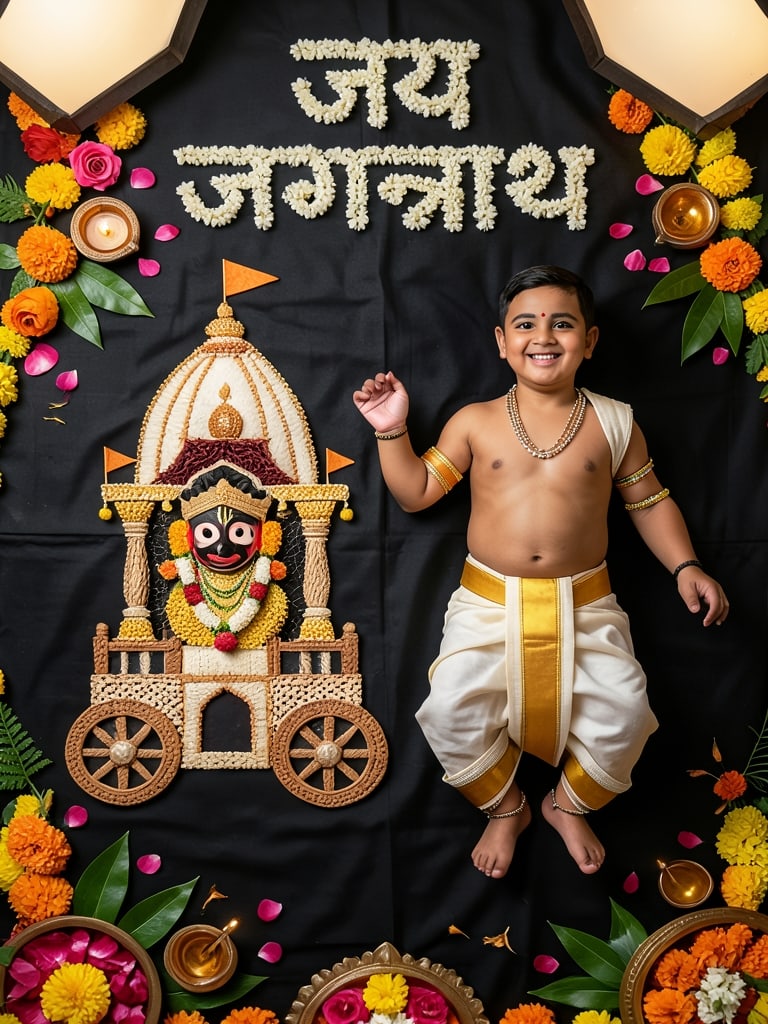
Strict Identity Compliance: Employ the provided photograph strictly as the baseline facial blueprint for the infant. Replicate every facial attribute precisely, covering cranium contours, forehead breadth, hairline trajectory, brow arches, eyelid curves, interocular spacing, ocular contours, nasal bridge, cheek fullness, lip fullness, jawline definition, chin shape, ear structure, skin pigmentation, dermal texture, facial symmetry, delighted grin, and developmental stage. Retain the child's cheerful demeanor, luminous gaze, plump cheeks, and natural glee without alteration. Avoid beautification, stylistic embellishment, ocular enlargement, structural reshaping, complexion modification, age shifting, or digital filters. The reference image dictates solely the face, while all garments, flat-lay compositions, floral arrangements, lettering, and religious motifs are built anew via explicit descriptions. Subject Concept: Produce a hyper-detailed premium religious festival infant milestone layout, integrating the child into an artful sacred tribute. The environment should emulate traditional artisanal handiwork built from organic seeds, legumes, blossoms, metal oil lamps, and customary celebratory ornaments. The infant ought to look at ease amidst indigenous devotional craftsmanship. Wardrobe Specifications: Dress the infant in an authentic ivory mulberry silk infant wrap boasting genuine woven grain and a soft natural luster. The wrap must include a wide vintage gold metallic border running vertically down the middle and along the tucked waistband. Draping must fold naturally around the limbs with realistic textile creases. Keep the upper torso uncovered following customary celebration norms. Accessorize with tiny dark protective wrist beads, a delicate dark hip cord, miniature traditional gold earrings, slender metallic anklets, a subtle herbal paste mark on the brow, and realistic baby skin softness and creases. Sacred Artifact Blueprint: Build an elaborate ceremonial temple cart entirely out of edible seeds and pulses. Utilize polished rice, split chickpeas, yellow lentils, red beans, black lentils, sesame seeds, mustard seeds, corn kernels, and white chickpeas. The carriage must incorporate a sanctuary cupola, saffron triangular banner, ornate columns, carved wheel motifs, decorative plinth, sacred portal, and a clearly defined religious icon formed completely from seeds. Every single seed must remain distinct with authentic surface texture. Above the art installation, construct Marathi devotional lettering reading “जय जगण्नाथ़ज्याय” fashioned densely from fresh white jasmine blossoms. Styling Elements: Frame the edges using fresh marigold blooms, rose petals, green foliage, metal oil lamps containing warm glowing oil, metal bowls holding blossoms, and scattered loose petals, all appearing handmade for a genuine festivity. Pose Arrangement: Position the baby comfortably on the right side of the frame. Roughly ninety-nine percent of body weight rests upon the soft textile base. The spinal column assumes natural infant curvature. The torso angles approximately four degrees toward the left of the frame. The head tilts roughly eight degrees toward the right. Both shoulders stay relaxed. The right knee bends slightly while the lower left limb stretches downward with relaxed feet. Hand Placement: The infant's right arm angles upward near the shoulder. The right palm stays softly relaxed with curved digits. The left limb reaches diagonally away from the body with a soft elbow bend. The left palm remains open with natural spacing. Avoid all muscle tension. Expressive Demeanor: The physical posture should convey excitement, joy, innocence, and cheerful involvement in the festivity. The relaxed stance, raised arms, gentle leg movement, and bright smile evoke genuine enjoyment rather than forced posing. Gaze Direction: The infant stares directly upward toward the top-down camera with luminous, curious, and joyful eyes. Natural catchlights ensure emotional authenticity. Camera Setup: Place the camera at an exact ninety-degree overhead angle. Maintain a perfectly perpendicular sensor alignment relative to the floor. Elevation: roughly 2.4 meters above the setup. Eliminate perspective distortion to ensure geometric precision. Optical Alignment: Center the focal point precisely between the infant and the temple cart artwork, establishing balanced visual weight between the devotional centerpiece and the child. Capture Distance: Shoot using a professional full-frame body paired with a 50mm macro prime optic elevated about 2.4 meters above the scene. This focal length maintains true proportions and corner-to-corner clarity across the entire top-down setup. Perspective Relationship: The strictly vertical perspective turns the complete arrangement into a sacred ceremonial canvas, making the viewer perceive the setup as an elaborate handcrafted ritual mandala crafted for the occasion. Optic Specs: Professional Full Frame Camera, 50mm Macro Prime Lens, f/7.1, complete corner-to-corner sharpness, zero perspective distortion, gallery-grade top-down rendering. Illumination Design: Light the scene utilizing two oversized overhead diffused softboxes set up symmetrically. Soft warm ambient fill light highlights the metal oil lamps without washing them out. The lighting must preserve realistic seed textures, silk sheens, infant skin tones, floral crispness, and metallic reflections without harsh shadows.

7 0 2
1mo
Preview of Devotional Ashadhi Ekadashi Baby Flat Lay Portrait
image / Gemini
Baby & KidsGemini · ChatGPT

Devotional Ashadhi Ekadashi Baby Flat Lay Portrait

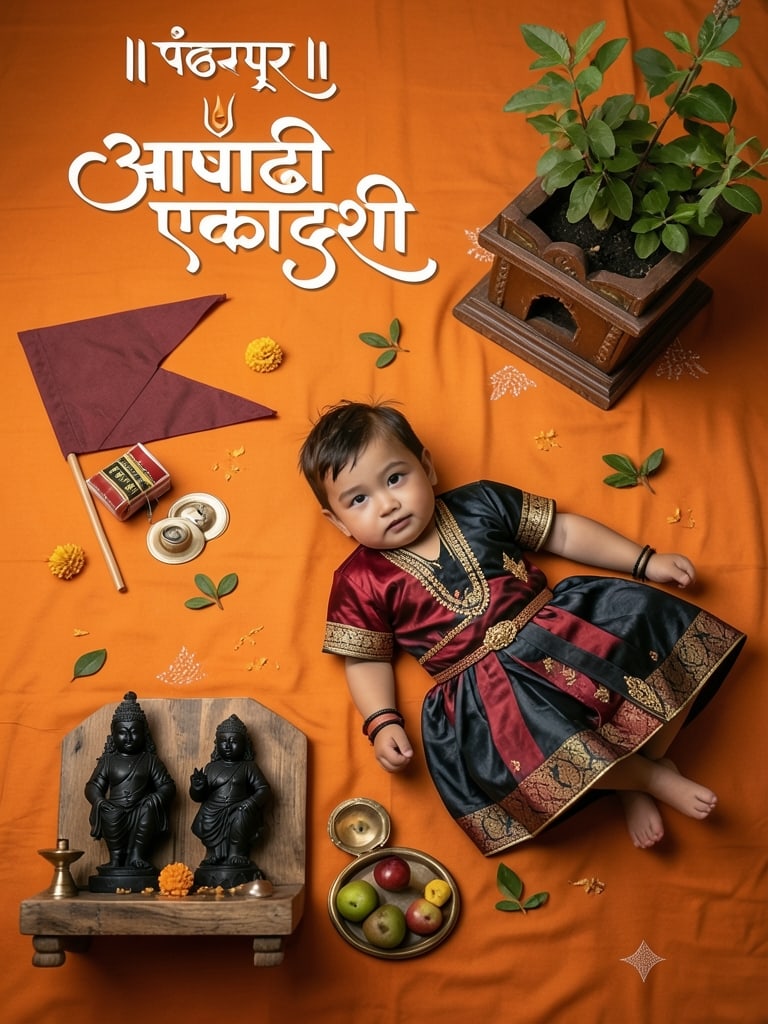
Strict Facial Recognition Compliance: Rely solely on the provided photograph to map the infant's facial identity; do not enhance, retouch, upscale eye dimensions, modify skin tone, alter perceived age, or apply cosmetic filters. Maintain the exact cranial proportions, hairline shape, brow architecture, eyelid contours, inter-pupillary distance, nasal bridge, cheek structure, lip fullness, jawline definition, chin contour, ear shape, dermal texture, and natural facial symmetry of the reference face, alongside its serene expression, gentle gaze, and authentic baby features. Every costume element, sacred artifact, typographic detail, and background setting must be built exclusively from the descriptive text below. Central Subject: Craft an exceptionally realistic premium devotional Ashadhi Ekadashi flat-lay infant portrait drawing inspiration from the holy Warkari tradition of Pandharpur. An infant rests serenely upon an artfully draped saffron devotional textile, serving as the focal point of a meticulously planned spiritual composition. Surrounding ritual items honor Lord Vitthal, the sacred Pandharpur pilgrimage, Tulsi reverence, and the pious atmosphere of Ashadhi Ekadashi while upholding high-end fine-art authenticity. Garment Specification: Outfit the baby in a traditional Maharashtrian celebration attire composed of a deep crimson Paithani-style infant dress showcasing genuine silk weave, organic folds, and authentic textile craftsmanship. The bottom hem displays ornate antique gold zari work bordered by rich emerald green trim. A waist sash crosses diagonally over the infant's chest with natural drapery folds and soft tension. Sleeves are short and gently gathered, while the skirt fans out organically underneath the infant with natural radial movement. Include minuscule traditional black bangles on both wrists, dainty gold studs, and a diminutive traditional black dot centered above the brow line. Sacred Artifacts: Build a comprehensive Ashadhi Ekadashi devotional scene encompassing the infant. Place carved black basalt effigies of Lord Vitthal and Goddess Rukmini on a weathered dark wood pedestal situated in the bottom-left quadrant of the frame. The statues exhibit genuine stone texture, organic signs of worship, holy adornments, and anatomically accurate sculptural proportions. Position an intricately sculpted Tulsi shrine near the upper-right zone complete with chiseled masonry work, classic ornamental painting, and a vibrant green holy basil plant sprouting organically from the core. Arrange a traditional saffron pilgrim banner near the upper-left section featuring pliable cotton texture and naturally draping folds. Incorporate tiny basil sprigs, scattered marigold blossoms, and faint traditional powder motifs integrated directly into the fabric creases rather than resting separately. Infant Positioning: The baby reclines diagonally across the bottom-right segment with the head placed slightly above the vertical midpoint. Roughly ninety-eight percent of body weight sinks comfortably into the plush saffron textile. The spinal column retains its natural infant curve while the torso twists roughly twelve degrees toward camera-left. The lower body stays relaxed with one limb loosely stretched out and the opposite leg gently flexed at the knee, producing lifelike infant ergonomics. The shoulders remain utterly unconstrained while the head tilts roughly eight degrees toward camera-left, preserving a placid countenance. Hand Placement: The infant's right arm stretches softly outward from the torso with the elbow loosely bent and the palm left unclasped. The digits exhibit genuine baby relaxation with soft curves rather than deliberate posing. The left forearm rests easily adjacent to the body with the wrist loose and the tiny fingers delicately curled inward. All joints stay anatomically sound, maintaining absolute infant realism. Postural Expression: The overall pose conveys tranquil innocence and sacred devotion. The baby appears completely at ease as though slumbering peacefully amidst the holy Ashadhi Ekadashi festivities. Every extremity rests naturally devoid of visible muscle tension, allowing the flowing garments and holy accessories to amplify the aura of calm. Gaze Direction: The infant gazes softly upward toward the top-down camera with a serene, tranquil look. The eyes stay naturally open featuring soft catchlights while retaining pure infant innocence. The look fosters an instant emotional bond with the observer. Optical Setup: Position the imaging device precisely perpendicular to the floor in an exact vertical 90-degree top-down flat-lay alignment. The image sensor stays perfectly parallel to the ritual display, eradicating all perspective distortion. The apparatus is mounted roughly 2.4 meters overhead, guaranteeing the entire sacred arrangement remains fully in frame while keeping authentic proportions throughout the layout. Framing Alignment: Center the camera precisely above the geometric midpoint of the saffron devotional setup. The optical center intersects the space between the infant and the surrounding ritual elements, making sure every sacred object stays proportionally balanced. Keep zero lateral offset and total overhead symmetry across the entire picture. Optics and Distance: Capture using a professional full-frame camera fitted with a 50mm high-grade macro prime lens from approximately 2.4 meters above the scene. This focal length preserves flawless flat-lay geometry devoid of wide-angle warping while sustaining outstanding clarity across the entire devotional arrangement. Perspective Relationship: The strictly overhead perspective converts the arrangement into sacred spiritual art

7 0 2
1mo
Preview of Divine Newborn Shiva Flatlay
image / Gemini
Baby & KidsGemini · ChatGPT

Divine Newborn Shiva Flatlay

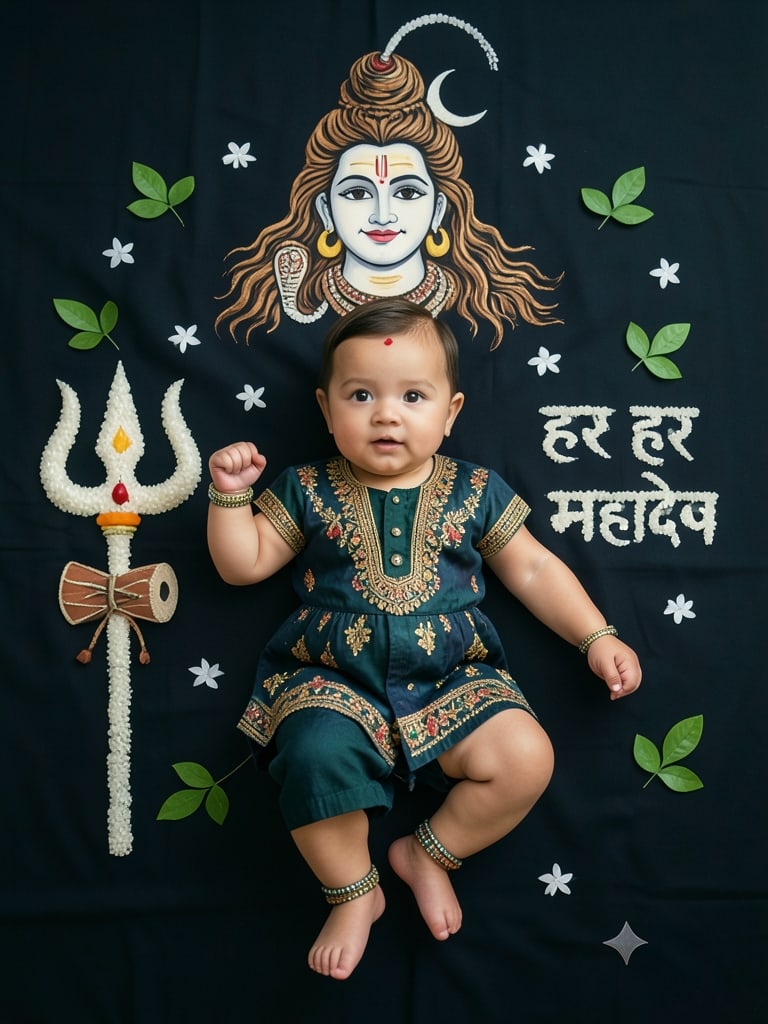
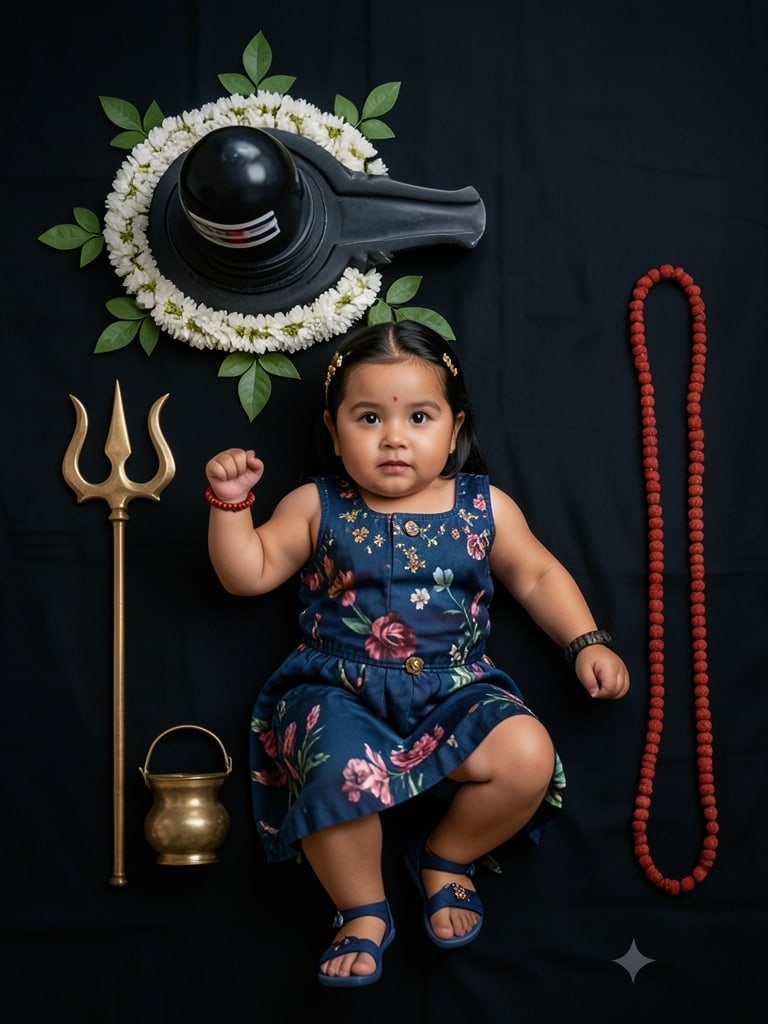
create image FACE IDENTITY PRESERVATION Use the supplied photograph solely as the reference for the infant’s facial features. Replicate every detail—head contour, forehead, hairline, fine baby hair texture, eyebrows, eyelids, eye shape and spacing, nose, lips, cheeks, ears, chin, natural skin hue, texture, symmetry, innocent gaze, and apparent age—without any beautification, eye enlargement, proportion changes, complexion alteration, skin smoothing, or beauty‑filter effects. The uploaded picture is only for facial fidelity; all other visual components are defined by the following descriptions. MAIN SUBJECT Render a high‑end, top‑down devotional newborn portrait inspired by Lord Shiva. The infant rests serenely at the exact centre of an artistic flat‑lay, dressed as a baby incarnation of Shiva, and surrounded by sacred motifs and handcrafted décor. The overall feeling should be divine, tranquil, culturally true, and aesthetically balanced. APPAREL Clothe the infant in a lifelike tiger‑print cotton wrap placed diagonally across torso and waist, echoing Shiva’s traditional garb. The cotton must show genuine texture and soft folds that naturally follow the baby’s shape. Adorn the neck and wrists with several Rudraksha bead malas, add tiny Rudraksha anklets, a black waist thread, and a small black thread bracelet. Paint three delicate white horizontal Vibhuti lines on the forehead with a minute red tilak centered. Keep the feet bare, toes and fingers relaxed. POSE & BODY LANGUAGE Position the infant on its back, centered in the layout. The spine stays straight with a subtle newborn curve. The head looks straight upward, unrotated. About 60 % of the body weight rests on the back. The right arm bends roughly 80° with a soft, closed fist near the shoulder; the left arm bends about 95° outward, fingers gently curled. The right knee is flexed about 20°, while the left leg extends slightly longer with the foot relaxed outward. Both feet and hands exhibit natural newborn looseness. EYE GAZE The child gazes directly upward toward the camera, eyes wide and expression curiously innocent. CAMERA SETUP Shoot from a perfectly vertical, 90° overhead perspective, camera plane parallel to the floor. Place the camera roughly 2.4 m above the scene to achieve flawless symmetry and eliminate perspective distortion. Keep equal margins on all sides. The infant should fill roughly 35 % of the frame, with the surrounding devotional layout occupying the rest. Use a vertical 9:16 aspect ratio. LENS SPECIFICATIONS Employ a professional full‑frame body equipped with a 35 mm prime lens set to f/5.6, delivering edge‑to‑edge sharpness across the flat‑lay while preserving uniform focus from the baby to every decorative piece. LIGHTING Apply soft, evenly diffused illumination that provides balanced exposure throughout. Brightness should be medium‑high, exposing texture without harsh highlights; shadows must be extremely soft and nearly invisible. Preserve strong contrast between the black background and white devotional elements, while allowing vivid natural tones in the tiger‑print fabric, green leaves, flowers, and Rudraksha beads. The ambience should feel sacred, calm, and luxurious. SHARPNESS & DEPTH Maintain consistent crispness across the entire composition; no background blur is required. The black fabric base serves as the foundational layer, the handcrafted devotional items as the secondary layer, and the infant as the primary focal layer with maximum detail. SETTINGS & BACKDROP Utilize a high‑quality matte black fabric stretched taut and wrinkle‑free as the base. Above the infant’s head, arrange a large handcrafted portrait of Lord Shiva using white flower petals, rice grains, and natural powders, complete with flowing hair, forehead markings, and a crescent moon. On the left, construct a sizable Trishul from white floral materials, placing a traditional Damru near its base. On the right, spell the Hindi phrase “हर हर महादेव” with white petals or grains in classic Devanagari script. Distribute small white blossoms and fresh green Bilva leaves symmetrically, preserving ample negative space for balance. NARRATIVE The scene celebrates the newborn’s purity through Shiva’s symbolic blessings, surrounding the child with hand‑crafted elements that convey divine protection, strength, and spiritual grace. The composition should resemble a sacred ceremonial artwork created by hand for a newborn milestone, not a digitally generated backdrop. COMPOSITIONAL BALANCE Arrange all components with perfect vertical symmetry: the handcrafted Shiva portrait crowns the upper portion, bestowing a blessing on the infant below; the Trishul anchors the left side, the Hindi text balances the right. The baby stays precisely centered.

7 0 2
1mo
Preview of Sacred Vitthal Devotional Baby Flat Lay
image / Gemini
Baby & KidsGemini · ChatGPT

Sacred Vitthal Devotional Baby Flat Lay

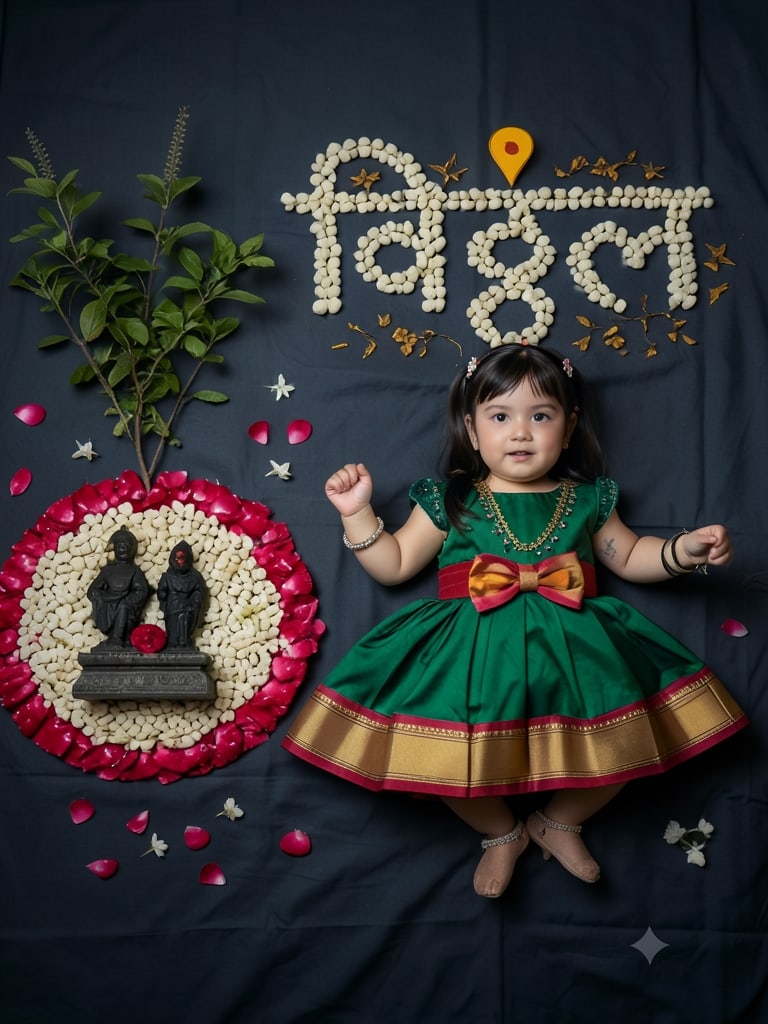
generate image STRICT FACE IDENTITY PRESERVATION DNA Rely exclusively on the provided image to replicate the infant's facial identity without modification. Maintain the exact bone structure, forehead width, hairline configuration, eyebrow arch, eyelid contour, eye distance, eye shape, nasal architecture, cheek contours, lip fullness, jawline definition, chin shape, ear structure, skin tone, skin texture, facial symmetry, and developmental age. The baby's serene, untainted expression, chubby cheeks, genuine baby grin, and delicate proportions must be transferred precisely as observed. Avoid beautification, stylistic alterations, eye enlargement, sharpening features, complexion alterations, age shifts, or any digital cosmetic enhancement. The reference image functions purely for facial mapping, whereas all spiritual artifacts, botanical layouts, textile dynamics, and surrounding spatial components are built entirely from scratch through descriptive parameters. SUBJECT DNA Produce an exceptionally lifelike, premium Tulsi Vivah-themed devotional infant flat-lay portrait that honors the sacred bond connecting Lord Vitthal, Tulsi Mata, and traditional Maharashtrian customs. The baby serves as the focal point of a bespoke spiritual composition where every surrounding detail builds a cohesive devotional story rather than functioning as random ornamentation. OUTFIT DNA Clothe the infant in an opulent, traditional Maharashtrian baby dress tailored from deep emerald-green silk boasting authentic woven texture and organic folds. The neckline and arm openings feature gentle gathering with expert craftsmanship. Fasten a handmade Paithani silk cummerbund around the waist, showcasing bright magenta, saffron, and vintage gold zari motifs, finished with a prominent central decorative silk bow. The lower hem showcases wide antique gold zari weaving bordered by royal magenta trim, with the skirt spreading out naturally around the infant's form through realistic silk draping. Include dainty silver anklets on both feet, dark infant bracelets on both wrists, miniature classic earrings, and a vertical white Vaishnav mark featuring a saffron dot in the middle of the brow. RITUAL OBJECT DNA Build a handcrafted spiritual arrangement inspired by holy basil veneration. Place a fully developed Tulsi shrub on the left side featuring organically branching stalks, vibrant green foliage, authentic seed pods, and true botanical formation. Beneath the basil plant, construct a bespoke floral platform using tightly clustered white jasmine flowers framed by a thick border of vivid pink rose petals. At the core of this floral mandala, position intricately carved miniature dark stone statues of Lord Vitthal and Goddess Rukmini resting upon an authentic sculpted stone base with realistic basalt grain. Above the child, form a large handmade Marathi devotional floor design spelling “विठ्ठल”, created entirely from tightly packed fresh white jasmine buds interspersed with naturally strewn saffron-orange marigold blossoms accentuating the script. Incorporate a saffron-yellow Vaishnav emblem into the center of the text. Scatter delicate loose rose petals and jasmine flowers organically across the textile to soften the boundaries between ritual items. POSITION DNA Recline the infant diagonally across the lower-right section of the flat-lay setup. Roughly ninety-eight percent of the infant's body weight rests softly against the textile ground. The spine adopts its natural baby curve while the torso twists roughly six degrees toward camera-left. The head tilts smoothly toward camera-right by about eight degrees while resting securely upon the cloth. The left leg stretches downward naturally with a relaxed knee, while the right knee curls gently outward, generating authentic infant posture. Both shoulders remain completely free of tension. HAND POSITION DNA Bend the baby's right forearm upward near the shoulder naturally, forming a loose, soft fist with the tiny hand. Extend the left arm slightly out from the body with a gently bent elbow and naturally parted fingers following true infant anatomy. All joints must stay loose and anatomically accurate, producing the impression of spontaneous motion instead of a staged pose. BODY LANGUAGE DNA Convey a sense of tranquil wonder and spiritual purity through the infant. The relaxed pose, softly raised limbs, naturally separated legs, and calm expression evoke a child resting peacefully inside a hallowed ceremonial zone designed with affection and reverence. Every physical movement remains biologically correct for a baby. EYE DIRECTION DNA Direct the infant's gaze straight up toward the top-down camera with serene, focused eyes catching soft natural glints. The look builds an immediate emotional bridge while maintaining absolute purity. CAMERA DNA Position the lens at a precise 90-degree overhead angle, perfectly orthogonal to the ground plane with zero perspective distortion. Elevate the camera roughly 2.3 meters above the spiritual display, guaranteeing full visibility of the infant alongside every ceremonial artifact while keeping symmetrical flat-lay proportions. CAMERA POSITION DNA Center the optical axis directly over the infant's chest while balancing the Tulsi plant, floral base, and Marathi floral typography throughout the frame. Keep the sensor strictly parallel to the fabric plane to banish distortion and retain museum-grade flat-lay accuracy. CAMERA DISTANCE DNA Shoot using a professional full-frame body equipped with a 50mm macro prime optic suspended approximately 2.3 meters above the arrangement. This focal length maintains true-to-life scale while providing edge-to-edge clarity across all ritual elements. CAMERA ELEVATION RELATIONSHIP DNA Perspective from the purely overhead viewpoint elevates the composition into sacred devotional art where each ceremonial prop holds equal significance within the visual hierarchy.

7 0 2
1mo
Preview of Minimalist Ashadhi Ekadashi Boy Photoshoot in Traditional Warkari Dress
image / Gemini
Baby & KidsGemini · ChatGPT

Minimalist Ashadhi Ekadashi Boy Photoshoot in Traditional Warkari Dress

generate image STRICT FACIAL IDENTITY MATCHING Derive the child's facial identity exclusively from the provided source photo. Retain the exact bone structure, forehead width, hairline, eyebrow shape, eyelid contours, eye distance and form, nasal architecture, cheek fullness, lip dimensions, jaw contour, chin shape, ear structure, skin tone, dermal texture, facial symmetry, and perceived age precisely as depicted. Keep the subject's genuine, unassuming smile, natural inquisitiveness, and soft facial features unchanged. Do not apply any beautification, stylistic alterations, eye enlargement, proportion adjustments, contour sharpening, skin smoothing, or digital filtering. The reference image is used solely for identity data, while all spiritual elements, surroundings, garments, and photographic dynamics are built completely from descriptive text. SUBJECT CONCEPT Craft a hyper-realistic, museum-grade devotional portrait depicting a young Warkari boy standing serenely amidst the holy pilgrimage of Pandharpur. The image ought to blend youthfulness with deep spiritual dedication. Rather than looking like a staged studio session, the subject should appear genuinely absorbed in the sacred environment, conveying subtle joy as he gazes toward an unseen holy presence. The overall aesthetic should evoke a timeless devotional photograph worthy of exhibition. ATTIRE SPECIFICATION Outfit the boy in an immaculate, traditional white handloom cotton Warkari kurta featuring a standing collar, neatly concealed button placket, genuine cotton texture, comfortable full-length sleeves, and realistic creases formed by natural posture. Combine this with a classic white cotton dhoti styled with handcrafted pleats and gentle organic folds. Place a neatly folded white Gandhi cap firmly upon his head, displaying visible cotton stitching and sharp geometric creases. Encircle his neck with a long, handcrafted Tulsi mala consisting of polished dark wooden beads that drop past the chest. Paint a vivid saffron-yellow Vaishnav tilak squarely on the center of the forehead, marked with a tiny black devotional dot within the yellow, accompanied by a delicate white sacred dot upon the left cheek. Finish the traditional spiritual look with small gold earrings. SYMBOLIC ELEMENTS Keep the spiritual symbolism understated by restricting identifiable sacred markers to the Gandhi cap, Tulsi mala, Vaishnav tilak, cheek marking, and traditional white garments. Omit extraneous ritual props to ensure the subject's spiritual demeanor remains the dominant focal point of the image. POSTURE AND STANCE Pose the child in a relaxed upright stance, shifting roughly sixty-five percent of his body weight onto the left supporting leg while the right leg remains slightly loose. Center the pelvis with minimal side-to-side displacement. Rotate the torso toward the right of the frame by approximately twelve degrees while keeping the posture straight. The spinal column follows a natural childhood curve, letting the shoulders drop and remain completely tension-free. Extend the neck upward slightly as the head turns roughly fifteen degrees to his right and tilts upward by about six degrees, forming a graceful and natural devotional profile. ARM AND HAND PLACEMENT Position both forearms lower down, outside the visible framing, keeping the shoulders completely relaxed. Leave the upper arm muscles loose so garments drape naturally over the shoulders and chest. The hidden hands rest comfortably near the lower stomach with softly curved fingers, maintaining anatomically correct posture despite the tight crop. EXPRESSION AND DEMEANOR Convey deep calm, gentle curiosity, and absolute innocence through the child's physical bearing. Every muscle stays relaxed, allowing the facial expression and upward glance to form the emotional core of the composition. The subtle head tilt and soft smile suggest the boy has caught sight of something spiritually enchanting just outside the camera's view. GADGET AND EYE LINE Direct the child's soft gaze toward the upper-right area of the composition using bright, expressive eyes filled with hope, wonder, and devotion. Keep the eyes focused sharply on an unseen sacred entity while subtle catchlights reflect ambient natural lighting. This upward sightline serves as the primary narrative focal point. CAMERA SETUP Position the camera sensor approximately 116 centimeters above ground level, aligning it directly with the boy's eye height. Maintain a square-on portrait angle while panning the camera about ten degrees toward his left side so the face turns slightly into the frame. Apply a minimal upward tilt of roughly one degree to maintain realistic proportions while emphasizing the upward devotional gaze. CAMERA PLACEMENT Set the camera roughly 2.6 meters away from the subject's face, centered horizontally on his torso. Align the optical axis straight through his eyes to guarantee maximum emotional connection. Leave ample negative space on the side facing his gaze so the framing follows his sightline toward the invisible divine presence. LENS AND DISTANCE Capture the scene using a professional full-frame camera body paired with an 85mm high-end portrait prime lens from a distance of 2.6 meters. This standoff distance preserves accurate facial dimensions while producing pleasing optical compression and soft background separation. The child's head and upper chest fill roughly sixty percent of the vertical frame while retaining comfortable headroom.

7 0 2
1mo
Preview of Devotional Ashadhi Ekadashi Baby Photoshoot Art
image / Gemini
Baby & KidsGemini · ChatGPT

Devotional Ashadhi Ekadashi Baby Photoshoot Art

generate a high-end spiritual newborn flat-lay layout themed around Lord Vitthal, infant Sant Tukaram, and traditional Maharashtrian floor art. Rely on the provided photograph strictly for facial identity. The source photo must not dictate the layout, clothing, accessories, lettering, illumination, palette, scenery, or decorative motifs unless explicitly stated. Render a hyper-detailed 4K Ultra HD portrait in vertical 9:16 format, showcasing artisanal powder art, elevated spiritual narrative, genuine regional heritage, and upscale commercial infant photography standards. STRICT FACE IDENTITY PRESERVATION Treat the source image exclusively for person identity. Keep the infant's facial features, facial expression, body build, and physical stance untouched. Maintain the exact eyes, brow structure, forehead, nose, mouth, cheeks, ears, skin tone, facial dimensions, baby age, natural hairline, facial symmetry, distance between eyes, nasal contours, lip shape, jawline, dermal texture, and cheerful smiling look as displayed. No enhancement, alteration, reshaping, touch-ups, age shifts, or creative modifications are allowed. The infant must match the reference image precisely while blending seamlessly into the cultural arrangement. Visual Blueprint Reconstruction Replicate the visual layout completely, keeping the identical structural hierarchy, spatial harmony, visual flow, and object positioning. Maintain a clean, upscale, minimal flat-lay arrangement featuring a large circular sacred mandala in the top portion and the baby resting separately in the bottom half. The scene should be neat, balanced, luxurious, and reverent, with every ornament placed purposefully and harmoniously. Canvas, Floor & Background Composition Set the photo shoot on a sleek, high-grade matte grey stone surface possessing realistic texture and delicate natural variations. The ground must stay immaculate and free of clutter, acting as a sophisticated neutral backdrop. Provide ample negative space between the upper sacred mandala and the infant to ensure an airy, opulent, professionally styled aesthetic. Sacred Vitthal Rangoli Artwork In the top center, craft a large, flawless circular white powder art base covering roughly the upper forty percent of the frame. Within the circle, build an intricate handcrafted portrait silhouette of Lord Vitthal using classic colored granules. The deity should feature only a dark upper torso and head, accompanied by fish-shaped earrings and a crown. Position a golden pilgrimage badge upon the forehead, a yellow blossom garland around the neck, twin saffron sectarian banners standing to the left, green sugarcane stalks featuring purple blooms on the right, and a traditional double-headed drum alongside a stringed drone instrument underneath the deity. Every element must look entirely handmade from genuine pigment powder, showing realistic grain texture, softened borders, natural color transitions, and minor artisanal flaws. Devotional Lighting Arrangement Encircle the round mandala with evenly distributed, burning traditional terracotta oil lamps arranged symmetrically around the outer perimeter. Each lamp should cast a warm golden illumination that gently washes over the adjacent powder art without overwhelming the visual. The radiance should foster a serene spiritual mood while retaining true-to-life visual authenticity. Baby Sant Tukaram Styling Place the infant in the lower portion of the image, resting comfortably on the floor with a naturally joyful, smiling demeanor while keeping the posture from the uploaded image. Outfit the baby in traditional regional garments reminiscent of the saint—comprising an unbleached white cotton tunic, a classic white lower wrap featuring thin red and gold woven borders, and a simple waist tie. Include holy basil and rudraksha bead necklaces, alongside gold armbands, bracelets, and foot rings for cultural accuracy. Style the infant with a plain white regional turban accented with subtle metallic threadwork and a tiny central jewel piece. Apply a small sandalwood mark on the forehead, preserving natural proportions and historical ascetic simplicity. Lower Decorative Elements Surrounding the infant, form elegant white pigment footprints directing gaze toward the upper deity artwork. Add graceful curved white powder swirls with saffron accents on either side of the baby, providing symmetrical balance to the layout. Scatter fresh orange and yellow marigold petals organically around the bottom zone without making the arrangement feel cramped. Position a polished metallic oil lamp on the infant's right side, matching the placement and scale of the reference. Embellish the bottom corners with verdant foliage creeping into the view to frame a luxurious festive border. Typography & Calligraphy Reconstruction Along the right margin, form the vertically oriented sacred phrase “॥ पांडुरंग विठ्ठल ॥” as hand-drawn white powder calligraphy instead of digital lettering. Every character must be individually crafted using fine white pigment dust, displaying visible grain texture, natural powder accumulation, soft handmade edges, uniform line weight, and authentic artistic imperfections. Retain the precise vertical placement, spacing, dimensions, punctuation marks, and general visual harmony seen in the reference. The text must convey the touch of a skilled artisan rather than machine-printed text. Materials & Rangoli Authenticity Ensure every powder art component visibly displays handmade characteristics using genuine colored grains with realistic pigment texture, natural hue blending, soft powder diffusion, layered application, and subtle manual irregularities. The lamps must be authentic terracotta vessels featuring genuine clay texture and flickering flames. Botanicals, metal artifacts, textiles, and adornments must exhibit top-tier material fidelity with museum-grade precision. Camera, L

7 0 1
1mo
Preview of Devotional Pilgrimage Portrait of Young Child
image / Gemini
Baby & KidsGemini · ChatGPT

Devotional Pilgrimage Portrait of Young Child

STRICT FACE IDENTITY PRESERVATION DNA: Utilize the provided image strictly as the facial structure template for the child. Maintain exact facial geometry, covering head shape, forehead dimensions, hairline structure, eyebrows, eyelids, inter-eye spacing, ocular contours, nasal architecture, cheek fullness, lip morphology, jaw contour, chin shape, ears, skin pigmentation, dermal texture, facial balance, and estimated chronological age. Retain the subject's natural upward-directed gaze, gentle lips, naturally full cheeks, and wide spiritual eyes exactly as seen. Avoid any cosmetic enhancement, stylistic alterations, eye enlargement, contour sharpening, skin tone modification, age shifting, or digital beauty filters. The reference image is solely for facial mapping, whereas every surrounding atmospheric, spiritual, and photographic element is constructed completely through descriptive text. SUBJECT DNA: Produce a hyper-realistic, high-end devotional portrait of a young Warkari girl during a holy trek. The image should highlight the purity of youthful faith, showing the child looking upward in absolute belief as though fixing her eyes on a divine presence. Instead of looking posed, the scene must resemble an authentic spiritual documentary frame elevated to museum-grade devotional fine-art photography. OUTFIT DNA: Dress the youngster in a classic handloom white Warkari tunic tailored from fine soft cotton, featuring a standing collar, concealed placket, naturally hanging long sleeves, genuine cotton weave texture, and organic creases formed by subtle bodily motion. Combine the tunic with a traditional white cotton wrap dhoti secured around the waist with authentic layered folds and natural draping. Place a crisp white Gandhi cap firmly on the head, showing visible cotton threading, soft-folded brims, and a tangible hand-pressed textile finish. Encircling the neck, position a lengthy handcrafted prayer bead necklace fashioned from naturally polished dark timber beads hanging past the chest. Paint a vibrant yellow sectarian mark upon the forehead with a tiny black meditative dot in the middle, accompanied by a traditional white sacred dot delicately applied to the left cheek. Tiny traditional gold hoop earrings finish the devotional look. RITUAL OBJECT DNA: Keep spiritual artifacts deliberately understated. The Gandhi cap, wooden prayer beads, sacred forehead emblem, pristine white garments, and facial marking serve as the core religious markers. No extraneous ceremonial items should detract from the youth's pious expression, allowing sheer innocence to act as the primary emblem of belief. POSITION DNA: Pose the youngster standing naturally while observed from an elevated vantage point. Roughly sixty-eight percent of body mass rests securely on the right supporting limb, leaving the left leg softly relaxed beneath the torso to maintain natural childhood balance. The pelvis stays centered with minimal sideways shift. The upper body twists slightly toward the left by about eight degrees while leaning forward a fraction beneath the high camera angle. The vertebral column adopts a relaxed, natural curve typical for a young child. Both shoulders stay low and loose while the neck stretches upward naturally, permitting the head to tilt roughly twenty-two degrees toward the top-right as the subject gazes upward with silent reverence. HAND POSITION DNA: The child's right hand softly grasps the front of the tunic near the upper chest, delicately pinching the cotton material between thumb and first two digits without apparent strain. The left hand rests naturally a bit higher across the torso, fingers gently curved and touching the clothing lightly as though unconsciously adjusting the garment. Every finger follows authentic juvenile anatomy with relaxed joints, producing organic rather than staged body language. BODY LANGUAGE DNA: The entire stance should express deep respect, curiosity, and childlike purity. The elevated chin, softly elongated neck, naturally sloped shoulders, and gentle hand placement convey the impression that the pilgrim has paused mid-journey after spotting something spiritually magnificent overhead. All movements must stay anatomically correct for a young child while keeping emotional truth intact. EYE DIRECTION DNA: The child looks up toward the upper-right section of the picture using large, expressive eyes brimming with wonder, hope, and devotion. The pupils remain sharply focused on an unseen holy presence outside the picture frame while catching soft highlights from the open sky. This look should form the emotional focal point of the portrait. CAMERA DNA: Position the recording device approximately 2.2 meters vertically above the child, generating a dramatic high-angle viewpoint. Tilt the lens downward at roughly 65 degrees, enabling the observer to look down at the youth while keeping realistic facial proportions. The optical center aligns directly over the subject's upper chest so the upward gaze naturally anchors the composition without introducing spatial warping. CAMERA POSITION DNA: Place the photographer nearly overhead with just a minor horizontal shift to the left by roughly fifteen centimeters. Keep a working distance of approximately 2.3 meters between the glass and the subject's face. This slight offset lets the face maintain dimensional depth while emphasizing the emotive upward eye contact. CAMERA DISTANCE DNA: Capture the shot utilizing a professional full-frame body fitted with an 85mm high-end portrait prime lens from roughly 2.3 meters away. This shooting distance preserves accurate facial dimensions while yielding tasteful background compression and luxurious separation from the backdrop. The subject should fill about seventy percent of the frame, leaving adequate peripheral area to accentuate the elevated viewpoint.

7 0 2
1mo
Preview of Devotional Lord Vitthal Warkari Baby Flat Lay
image / Gemini
Baby & KidsGemini · ChatGPT

Devotional Lord Vitthal Warkari Baby Flat Lay

generate a high-end devotional infant flat lay scene drawing inspiration from sacred Vitthal heritage, Baby Sant Tukaram imagery, and detailed Maharashtrian powder floor art. Use the provided photograph exclusively for facial identity reference. The reference picture must not dictate the arrangement, clothing, props, text styling, backdrop, illumination, or creative layout unless specified. Produce a hyper-detailed 4K Ultra HD portrait-oriented 9:16 frame featuring museum-grade spiritual storytelling, genuine rangoli artistry, elite top-down imagery, and refined devotional ambiance. STRICT FACE IDENTITY PRESERVATION Treat the uploaded portrait solely as a face identity source. Keep the infant's facial structure, expression, body build, and natural resting pose unchanged unless the instructions state otherwise. Retain the exact eyes, brow structure, forehead shape, nose, mouth, cheeks, ears, complexion, facial geometry, infant developmental stage, natural hairline, facial symmetry, inter-pupillary distance, nasal bone configuration, lip contours, jawline, skin grain, and peaceful sleeping demeanor from the source image. No beauty enhancements, digital altering, face shaping, age adjustments, gender modifications, or creative styling are allowed. The baby must stay completely recognizable to the input picture while seamlessly blending into the spiritual artwork. Visual Blueprint Reconstruction Recreate the source layout as an exact structural template rather than general inspiration. Maintain the original spatial hierarchy, balance, symmetry, proportions, element spacing, scaling, negative space, and visual pacing precisely. The entire picture must look like an intricate manual powder art installation photographed overhead, keeping all elements in their exact relative placements and visual weight as the source, centered around Lord Vitthal and Baby Sant Tukaram iconography. Canvas Layout, Composition & Spatial DNA Render a tall rectangular rangoli filling almost the entire frame with thin outer margins framing the art. Enclose the entire piece with a continuous handmade frame of evenly sized vivid pink circular pigment dots, keeping consistent spacing, width, pacing, and stroke thickness along all four borders. The central layout requires strong symmetry along the vertical midline, featuring the Lord Vitthal silhouette as the primary visual anchor taking up roughly seventy percent of the frame's height. Place the infant inside the lower region of the silhouette so the child becomes part of the deity's sacred presence rather than resting separately. Leave ample blue negative space around the silhouette, symmetrically balanced by floral elements and spiritual typography. Rangoli Background & Sacred Vitthal Silhouette Build the complete scene exclusively from authentic coloured pigment powders hand-applied on a flat floor. The backdrop should feature deep royal-blue powder with organic pigment blending, visible manual grain patterns, soft dust diffusion, subtle shade shifts, and authentic handmade flaws. At the midpoint, render the monumental dark silhouette of Lord Vitthal in his classic standing pose with both hands on his hips. The silhouette needs broad shoulders, gently narrowing sides, and a steady symmetrical stance matching the original proportions. Encircle the figure with a fine white powder border separating the dark body from the blue backdrop. Behind the cranium, construct a perfectly centered round halo using concentric powder gradients shifting from bright golden yellow inside to warm orange and deep reddish-orange at the perimeter. Add a traditional yellow marigold floral necklace around the silhouette's neck using individual petal motifs, and place the golden pilgrimage marker exactly on the deity's forehead. Baby Sant Tukaram Composition Place the infant sleeping quietly in the lower middle section of the Lord Vitthal figure, occupying about one-third of the silhouette's height while remaining perfectly centered. Keep the relaxed sleeping posture with both arms raised upward, elbows slightly bent, palms open, legs softly crossed, and facial features completely relaxed. Dress the baby in genuine traditional white Maharashtrian Warkari garments consisting of a plain white tunic, white dhoti finished with fine woven gold trims, and an ivory shoulder cloth draped diagonally with delicate gold borders. Wrap the head in a neatly tied traditional white Maharashtrian turban keeping the styling minimal, spiritual, and historically accurate. Include a small traditional forehead mark and let the fabric drape naturally showing authentic cotton texture, fine stitching, gentle wrinkles, and soft shading. The overall look should gently suggest Baby Sant Tukaram while staying true to the reference layout. Supporting Devotional Objects & Relationship DNA Keep the exact spatial arrangement of all accessory items. Position a polished wooden string instrument diagonally to the bottom left of the infant with correct scaling, lifelike wood grain, carved details, and cultural relevance. Place a round clay vase right beside the instrument holding several upright yellow tulips with vibrant green stems. Arrange eight handcrafted powder flowers across the blue backdrop maintaining the exact placement, distribution, and visual rhythm of the source. Each bloom must feature white petals outlined with warm yellow and orange centres. --ar 9:16 --v 7

7 0 2
1mo
Preview of Devotional Paithani Infant Portrait in Warkari Style
image / Gemini
Festivals & OccasionsGemini · ChatGPT

Devotional Paithani Infant Portrait in Warkari Style

generate a picture of “Vitthal Rukmini Warkari Baby Devotional Portrait”, 9:16 vertical aspect ratio, ultra-detailed photography, 4K resolution, high-end spiritual infant portraiture, genuine Warkari devotional mood, sophisticated cultural visual narrative. Utilize the provided photograph strictly for facial identity reference. Never alter the infant's facial structure, expression, physique, or stance. Adhere to the following specifications while maintaining absolute fidelity to the source face. STRICT FACE IDENTITY PRESERVATION The supplied infant photograph functions solely as the facial identity template. Keep the eyes, brows, forehead, nose, mouth, cheeks, ears, complexion, facial geometry, infant age, natural hairline, and serene expression precisely unchanged. Zero alterations, artificial enhancements, reshaping, cosmetic tweaks, or aging are allowed. The infant must match the source reference unmistakably. VISUAL REFERENCE DNA Replicate the composition precisely to mirror the source layout. The design adheres to a high-end religious poster format featuring strict vertical balance. The infant takes up roughly 36 to 40 percent of the frame height, centered accurately. Standing behind the infant is a colossal shadow profile of Lord Vitthal, filling nearly 82 percent of the vertical frame. The shooting distance is about 2.5 meters utilizing an 85mm full-frame portrait focal length equivalent, captured from a dead-center eye-level perspective. Maintain identical framing proportions, spacing, negative space, and poster composition. SUBJECT DNA The infant maintains an upright posture identical to the reference, with both feet clearly visible beneath the attire. Both hands rest firmly on the hips, mimicking the classic Vitthal Maharaj hip-girdle pose. Retain the calm forward-facing gaze and natural facial expression from the visual reference. OUTFIT DNA Clothe the infant in a genuine traditional Maharashtrian Rukmini Devi-style Paithani garment. The silk attire boasts a deep emerald green base paired with magenta panels and wide vintage gold zari borders. The textile exhibits authentic silk gloss, woven traditional patterns, natural folds, and proper Maharashtrian draping. Decorate the infant with layered vintage gold necklaces, a waist chain, bracelets, earrings, arm cuffs, anklets, and a majestic traditional Maharashtrian crown showcasing fine gold work inset with emerald green gems. All adornments must closely match the scale and design of the reference. BACKGROUND DNA Set behind the infant is a massive outline of Lord Vitthal in the classical hands-on-hip stance. The silhouette is rendered in matte black, while a vast circular white halo radiates softly behind the deity's crown, creating striking spiritual contrast. Positioned over Lord Vitthal's chest is the glowing golden Pandharpur geographic emblem, matching the source layout precisely. Just beneath it, render the luminous sacred “ॐ” symbol in a warm golden hue directly above the infant's headgear. WARKARI PALAKHI DNA In the lower background, depict the outlines of numerous Warkari pilgrims taking part in the Sant Tukaram Maharaj and Sant Dnyaneshwar Maharaj Palakhi procession. The devotees carry traditional saffron banners, chant hymns, strike cymbals, and march happily along the journey. On the right side, incorporate the silhouette of the ceremonial Palakhi palanquin borne by followers. These silhouettes serve as supporting elements matching the visual weight of the template. LIGHTING DNA Lit using flattering soft frontal studio illumination paired with a delicate warm golden rim light that separates the child from the deity silhouette. Ornaments, crown, silk textile, and facial features catch subtle golden highlights while the backdrop stays deeply subdued. Preserve the cinematic spiritual ambiance seen in the reference. COLOR RELATIONSHIP DNA Keep the refined spiritual palette comprising charcoal grey, matte black, radiant white halo, antique gold, emerald green silk, magenta silk, saffron pilgrimage banners, and natural skin tones. Keep contrast well-balanced and maintain a premium spiritual aesthetic without hyper-saturation. TYPOGRAPHY DNA Recreate the lettering to match the source layout across hierarchy, placement, spacing, proportions, font thickness, color harmony, and visual impact. At the lower middle display: ॥ विठ्ठल ॥ rendered in prominent embossed metallic antique gold Devanagari script. Directly underneath, write the devotional Marathi verse: अभंग संतांचा, विठ्ठल आवाज भक्तांचा विठ्ठल अर्थ जीवनाचा using refined centered white Devanagari lettering with exact line spacing and alignment. The script should look professionally incorporated into the poster layout featuring realistic carved depth and soft shadowing. PHOTOGRAPHY DNA Produced as a supreme spiritual infant portrait highlighting lifelike baby skin textures, authentic Paithani silk texture, museum-grade vintage gold jewelry artistry, sophisticated cinematic lighting, razor-sharp facial tack-sharpness, dramatic spiritual background isolation, genuine Warkari devotional ambience, and exceptionally high-resolution cultural poster realism.

7 0 2
1mo
Preview of Divine Newborn Flat‑Lay with Shivling
image / Gemini
Baby & KidsGemini · ChatGPT

Divine Newborn Flat‑Lay with Shivling

create image IDENTITY PRESERVATION Use the supplied photograph solely as the reference for the infant's facial features. Replicate every detail of the face exactly – head shape, forehead proportion, hairline, eyebrows, eyelids, eye shape and spacing, nose, lips, cheeks, chin, ears, skin tone, natural texture, symmetry, innocent proportions, and the apparent age. Keep the alert, natural expression shown in the source. Do not apply any beautification, eye enlargement, complexion alteration, skin smoothing, reshaping, or beauty‑filter effects. MAIN SUBJECT Render a high‑end devotional newborn flat‑lay where the baby rests peacefully next to an impressive Shivling arrangement. The scene should evoke a handcrafted Mahashivratri artwork or a traditional Hindu newborn photoshoot, with each sacred item placed respectfully, symmetrically, and authentically. CLOTHING AND ACCESSORIES Swathe the baby in a realistic tiger‑print cotton wrap reminiscent of Lord Shiva’s tiger‑skin attire. The fabric should drape diagonally across torso and waist, forming natural soft folds, while one tiny leg remains partially visible. Add Rudraksha bead bracelets on both wrists, tiny silver anklets on both feet, and a thin black sacred thread around the waist. Paint three horizontal white Vibhuti lines across the forehead and a small red tilak at the centre. The baby stays barefoot, fingers relaxed and toes curled. POSE AND BODY LANGUAGE Lay the infant on its back with a naturally straight, relaxed spine, positioned about 25 cm to the right of the Shivling. Roughly 65 % of the body weight rests evenly on the back. Both arms are bent near 90°, fists resting beside the shoulders in a gentle curl, mirroring each other for symmetry. The right leg extends with a soft knee bend of ~15°, while the left knee bends slightly more at ~25°, allowing the left foot to turn outward naturally. All fingers and toes remain softly curled, reflecting authentic newborn relaxation. EYE DIRECTION The baby’s eyes stay open, gazing straight upward toward the camera with a calm, innocent, slightly curious devotional look. CAMERA SETUP Shoot from a perfect 90° overhead flat‑lay angle, completely parallel to the surface with zero perspective distortion. Place the camera about 2.3 m above the scene so the infant occupies roughly 32 % of the frame, leaving ample space for the devotional elements. Use a centered vertical 9:16 composition. LENS SPECIFICATIONS Employ a professional full‑frame body fitted with a 35 mm prime lens set to f/5.6, delivering edge‑to‑edge sharpness that keeps every devotional object, floral detail, and facial feature in crisp focus. LIGHTING DESIGN Light the arrangement with balanced soft diffusion, achieving medium‑high overall brightness and very gentle shadow transitions beneath the baby and sacred items. Preserve deep rich blacks in the background while allowing the Shivling, flowers, tiger‑print fabric, Rudraksha beads, and brass accessories to display true colour and texture. Highlights should be soft, controlled, and free of glare. Use a slightly warm neutral temperature around 5600 K to create a peaceful, sacred, premium atmosphere. DEPTH AND SHARPNESS Maintain uniform sharpness across the entire flat‑lay; the matte black fabric forms the base layer, devotional objects occupy the middle layer, and the baby is the primary focal point with maximum facial detail and realistic textile rendering. No background blur is introduced. ENVIRONMENT AND SET DESIGN Set the scene on a pristine, wrinkle‑free matte black fabric backdrop. Position a large polished black stone Shivling on the left, adorned with three horizontal white Vibhuti stripes and a central red tilak. Encircle its base with a perfect circle of fresh white jasmine blossoms and green Bilva leaves arranged symmetrically. Place an antique brass Trishul vertically beside the Shivling, with a traditional brass Kamandalu beneath it. Align a long authentic Rudraksha mala vertically along the baby’s right side, allowing natural bead spacing. Keep generous negative space around each element to sustain balance and spiritual simplicity. NARRATIVE CONTEXT The image conveys Lord Shiva’s divine protection over the newborn; the infant rests calmly beside the sacred Shivling, surrounded by symbols of purity, strength, spirituality, and eternal guardianship. All items should appear as part of a lovingly handcrafted devotional arrangement rather than a generic studio setup. COMPOSITIONAL BALANCE Arrange the composition with perfect vertical equilibrium: the Shivling dominates the left side, the baby occupies the right half with equal visual weight. The Trishul defines the left boundary, the Rudraksha mala the right, naturally framing the infant. The circular floral garland around the Shivling guides the viewer’s eye toward the baby’s serene face, creating a harmonious devotional flow. FINAL OUTPUT Create an ultra‑realistic 4K Ultra HD luxury devotional newborn flat‑lay featuring a

7 0 2
1mo
Other use cases

Search prompts

Search by keyword or describe what you need